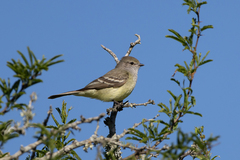

Southern Scrub-Flycatcher

Southern Scrub-Flycatcher

Sublegatus modestus

Silhouette: Emily Willoughby · PhyloPic

LCLeast ConcernNTVUENCR
Daily sighting probability <5% · Rare
at Chapada Diamantina National Park

In 3 days <5% in a week ~10%

6 Verified sightings at Chapada Diamantina National Park From 2019 to 2026
133 In all 8 parks
August Best month
☀️ Diurnal When it's spotted

About the Southern Scrub-Flycatcher

The southern scrub flycatcher (Sublegatus modestus) is a species of bird in the family Tyrannidae, the tyrant flycatchers. It is found in Argentina, Bolivia, Brazil, Paraguay, Peru, and Uruguay. Other sources also place it in Guyana, Suriname, as a non-breeding visitor to Colombia, and as a vagrant in Ecuador.

What are now the southern scrub flycatcher, northern scrub flycatcher (S. arenarum), and Amazonian scrub flycatcher (S. obscurior) were previously members of the single species named scrub flycatcher with the binomial S. modestus. The further taxonomy of the three scrub flycatchers has not been fully resolved.

At least one author has treated the Amazonian scrub flycatcher as a third subspecies. The southern scrub flycatcher is 13 to 15 cm (5.1 to 5.9 in) long and weighs 9.5 to 13 g (0.34 to 0.46 oz). The sexes have the same plumage. Adults of the nominate subspecies have a grayish brown crown that sometimes erects as a shaggy crest. Their face is mostly whitish to pale... Wikipedia →

Sounds

Call0:10

Brazil · 2026

© JAYRSON ARAUJO DE OLIVEIRA · XC1141910 · CC BY-NC-SA 4.0

Song0:27

Uruguay · 2017

© Pedro Rinaldi · XC764050 · CC BY-NC-SA 4.0

Dawn song0:48

Argentina · 2013

© Peter Boesman · XC273188 · CC BY-NC-ND 4.0

Global Distribution

Parks Where Found

# Park Country Daily sighting probability
1 El Impenetrable National Park 🇦🇷 Argentina
~10%
2 Serra da Canastra National Park 🇧🇷 Brazil
<5%
3 Amboró National Park 🇧🇴 Bolivia
<5%
4 Parque Estadual Encontro das Águas 🇧🇷 Brazil
<5%
5 Iberá National Park 🇦🇷 Argentina
<5%
6 Manu National Park 🇵🇪 Peru
<5%
7 Chapada Diamantina National Park 🇧🇷 Brazil
<5%
8 Chapada dos Guimarães National Park 🇧🇷 Brazil
<5%

Cities Where Found

# City Country Daily sighting probability
1 Cordoba 🇦🇷 Argentina
<5%
2 Santa Cruz de la Sierra 🇧🇴 Bolivia
<5%
3 Asuncion 🇵🇾 Paraguay
<5%

Before you go

What are the chances of seeing a Southern Scrub-Flycatcher in Chapada Diamantina National Park?

Rare

Under 5% of wildlife watchers report a Southern Scrub-Flycatcher sighting in Chapada Diamantina National Park on a given day, based on 6 verified sightings from GBIF citizen-science data from 2019 to 2026. It is the 249th most-seen of the 271 birds we can rate there. Over three days the chance rises to under 5%, and over a week to about 10%, if each day is a fresh chance.

When is the best time to see a Southern Scrub-Flycatcher in Chapada Diamantina National Park?

August

In that month about 10% of wildlife watchers report a Southern Scrub-Flycatcher in Chapada Diamantina National Park on a given day, against under 5% in September to July, the lowest months.

What time of day is best to see a Southern Scrub-Flycatcher?

Between 8 and 11 am

Across all the parks we cover, that three-hour window holds the most Southern Scrub-Flycatcher sightings with a recorded time, and about 9 in 10 of them come between 6 am and 6 pm: it is a daytime animal.

Which relatives of the Southern Scrub-Flycatcher live in Chapada Diamantina National Park?

Same family: Tyrannidae

The closest relatives of the Southern Scrub-Flycatcher that you can see in Chapada Diamantina National Park (family Tyrannidae, Tyrant Flycatchers) are Tropical Kingbird (about 50%), Plain-crested Elaenia (about 50%) and Great Kiskadee (about 50%), with each one's daily chance of a sighting.

Where does the Southern Scrub-Flycatcher sighting chance come from?

GBIF citizen-science records

It is estimated from how often the Southern Scrub-Flycatcher is recorded against all the birds logged in Chapada Diamantina National Park (6 verified sightings from 2019 to 2026), calibrated against known sighting rates. Figures are rounded to the nearest 10% because citizen-science data supports honest approximations, not decimals, and months with records from fewer than five people show "—". How it works.

← Back to Chapada Diamantina National Park