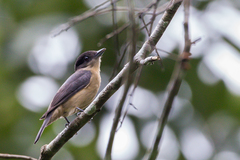
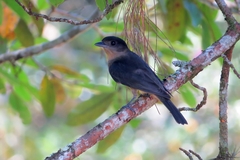
Crested Becard

Crested Becard

Pachyramphus validus

Silhouette: Sheatherius · PhyloPic

LCLeast ConcernNTVUENCR
Daily sighting probability ~10% · With luck
at Chapada dos Guimarães National Park

In 3 days ~20% in a week ~50%

70 Verified sightings at Chapada dos Guimarães National Park From 2019 to 2026
442 In all 8 parks
October Best month
☀️ Diurnal When it's spotted

About the Crested Becard

The crested becard (Pachyramphus validus), also known as the plain becard, is a species of bird in the family Tityridae, the tityras, becards, and allies. It is found in Argentina, Bolivia, Brazil, Paraguay, Peru, and possibly Ecuador.

The crested becard was originally described in 1831 as Lanius validus, mistakenly placing it in the shrike family. It was later briefly placed in its own genus Hylonax and then in genus Platypsaris. The latter was merged by most taxonomists into Pachyramphus in 1973. It is now one of 18 becards in genus Pachyramphus that had been introduced in 1839 by George Gray. The genus Pachyramphus has variously been assigned to the tyrant flycatcher family Tyrannidae and the cotinga family Cotingidae. Several early twenty-first century studies confirmed the placement of Pachyramphus in Tityridae and taxonomic systems made the reassignment.

The crested becard is 17 to 18.5 cm (6.7 to 7.3 in) long. The species is sexually dimorphic. Though its crown is somewhat shaggy it does not have an obvious... Wikipedia →

Sounds

Call0:35

Brazil · 2025

© JAYRSON ARAUJO DE OLIVEIRA · XC1016162 · CC BY-NC-SA 4.0

Canto0:29

Brazil · 2019

© Caio Brito · XC556469 · CC BY-NC-SA 4.0

Song1:21

Brazil · 2011

© Rodrigo Dela Rosa · XC538935 · CC BY-NC-SA 4.0

Global Distribution

Parks Where Found

# Park Country Daily sighting probability
1 Chapada dos Guimarães National Park 🇧🇷 Brazil
~10%
2 Serra dos Órgãos National Park 🇧🇷 Brazil
~10%
3 Chapada Diamantina National Park 🇧🇷 Brazil
~10%
4 Iberá National Park 🇦🇷 Argentina
<5%
5 Itatiaia National Park 🇧🇷 Brazil
<5%
6 El Impenetrable National Park 🇦🇷 Argentina
<5%
7 Iguazú National Park 🇦🇷 Argentina
<5%
8 Iguaçu National Park 🇧🇷 Brazil
<5%

Cities Where Found

# City Country Daily sighting probability
1 Curitiba 🇧🇷 Brazil
~10%
2 São Paulo 🇧🇷 Brazil
<5%
3 Campo Grande 🇧🇷 Brazil
<5%
4 Asuncion 🇵🇾 Paraguay
<5%
5 Santos 🇧🇷 Brazil
<5%

Before you go

What are the chances of seeing a Crested Becard in Chapada dos Guimarães National Park?

With luck

About 10% of wildlife watchers report a Crested Becard sighting in Chapada dos Guimarães National Park on a given day, based on 70 verified sightings from GBIF citizen-science data from 2019 to 2026. It is the 116th most-seen of the 273 birds we can rate there. Over three days the chance rises to about 20%, and over a week to about 50%, if each day is a fresh chance.

When is the best time to see a Crested Becard in Chapada dos Guimarães National Park?

May, August–October and December–January

In those months about 10% of wildlife watchers report a Crested Becard in Chapada dos Guimarães National Park on a given day, against under 5% in June–July and November, the lowest months. February to April have too few records to rate.

What time of day is best to see a Crested Becard?

Between 8 and 11 am

Across all the parks we cover, that three-hour window holds the most Crested Becard sightings with a recorded time, and about 9 in 10 of them come between 6 am and 6 pm: it is a daytime animal.

Is Chapada dos Guimarães National Park the best place to see a Crested Becard?

Yes

Of the 8 parks where we can rate Crested Becard sightings, Chapada dos Guimarães National Park has the highest daily chance: about 10%. Next come Serra dos Órgãos National Park (Brazil, about 10%) and Chapada Diamantina National Park (Brazil, about 10%).

Where does the Crested Becard sighting chance come from?

GBIF citizen-science records

It is estimated from how often the Crested Becard is recorded against all the birds logged in Chapada dos Guimarães National Park (70 verified sightings from 2019 to 2026), calibrated against known sighting rates. Figures are rounded to the nearest 10% because citizen-science data supports honest approximations, not decimals, and months with records from fewer than five people show "—". How it works.

← Back to Chapada dos Guimarães National Park