Pectoral Sparrow

Pectoral Sparrow

Arremon taciturnus

Silhouette: Juan Camilo Cepeda-Duque · PhyloPic

LCLeast ConcernNTVUENCR
Daily sighting probability ~10% · With luck
at Chapada dos Guimarães National Park

In 3 days ~10% in a week ~30%

40 Verified sightings at Chapada dos Guimarães National Park From 2019 to 2026
677 In all 7 parks
October Best month
☀️ Diurnal When it's spotted

About the Pectoral Sparrow

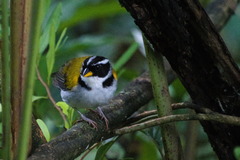
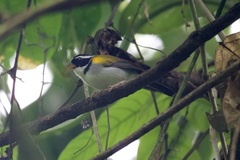
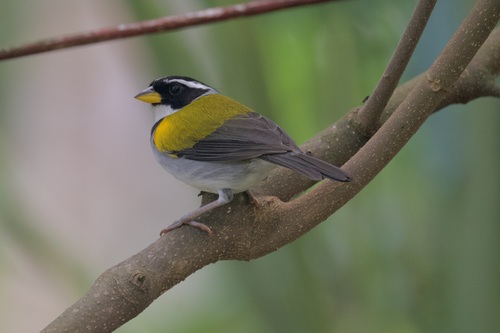
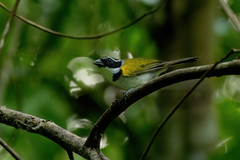
The pectoral sparrow (Arremon taciturnus) is a small species of New World sparrow first described in 1779 by Georges-Louis Leclerc. It has two subspecies. Like other sparrows in its family Arremon, it has pale green-to-olive wings, a distinctive black band going across its breast, however in subspecies nigrirostris it is not continuous and instead breaks in the center. It is found throughout southeastern South America, in subtropical or tropical moist lowland forests. The phenology of its breeding is unknown, however it has been observed nest building as early as August and as late as December. Incubation takes 15–17 days, however the duration of the nestling and fledgling stages are unknown due to a lack of research. It is omnivorous, mainly eating insects and seeds, and are considered a least-concern species by BirdLife International due to its large population and range.

The pectoral sparrow was described in 1779 by French polymath Georges-Louis Leclerc, Comte de Buffon in his Histoire Naturelle des Oiseaux under the French name L'Oiseau Silencieux, meaning "the silent bird". It was also illustrated in a hand-colored plate that was produced to accompany Buffon's book... Wikipedia →
Sounds

Call0:13

Brazil · 2026

© JAYRSON ARAUJO DE OLIVEIRA · XC1166172 · CC BY-NC-SA 4.0

Song1:03

Colombia · 2022

© Mauricio Cuéllar Ramírez · XC706550 · CC BY-NC-SA 4.0

Canto0:42

Brazil · 2014

© Caio Brito · XC427096 · CC BY-NC-SA 4.0

Global Distribution

Parks Where Found

# Park Country Daily sighting probability
1 Manu National Park 🇵🇪 Peru
~10%
2 Brownsberg Nature Park 🇸🇷 Suriname
~10%
3 Chapada dos Guimarães National Park 🇧🇷 Brazil
~10%
4 Sierra de la Macarena National Park 🇨🇴 Colombia
<5%
5 Chapada Diamantina National Park 🇧🇷 Brazil
<5%
6 Amboró National Park 🇧🇴 Bolivia
<5%
7 Tambopata National Reserve 🇵🇪 Peru
<5%

Cities Where Found

# City Country Daily sighting probability
1 Belém 🇧🇷 Brazil
~10%
2 Goiânia 🇧🇷 Brazil
~10%
3 Maceió 🇧🇷 Brazil
<5%

Before you go

What are the chances of seeing a Pectoral Sparrow in Chapada dos Guimarães National Park?

With luck

About 10% of wildlife watchers report a Pectoral Sparrow sighting in Chapada dos Guimarães National Park on a given day, based on 40 verified sightings from GBIF citizen-science data from 2019 to 2026. It is the 162nd most-seen of the 273 birds we can rate there. Over three days the chance rises to about 10%, and over a week to about 30%, if each day is a fresh chance.

When is the best time to see a Pectoral Sparrow in Chapada dos Guimarães National Park?

October

In that month about 20% of wildlife watchers report a Pectoral Sparrow in Chapada dos Guimarães National Park on a given day, against under 5% in May–August and November–December, the lowest months. February to April have too few records to rate.

What time of day is best to see a Pectoral Sparrow?

Between 7 and 10 am

Across all the parks we cover, that three-hour window holds the most Pectoral Sparrow sightings with a recorded time, and about 9 in 10 of them come between 6 am and 6 pm: it is a daytime animal.

Is Chapada dos Guimarães National Park the best place to see a Pectoral Sparrow?

Among the best

Of the 7 parks where we can rate Pectoral Sparrow sightings, Chapada dos Guimarães National Park ranks 3rd at about 10%, level with the leaders once rounded. The best odds are in Manu National Park (Peru, about 10%) and Brownsberg Nature Park (Suriname, about 10%).

Where does the Pectoral Sparrow sighting chance come from?

GBIF citizen-science records

It is estimated from how often the Pectoral Sparrow is recorded against all the birds logged in Chapada dos Guimarães National Park (40 verified sightings from 2019 to 2026), calibrated against known sighting rates. Figures are rounded to the nearest 10% because citizen-science data supports honest approximations, not decimals, and months with records from fewer than five people show "—". How it works.

← Back to Chapada dos Guimarães National Park