Saffron-billed Sparrow

Saffron-billed Sparrow

Arremon flavirostris

Silhouette: Juan Camilo Cepeda-Duque · PhyloPic

LCLeast ConcernNTVUENCR
Daily sighting probability ~20% · Possible
at Chapada dos Guimarães National Park

In 3 days ~50% in a week ~80%

150 Verified sightings at Chapada dos Guimarães National Park From 2019 to 2026
1,550 In all 8 parks
July Best month
☀️ Diurnal When it's spotted

About the Saffron-billed Sparrow

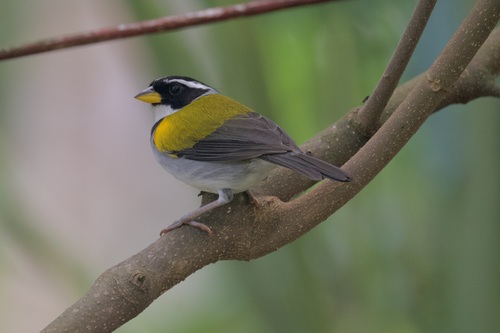
The saffron-billed sparrow (Arremon flavirostris) is a species of bird in the family Passerellidae, the New World sparrows. It is found in Argentina, Bolivia, Brazil, and Paraguay. The saffron-billed sparrow has two subspecies, the nominate Arremon flavirostris flavirostris and the "gray-backed" A. f. polionotus.

The saffron-billed sparrow's name comes from its "striking orange bill". The adult male's head is mostly black, with a white supercilium from above the eye to the back of the head. The neck is gray and the back, wings, and tail are green. Its underside is white with grayish edges and a narrow black band across the upper chest. The adult female is similar but duller overall. The female's underparts are buffy with brown flanks. Juveniles are similar to the adults but duller. The species' length is from 15 to 16.5 cm (5.9 to 6.5 in). The mean weights of 27 specimens from... Wikipedia →

Sounds

Song0:37

Argentina · 2024

© Marcos E. Sosa · XC1075019 · CC BY-NC-SA 4.0

Call0:13

Brazil · 2022

© JAYRSON ARAUJO DE OLIVEIRA · XC732925 · CC BY-NC-SA 4.0

Song0:43

Paraguay · 2025

© Guillermo Menéndez (gmmv80) · XC1067632 · CC BY-NC-SA 4.0

Global Distribution

Parks Where Found

# Park Country Daily sighting probability
1 Chapada dos Guimarães National Park 🇧🇷 Brazil
~20%
2 El Impenetrable National Park 🇦🇷 Argentina
~20%
3 Iguazú National Park 🇦🇷 Argentina
~20%
4 Iguaçu National Park 🇧🇷 Brazil
~10%
5 Serra da Canastra National Park 🇧🇷 Brazil
<5%
6 Emas National Park 🇧🇷 Brazil
<5%
7 Iberá National Park 🇦🇷 Argentina
<5%
8 Parque Estadual Encontro das Águas 🇧🇷 Brazil
<5%

Cities Where Found

# City Country Daily sighting probability
1 Belo Horizonte 🇧🇷 Brazil
<5%

Before you go

What are the chances of seeing a Saffron-billed Sparrow in Chapada dos Guimarães National Park?

Possible

About 20% of wildlife watchers report a Saffron-billed Sparrow sighting in Chapada dos Guimarães National Park on a given day, based on 150 verified sightings from GBIF citizen-science data from 2019 to 2026. It is the 66th most-seen of the 273 birds we can rate there. Over three days the chance rises to about 50%, and over a week to about 80%, if each day is a fresh chance.

When is the best time to see a Saffron-billed Sparrow in Chapada dos Guimarães National Park?

July

In that month about 30% of wildlife watchers report a Saffron-billed Sparrow in Chapada dos Guimarães National Park on a given day, against about 10% in October and November, the lowest months. That is one of Chapada dos Guimarães National Park's driest months, with almost no rain against 240 mm in March. February to April have too few records to rate.

What time of day is best to see a Saffron-billed Sparrow?

Between 8 and 11 am

Across all the parks we cover, that three-hour window holds the most Saffron-billed Sparrow sightings with a recorded time, and about 9 in 10 of them come between 6 am and 6 pm: it is a daytime animal.

Is Chapada dos Guimarães National Park the best place to see a Saffron-billed Sparrow?

Yes

Of the 8 parks where we can rate Saffron-billed Sparrow sightings, Chapada dos Guimarães National Park has the highest daily chance: about 20%. Next come El Impenetrable National Park (Argentina, about 20%) and Iguazú National Park (Argentina, about 20%).

Where does the Saffron-billed Sparrow sighting chance come from?

GBIF citizen-science records

It is estimated from how often the Saffron-billed Sparrow is recorded against all the birds logged in Chapada dos Guimarães National Park (150 verified sightings from 2019 to 2026), calibrated against known sighting rates. Figures are rounded to the nearest 10% because citizen-science data supports honest approximations, not decimals, and months with records from fewer than five people show "—". How it works.

← Back to Chapada dos Guimarães National Park