Black-faced Solitaire

Black-faced Solitaire

Myadestes melanops

Silhouette: Francesco "Architetto" Rollandin · PhyloPic

LCLeast ConcernNTVUENCR
Daily sighting probability ~20% · Possible
at Chirripó National Park

In 3 days ~50% in a week ~80%

317 Verified sightings at Chirripó National Park From 2019 to 2026
17,046 In all 11 parks
December Best month
☀️ Diurnal When it's spotted

About the Black-faced Solitaire

The black-faced solitaire (Myadestes melanops) is a bird in the thrush family endemic to highlands in Costa Rica and western Panama. This is a bird of dense undergrowth and bamboo clumps in wet mountain forest, normally from 750 to 3,000 m (2,460 to 9,840 ft) altitude. It disperses as low as 400 m (1,300 ft) in the wet season, when it may form loose flocks. It builds a cup nest of mosses and liverworts in a tree crevice, hole in a mossy bank, or concealed amongst mosses and epiphytes in a tree fork up to 3.5 m (11 ft) above the ground. The female lays two or three rufous-brown marked white or pinkish eggs between April and June. The fledging period is 15–16 days.

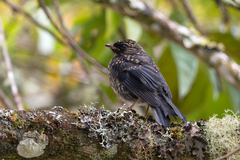
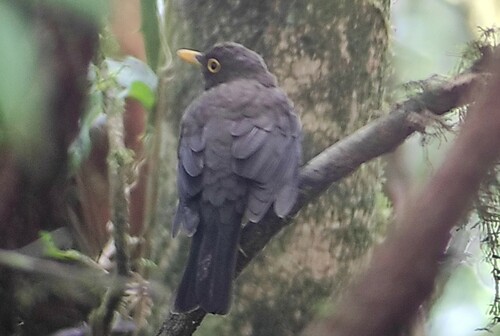
The black-faced solitaire is a slim thrush, 16–18.5 cm (6.3–7.3 in) long, and weighing 33 g (1.2 oz) on average. The adult is slate gray with a black face and chin which contrast with the broad orange bill. The wings and tail are slate-edged black, and the underwing coverts are silvery-white, a feature which shows well in flight. The legs are orange. The juvenile has buff streaks on the head and upper parts, and buff and brown mottling on the underparts.

The black-faced solitaire usually forages low in vegetation, mainly for berries, but also insects. It will ascend into the canopy or emerge into trees in pasture in its search for food. The call is a nasal ghank or liquid quirt, and the song is a beautiful fluty whistled teedleedlee…tleedleeee…lee-dah…lee-dah given mainly in the evening from a shady canopy perch. While the extremely slow song is of a wonderfully pure, ethereal color in nature, when held in a cage the sound leads to it commonly being called "squeaky hinge bird".

The black-faced solitaire remains common in protected and inaccessible areas, but trapping of this prized songster for the cage-bird trade has badly affected its numbers elsewhere. Wikipedia →

Sounds

Song0:43

Panama · 2019

© Guy Kirwan · XC500081 · CC BY-NC-SA 4.0

Call0:14

Costa Rica · 2016

© Scott Olmstead · XC374607 · CC BY-NC-SA 4.0

Song1:02

Costa Rica · 2019

© Brendan Sloan · XC486848 · CC BY-NC-ND 4.0

Global Distribution

Parks Where Found

# Park Country Daily sighting probability
1 Volcán Barú National Park 🇵🇦 Panama
~50%
2 Los Quetzales National Park 🇨🇷 Costa Rica
~40%
3 Monteverde Cloud Forest Reserve 🇨🇷 Costa Rica
~30%
4 Tapantí-Macizo de la Muerte National Park 🇨🇷 Costa Rica
~20%
5 La Amistad International Park (Panama) 🇵🇦 Panama
~20%
6 Chirripó National Park 🇨🇷 Costa Rica
~20%
7 Braulio Carrillo National Park 🇨🇷 Costa Rica
~20%
8 Poás Volcano National Park 🇨🇷 Costa Rica
~10%
9 Arenal Volcano National Park 🇨🇷 Costa Rica
~10%
10 Irazú Volcano National Park 🇨🇷 Costa Rica
~10%
11 Tenorio Volcano National Park 🇨🇷 Costa Rica
<5%

Cities Where Found

# City Country Daily sighting probability
1 San José 🇨🇷 Costa Rica
<5%

Before you go

What are the chances of seeing a Black-faced Solitaire in Chirripó National Park?

Possible

About 20% of wildlife watchers report a Black-faced Solitaire sighting in Chirripó National Park on a given day, based on 317 verified sightings from GBIF citizen-science data from 2019 to 2026. It is the 61st most-seen of the 332 birds we can rate there. Over three days the chance rises to about 50%, and over a week to about 80%, if each day is a fresh chance.

When is the best time to see a Black-faced Solitaire in Chirripó National Park?

December

In that month about 40% of wildlife watchers report a Black-faced Solitaire in Chirripó National Park on a given day, against under 5% in June, the lowest month. That is one of Chirripó National Park's driest months, with about 120 mm of rain against 690 mm in October.

What time of day is best to see a Black-faced Solitaire?

Between 8 and 11 am

Across all the parks we cover, that three-hour window holds the most Black-faced Solitaire sightings with a recorded time, and about 8 in 10 of them come between 6 am and 6 pm: it is a daytime animal.

Which relatives of the Black-faced Solitaire live in Chirripó National Park?

Same family: Turdidae

The closest relatives of the Black-faced Solitaire that you can see in Chirripó National Park (family Turdidae, Thrushes) are Clay-colored Thrush (about 60%), Orange-billed Nightingale-Thrush (about 30%) and Mountain Thrush (about 10%), with each one's daily chance of a sighting.

Where does the Black-faced Solitaire sighting chance come from?

GBIF citizen-science records

It is estimated from how often the Black-faced Solitaire is recorded against all the birds logged in Chirripó National Park (317 verified sightings from 2019 to 2026), calibrated against known sighting rates. Figures are rounded to the nearest 10% because citizen-science data supports honest approximations, not decimals, and months with records from fewer than five people show "—". How it works.

← Back to Chirripó National Park