Rufous-capped Motmot

Rufous-capped Motmot

Baryphthengus ruficapillus

Silhouette: Sofía Terán Sánchez · PhyloPic

LCLeast ConcernNTVUENCR
Daily sighting probability <5% · Rare
at Belo Horizonte

In 3 days <5%

10 Verified sightings at Belo Horizonte
2,858 In all 6 parks From 2019 to 2026
May Best month
☀️ Diurnal When it's spotted

About the Rufous-capped Motmot

The rufous-capped motmot (Baryphthengus ruficapillus) is a species of bird in the family Momotidae. It is found in Argentina, Brazil, and Paraguay. The rufous-capped motmot and rufous motmot (Baryphtengus martii) are the only two species in their genus, and have sometimes been treated as conspecific. The rufous-capped motmot is monotypic. Though subspecies have been proposed within its Brazilian population, the differences have been shown to be simply individual variation.

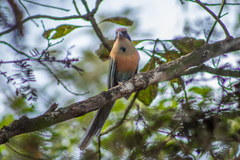
The rufous-capped motmot is 42 cm (17 in) long and weighs 140 to 151 g (4.9 to 5.3 oz). The adults are mostly green above and olive-green below. The crown and nape are rufous and a black "mask" has a turquoise border. The chest has a black spot, there is a rufous band across the belly, and the lower belly is blue-green. The juvenile is similarly colored but duller.

The rufous-capped motmot is found across southeastern Brazil, in eastern Paraguay, and in far northeastern Argentina. It inhabits primary and gallery forest, the latter mostly along watercourses. It ranges in elevation from near sea level to 1,200 m (3,900 ft). Wikipedia →

Sounds

Song0:18

Argentina · 2026

© Faustino Hollmann · XC1176787 · CC BY-NC-SA 4.0

Duet0:08

Brazil · 2016

© Odirlei Vieira da Fonseca · XC668743 · CC BY-NC-SA 4.0

Call0:34

Brazil · 2015

© Jerome Fischer · XC292904 · CC BY-NC-SA 4.0

Global Distribution

Parks Where Found

# Park Country Daily sighting probability
1 Serra dos Órgãos National Park 🇧🇷 Brazil
~30%
2 Iguazú National Park 🇦🇷 Argentina
~20%
3 Iguaçu National Park 🇧🇷 Brazil
~20%
4 Itatiaia National Park 🇧🇷 Brazil
~20%
5 Serra da Canastra National Park 🇧🇷 Brazil
<5%
6 Tijuca National Park 🇧🇷 Brazil
<5%

Cities Where Found

# City Country Daily sighting probability
1 Belo Horizonte 🇧🇷 Brazil
<5%

Before you go

What are the chances of seeing a Rufous-capped Motmot in Belo Horizonte?

Rare

Under 5% of wildlife watchers report a Rufous-capped Motmot sighting in Belo Horizonte on a given day, based on 10 verified sightings from GBIF citizen-science data. It is the 179th most-seen of the 220 birds we can rate there. Over three days the chance rises to under 5%, if each day is a fresh chance.

When is the best time to see a Rufous-capped Motmot in Belo Horizonte?

May

In that month about 10% of wildlife watchers report a Rufous-capped Motmot in Belo Horizonte on a given day, against under 5% in June to April, the lowest months. That is one of Belo Horizonte's driest months, with about 25 mm of rain against 270 mm in December.

What time of day is best to see a Rufous-capped Motmot?

Between 10 am and 1 pm

Across all the parks we cover, that three-hour window holds the most Rufous-capped Motmot sightings with a recorded time, and about 9 in 10 of them come between 6 am and 6 pm: it is a daytime animal.

Where else can you see a Rufous-capped Motmot?

Only Belo Horizonte, in our data

Belo Horizonte is the only city on Wallace's Line with enough records to rate Rufous-capped Motmot sightings: under 5% of wildlife watchers there report one on a given day.

Which relatives of the Rufous-capped Motmot live in Belo Horizonte?

Same order: Coraciiformes

The closest relatives of the Rufous-capped Motmot that you can see in Belo Horizonte (order Coraciiformes, Rollers, Kingfishers, and Allies) are Amazon Kingfisher (about 10%) and Ringed Kingfisher (about 10%), with each one's daily chance of a sighting.

Where does the Rufous-capped Motmot sighting chance come from?

GBIF citizen-science records

It is estimated from how often the Rufous-capped Motmot is recorded against all the birds logged in Belo Horizonte (10 verified sightings), calibrated against known sighting rates. Figures are rounded to the nearest 10% because citizen-science data supports honest approximations, not decimals, and months with records from fewer than five people show "—". How it works.

← Back to Belo Horizonte