
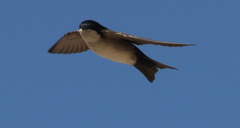
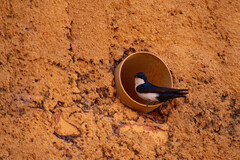
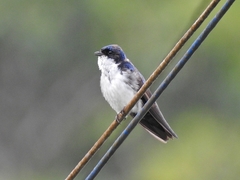

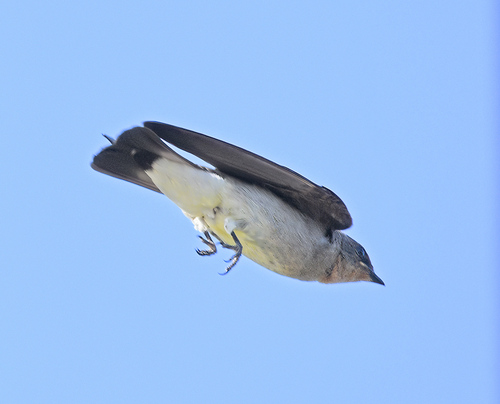
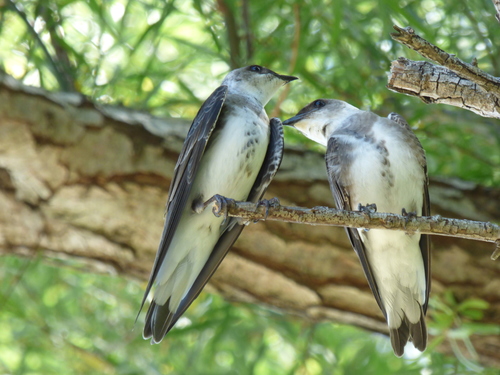
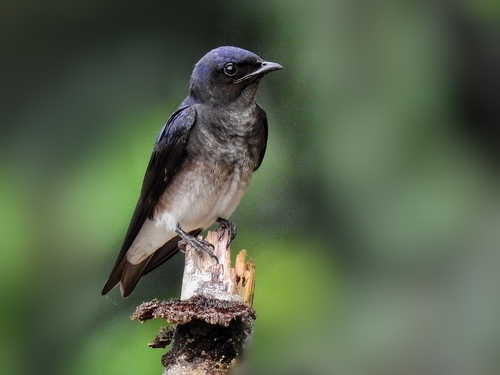
Blue-and-white Swallow

Blue-and-white Swallow

Notiochelidon cyanoleuca

Silhouette: Andy Wilson · PhyloPic

LCLeast ConcernNTVUENCR
Daily sighting probability ~70% · Very likely
at Belo Horizonte

In 3 days >90%

1,275 Verified sightings at Belo Horizonte
27,659 In all 45 parks From 2019 to 2026
October Best month
☀️ Diurnal When it's spotted

About the Blue-and-white Swallow

The blue-and-white swallow (Pygochelidon cyanoleuca) is a passerine bird that breeds from Nicaragua south throughout South America, except in the deserts and the Amazon Basin. The southern race is migratory, wintering as far north as Trinidad, where it is a regular visitor. The nominate northern race may have bred on that island.

The blue-and-white swallow was first formally described as Hirundo cyanoleuca by the French ornithologist Louis Pierre Vieillot in 1817, based on a specimen he believed to be from Paraguay. The scientific name has the same meaning as the English common name.

This species was formerly placed in the genus Notiochelidon. It was moved to the resurrected genus Pygochelidon based on a phylogenetic study published in 2005. Three subspecies are recognised: It has dark blue upperparts and white underparts, and its underwings and the... Wikipedia →

Sounds

Call0:23

Peru · 2026

© Étienne Leroy · XC1185159 · CC BY-NC-SA 4.0

Flight call0:20

Brazil · 2026

© JAYRSON ARAUJO DE OLIVEIRA · XC1150897 · CC BY-NC-SA 4.0

Song0:22

Colombia · 2021

© Mauricio Cuellar Ramirez (@Birding.travel) · XC656171 · CC BY-NC-SA 4.0

Global Distribution

Parks Where Found

# Park Country Daily sighting probability
1 Serra da Canastra National Park 🇧🇷 Brazil
~60%
2 Los Quetzales National Park 🇨🇷 Costa Rica
~60%
3 Itatiaia National Park 🇧🇷 Brazil
~60%
4 Serra dos Órgãos National Park 🇧🇷 Brazil
~60%
5 Tijuca National Park 🇧🇷 Brazil
~50%
6 Tapantí-Macizo de la Muerte National Park 🇨🇷 Costa Rica
~40%
7 Península Valdés 🇦🇷 Argentina
~30%
8 Podocarpus National Park 🇪🇨 Ecuador
~30%
9 Vicente Pérez Rosales National Park 🇨🇱 Chile
~20%
10 Irazú Volcano National Park 🇨🇷 Costa Rica
~20%
11 Chirripó National Park 🇨🇷 Costa Rica
~20%
12 Volcán Barú National Park 🇵🇦 Panama
~20%
13 Farallones de Cali National Natural Park 🇨🇴 Colombia
~20%
14 Monteverde Cloud Forest Reserve 🇨🇷 Costa Rica
~20%
15 Torres del Paine National Park 🇨🇱 Chile
~20%
16 Lauca National Park 🇨🇱 Chile
~20%
17 Tenorio Volcano National Park 🇨🇷 Costa Rica
~20%
18 Chapada Diamantina National Park 🇧🇷 Brazil
~20%
19 La Amistad International Park (Panama) 🇵🇦 Panama
~20%
20 El Palmar National Park 🇦🇷 Argentina
~20%
21 Arenal Volcano National Park 🇨🇷 Costa Rica
~10%
22 Machalilla National Park 🇪🇨 Ecuador
~10%
23 Braulio Carrillo National Park 🇨🇷 Costa Rica
~10%
24 Los Nevados National Natural Park 🇨🇴 Colombia
~10%
25 Iguazú National Park 🇦🇷 Argentina
~10%
26 Poás Volcano National Park 🇨🇷 Costa Rica
~10%
27 Iguaçu National Park 🇧🇷 Brazil
~10%
28 Henri Pittier National Park 🇻🇪 Venezuela
~10%
29 Nahuel Huapi National Park 🇦🇷 Argentina
~10%
30 Chapada dos Guimarães National Park 🇧🇷 Brazil
~10%
31 Rincón de la Vieja National Park 🇨🇷 Costa Rica
~10%
32 Cuyabeno Wildlife Reserve 🇪🇨 Ecuador
<5%
33 Amboró National Park 🇧🇴 Bolivia
<5%
34 Manu National Park 🇵🇪 Peru
<5%
35 Emas National Park 🇧🇷 Brazil
<5%
36 Sierra de la Macarena National Park 🇨🇴 Colombia
<5%
37 Chingaza National Natural Park 🇨🇴 Colombia
<5%
38 Yasuní National Park 🇪🇨 Ecuador
<5%
39 Tayrona National Natural Park 🇨🇴 Colombia
<5%
40 Iberá National Park 🇦🇷 Argentina
<5%
41 Parque Estadual Encontro das Águas 🇧🇷 Brazil
<5%
42 Tierra del Fuego National Park 🇦🇷 Argentina
<5%
43 Tambopata National Reserve 🇵🇪 Peru
<5%
44 Cahuita National Park 🇨🇷 Costa Rica
<5%
45 Gandoca-Manzanillo Wildlife Refuge 🇨🇷 Costa Rica
<5%

Cities Where Found

# City Country Daily sighting probability
1 Arequipa 🇵🇪 Peru
~80%
2 Belo Horizonte 🇧🇷 Brazil
~70%
3 San José 🇨🇷 Costa Rica
~70%
4 Niterói 🇧🇷 Brazil
~60%
5 Cochabamba 🇧🇴 Bolivia
~60%
6 São Paulo 🇧🇷 Brazil
~60%
7 Campinas 🇧🇷 Brazil
~60%
8 Cali 🇨🇴 Colombia
~60%
9 Vitória 🇧🇷 Brazil
~60%
10 Santos 🇧🇷 Brazil
~60%

Before you go

What are the chances of seeing a Blue-and-white Swallow in Belo Horizonte?

Very likely

About 70% of wildlife watchers report a Blue-and-white Swallow sighting in Belo Horizonte on a given day, based on 1,275 verified sightings from GBIF citizen-science data. It is the 6th most-seen of the 220 birds we can rate there. Over three days the chance rises to over 90%, if each day is a fresh chance.

When is the best time to see a Blue-and-white Swallow in Belo Horizonte?

February, April–May and October–December

In those months about 70% of wildlife watchers report a Blue-and-white Swallow in Belo Horizonte on a given day, against about 60% in January, March and June–September, the lowest months.

What time of day is best to see a Blue-and-white Swallow?

Between 8 and 11 am

Across all the parks we cover, that three-hour window holds the most Blue-and-white Swallow sightings with a recorded time, and about 9 in 10 of them come between 6 am and 6 pm: it is a daytime animal.

Is Belo Horizonte the best place to see a Blue-and-white Swallow?

2nd of 33

Of the 33 cities where we can rate Blue-and-white Swallow sightings, Belo Horizonte ranks 2nd at about 70%. The best odds are in Arequipa (Peru, about 80%).

Where does the Blue-and-white Swallow sighting chance come from?

GBIF citizen-science records

It is estimated from how often the Blue-and-white Swallow is recorded against all the birds logged in Belo Horizonte (1,275 verified sightings), calibrated against known sighting rates. Figures are rounded to the nearest 10% because citizen-science data supports honest approximations, not decimals, and months with records from fewer than five people show "—". How it works.

← Back to Belo Horizonte