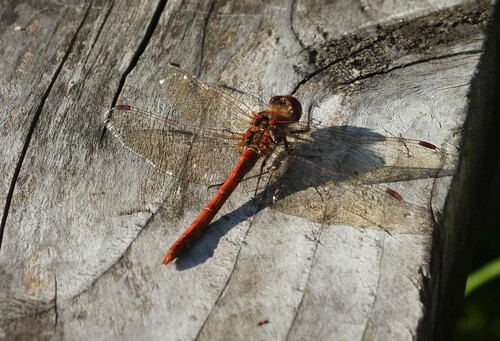
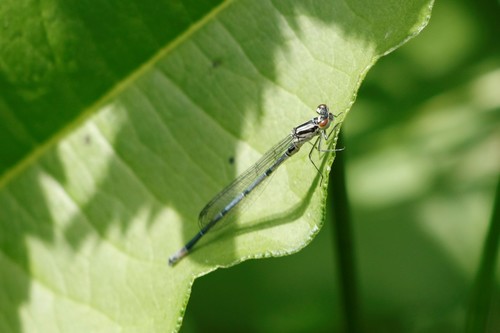
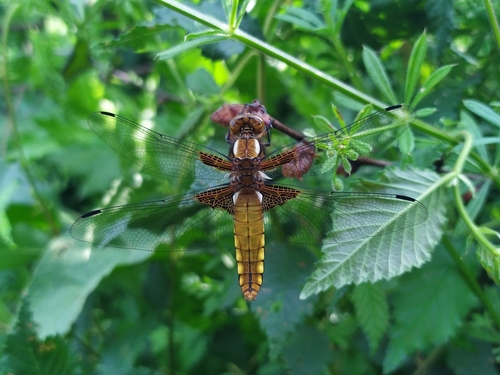
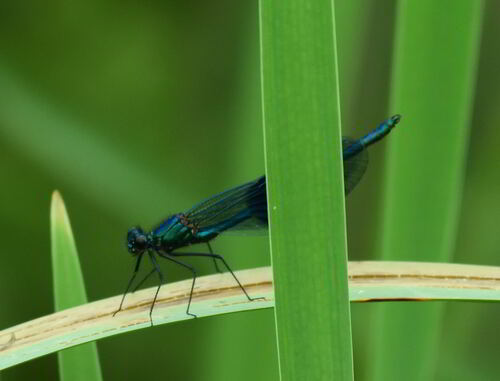
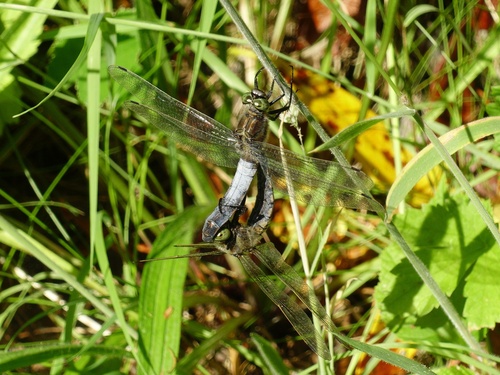
Southern Hawker

Southern Hawker

Aeshna cyanea

Daily sighting probability ~10% · With luck
at Birmingham

In 3 days ~30% in a week ~50%

59 Verified sightings at Birmingham
249 In all 9 parks From 2019 to 2026
July Best month
☀️ Diurnal When it's spotted

About the Southern Hawker

The southern hawker or blue hawker (Aeshna cyanea) is a species of hawker dragonfly. The species is one of the most common and most widespread dragonflies in Europe. The range in the Western Palearctic covers a large part of Europe, to Scotland and southern Scandinavia in the north and to Italy (without the southwest) and the northern Balkans in the south); the eastern boundary is formed by the Urals and the western by Ireland. It is also found in northwest Africa (Algeria). In Central Europe the species is very common.

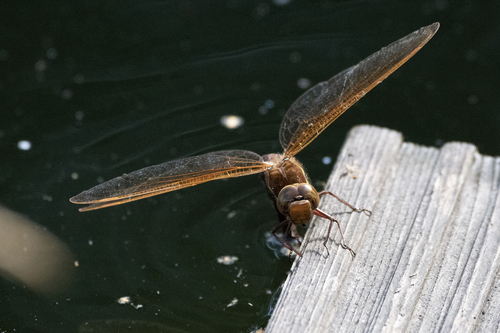
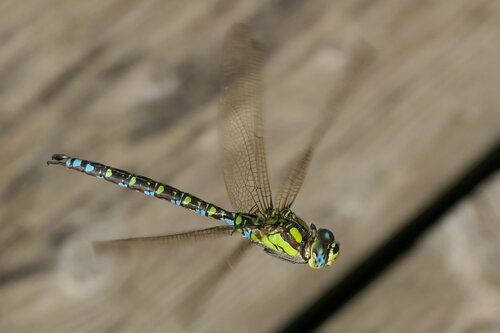
These dragonflies mainly inhabit well-vegetated, small ponds and garden ponds, but they wander widely, and they are often seen in gardens and open woodland. Aeshna cyanea can reach a body length of about 70 millimetres (2.8 in), with a wingspan up to 110 millimetres (4.3 in). It is a large, brightly coloured dragonfly, with a long body. The thorax is brown, with two ante-humeral wide green longitudinal stripes. On the forehead there is a black spot in the form of the letter T. The wings are hyaline with a dark pterostigma. The leading edge of the wings is dark.

Males have a dark abdomen with bright apple green markings... Wikipedia →

Global Distribution

Parks Where Found

# Park Country Daily sighting probability
1 Tatra National Park 🇸🇰 Slovakia
~20%
2 Aigüestortes National Park 🇪🇸 Spain
~20%
3 Snowdonia National Park 🇬🇧 United Kingdom
~10%
4 Bavarian Forest National Park 🇩🇪 Germany
~10%
5 Mercantour National Park 🇫🇷 France
~10%
6 Cévennes National Park 🇫🇷 France
~10%
7 Pyrénées National Park 🇫🇷 France
~10%
8 Wadden Sea National Park 🇩🇪 Germany
~10%
9 Sierra de Guadarrama National Park 🇪🇸 Spain
<5%

Cities Where Found

# City Country Daily sighting probability
1 Manchester 🇬🇧 United Kingdom
~10%
2 Munich 🇩🇪 Germany
~10%
3 Leeds 🇬🇧 United Kingdom
~10%
4 Birmingham 🇬🇧 United Kingdom
~10%
5 Brussels 🇧🇪 Belgium
~10%
6 London 🇬🇧 United Kingdom
~10%
7 Essen 🇩🇪 Germany
~10%
8 Helsinki 🇫🇮 Finland
~10%
9 Hamburg 🇩🇪 Germany
~10%
10 Liverpool 🇬🇧 United Kingdom
~10%

Before you go

What are the chances of seeing a Southern Hawker in Birmingham?

With luck

About 10% of wildlife watchers report a Southern Hawker sighting in Birmingham on a given day, based on 59 verified sightings from GBIF citizen-science data. It is the 151st most-seen of the 811 insects we can rate there. Over three days the chance rises to about 30%, and over a week to about 50%, if each day is a fresh chance.

When is the best time to see a Southern Hawker in Birmingham?

July to October

In those months about 20% of wildlife watchers report a Southern Hawker in Birmingham on a given day, against under 5% in November to May, the lowest months.

What time of day is best to see a Southern Hawker?

Between noon and 3 pm

Across all the parks we cover, that three-hour window holds the most Southern Hawker sightings with a recorded time, and about 8 in 10 of them come between 6 am and 6 pm: it is a daytime animal.

Is Birmingham the best place to see a Southern Hawker?

Among the best

Of the 29 cities where we can rate Southern Hawker sightings, Birmingham ranks 4th at about 10%, level with the leaders once rounded. The best odds are in Manchester (United Kingdom, about 10%), Munich (Germany, about 10%) and Leeds (United Kingdom, about 10%).

Which relatives of the Southern Hawker live in Birmingham?

Same genus: Aeshna

The closest relatives of the Southern Hawker that you can see in Birmingham (genus Aeshna, Hawkers and Typical Darners) are Brown Hawker (about 10%) and Migrant Hawker (about 10%), with each one's daily chance of a sighting.

Where does the Southern Hawker sighting chance come from?

GBIF citizen-science records

It is estimated from how often the Southern Hawker is recorded against all the insects logged in Birmingham (59 verified sightings), calibrated against known sighting rates. Figures are rounded to the nearest 10% because citizen-science data supports honest approximations, not decimals, and months with records from fewer than five people show "—". How it works.
← Back to Birmingham