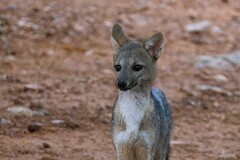
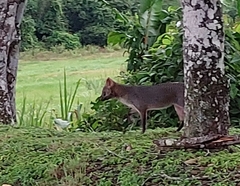
About the Crab-eating Fox
The crab-eating fox (Cerdocyon thous), also known as the forest dog, wood fox, bushfox (not to be confused with the bush dog) or maikong, is an extant species of medium-sized canid endemic to the central part of South America since at least the Pleistocene epoch. Like South American foxes, which are in the genus Lycalopex, it is not closely related to true foxes. Cerdocyon comes from the Greek words kerdo (meaning fox) and kyon (dog) referring to the dog- and fox-like characteristics of this animal.
The crab-eating fox was originally described as Canis thous by Linnaeus (1766), and first placed in its current genus Cerdocyon by Hamilton-Smith in 1839. Cerdocyonina is a tribe which appeared around 6.0 million years ago (Mya) in North America as Ferrucyon avius becoming extinct by around 1.4–1.3 Mya. living about 4.7 million years. This genus has persisted in South America from an undetermined time, possibly around 3.1 Mya, and continues to the present in the same or a similar form to the crab-eating fox.
As one of the species of the tribe Canini, it is related to the genus Canis. The crab-eating fox's nearest living relative, as theorized at present, is the... Wikipedia →