Field Sparrow

Field Sparrow

Spizella pusilla

Silhouette: Andy Wilson · PhyloPic

LCLeast ConcernNTVUENCR
Daily sighting probability <5% · Rare
at Boston

In 3 days ~10%

778 Verified sightings at Boston
3,545 In all 9 parks From 2019 to 2026
October Best month
☀️ Diurnal When it's spotted

About the Field Sparrow

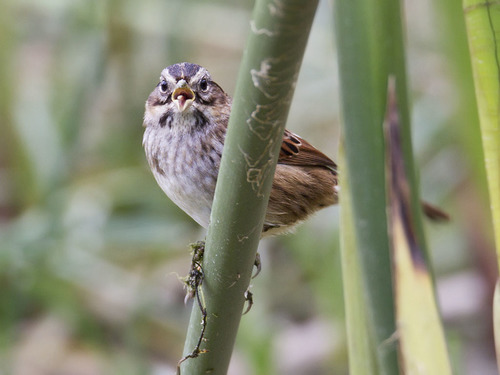
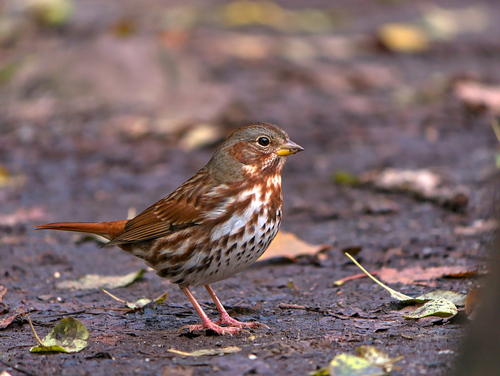
The field sparrow (Spizella pusilla) is a small New World sparrow in the family Passerellidae. It is about 140 mm (6 in) long and weighs about 12.5 g (0.4 oz). The head is grey with a rust-coloured crown, white eye-ring and pink bill. The upper parts are brown streaked with black and buff, the breast is buff, the belly is white and the tail is forked. There are two different colour morphs, one being greyer and the other more rufous.

The field sparrow is distributed across eastern Canada and the eastern United States, with northern populations migrating southwards to southern United States and north-eastern Mexico in the fall. The typical habitat of this bird is bushy country with shrubs and grassland. The nest is a cup-shaped construction built on the ground and hidden beneath a bush or clump of grass. The birds forage on the ground or in low vegetation, feeding mainly on seeds and insects. The population is thought to be in slow decline, but it is a common species with a wide range, and the International Union for Conservation of Nature has assessed its conservation status as being of "least concern".

Adults have brown upperparts, a buffy breast, a white belly, two... Wikipedia →

Sounds

Song0:56

United States · 2022

© Sue Riffe · XC1086871 · CC BY-NC-SA 4.0

Canto1:15

United States · 2019

© Caio Brito · XC556599 · CC BY-NC-SA 4.0

Call0:16

United States · 2016

© Jonathon Jongsma · XC320482 · CC BY-SA 4.0

Global Distribution

Parks Where Found

# Park Country Daily sighting probability
1 Great Smoky Mountains National Park 🇺🇸 United States
~20%
2 Shenandoah National Park 🇺🇸 United States
~10%
3 Point Pelee National Park 🇨🇦 Canada
~10%
4 Badlands National Park 🇺🇸 United States
~10%
5 Congaree National Park 🇺🇸 United States
<5%
6 Death Valley National Park 🇺🇸 United States
<5%
7 Big Bend National Park 🇺🇸 United States
<5%
8 Acadia National Park 🇺🇸 United States
<5%
9 Merritt Island National Wildlife Refuge 🇺🇸 United States
<5%

Cities Where Found

# City Country Daily sighting probability
1 Philadelphia 🇺🇸 United States
~10%
2 Baltimore 🇺🇸 United States
~10%
3 Chicago 🇺🇸 United States
~10%
4 New York City 🇺🇸 United States
<5%
5 Washington 🇺🇸 United States
<5%
6 Austin 🇺🇸 United States
<5%
7 Toronto 🇨🇦 Canada
<5%
8 San Antonio 🇺🇸 United States
<5%
9 Dallas 🇺🇸 United States
<5%
10 Boston 🇺🇸 United States
<5%

Zoos & Centres Where Found

# Zoo / Centre Country
1 Wilhelma 🇩🇪 Germany In captivity

Before you go

What are the chances of seeing a Field Sparrow in Boston?

Rare

Under 5% of wildlife watchers report a Field Sparrow sighting in Boston on a given day, based on 778 verified sightings from GBIF citizen-science data. It is the 146th most-seen of the 283 birds we can rate there. Over three days the chance rises to about 10%, if each day is a fresh chance.

When is the best time to see a Field Sparrow in Boston?

October

In that month about 10% of wildlife watchers report a Field Sparrow in Boston on a given day, against under 5% in November to September, the lowest months.

What time of day is best to see a Field Sparrow?

Between 9 am and noon

Across all the parks we cover, that three-hour window holds the most Field Sparrow sightings with a recorded time, and about 8 in 10 of them come between 6 am and 6 pm: it is a daytime animal.

Is Boston the best place to see a Field Sparrow?

10th of 16

Of the 16 cities where we can rate Field Sparrow sightings, Boston ranks 10th at under 5%. The best odds are in Philadelphia (United States, about 10%), Baltimore (United States, about 10%) and Chicago (United States, about 10%).

Where does the Field Sparrow sighting chance come from?

GBIF citizen-science records

It is estimated from how often the Field Sparrow is recorded against all the birds logged in Boston (778 verified sightings), calibrated against known sighting rates. Figures are rounded to the nearest 10% because citizen-science data supports honest approximations, not decimals, and months with records from fewer than five people show "—". How it works.

← Back to Boston