Black-Shouldered Shieldbug

Black-Shouldered Shieldbug

Carpocoris purpureipennis

Daily sighting probability ~10% · With luck
at Budapest

In 3 days ~20% in a week ~40%

7 Verified sightings at Budapest
391 In all 11 parks From 2019 to 2026
November Best month
☀️ Diurnal When it's spotted

About the Black-Shouldered Shieldbug

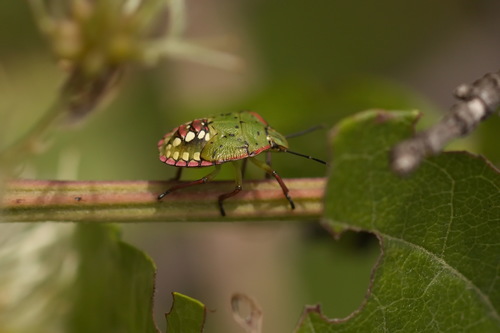
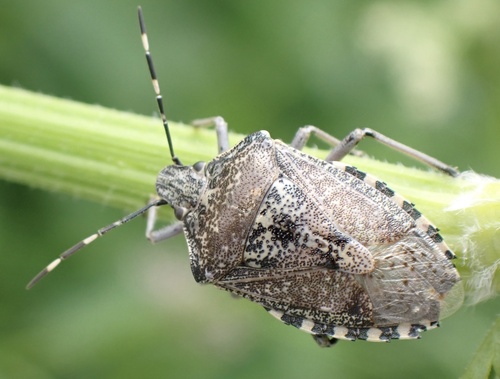
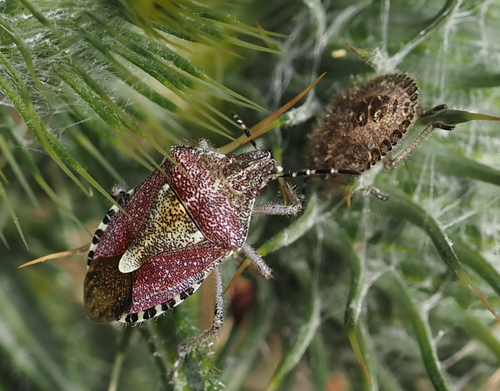
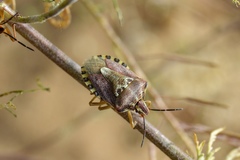
Carpocoris purpureipennis is a species of shield bug of the family Pentatomidae, subfamily Pentatominae. This species can be found in most of Europe and in central Asia. They live in meadows, roadsides, edges of forests and gardens.

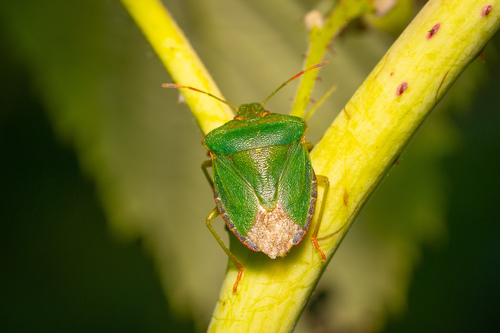
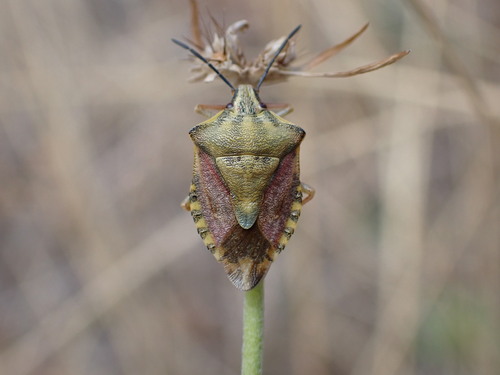
Carpocoris purpureipennis can reach a length of 11–13 millimetres (0.43–0.51 in). The pronotum is wide with a regular punctuation, almost straight and slightly pointed lateral margins with blunt tips. Also the lateral edges of the scutellum are nearly straight.

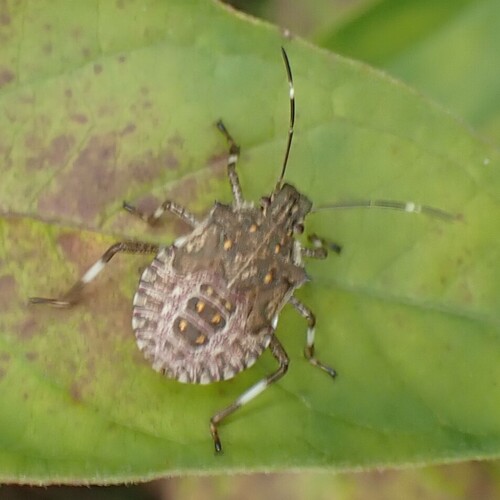
The body color varies from purple or reddish-brown to yellowish. The pronotum angles are black. Moreover pronotum usually shows short longitudinal black stripes, while the scutellum may have some contrasting black spots. Antennae are black and legs are orange.

This species is quite similar to, and can be easily confused with Carpocoris pudicus, C. fuscispinus, and C. mediterraneus. Both the adult bugs and their nymphs are polyphagous. Adults mainly feed on juices of Cirsium arvense and nectar of Leucanthemum vulgare.

In late May-early June these insects lay eggs on various herbaceous plants of the family of cereals (Poaceae), legumes... Wikipedia →
Global Distribution

Parks Where Found

# Park Country Daily sighting probability
1 Kiskunság National Park 🇭🇺 Hungary
~30%
2 Cévennes National Park 🇫🇷 France
~20%
3 Vanoise National Park 🇫🇷 France
~20%
4 Aigüestortes National Park 🇪🇸 Spain
~20%
5 Pyrénées National Park 🇫🇷 France
~20%
6 Mercantour National Park 🇫🇷 France
~20%
7 Ecrins National Park 🇫🇷 France
~10%
8 Bavarian Forest National Park 🇩🇪 Germany
~10%
9 Triglav National Park 🇸🇮 Slovenia
~10%
10 Białowieża National Park 🇵🇱 Poland
~10%
11 Fertő-Hanság National Park 🇭🇺 Hungary
~10%

Cities Where Found

# City Country Daily sighting probability
1 Kharkiv 🇺🇦 Ukraine
~10%
2 Helsinki 🇫🇮 Finland
~10%
3 Warsaw 🇵🇱 Poland
~10%
4 Kyiv 🇺🇦 Ukraine
~10%
5 Berlin 🇩🇪 Germany
~10%
6 Turin 🇮🇹 Italy
~10%
7 Budapest 🇭🇺 Hungary
~10%
8 Lyon 🇫🇷 France
~10%
9 Prague 🇨🇿 Czechia
~10%
10 Vienna 🇦🇹 Austria
~10%

Before you go

What are the chances of seeing a Black-Shouldered Shieldbug in Budapest?

With luck

About 10% of wildlife watchers report a Black-Shouldered Shieldbug sighting in Budapest on a given day, based on 7 verified sightings from GBIF citizen-science data. It is the 261st most-seen of the 404 insects we can rate there. Over three days the chance rises to about 20%, and over a week to about 40%, if each day is a fresh chance.

When is the best time to see a Black-Shouldered Shieldbug in Budapest?

April, June–July, September and November

In those months about 10% of wildlife watchers report a Black-Shouldered Shieldbug in Budapest on a given day, against under 5% in May, August, October and December–March, the lowest months.

What time of day is best to see a Black-Shouldered Shieldbug?

Between 1 and 4 pm

Across all the parks we cover, that three-hour window holds the most Black-Shouldered Shieldbug sightings with a recorded time, and about 8 in 10 of them come between 6 am and 6 pm: it is a daytime animal.

Is Budapest the best place to see a Black-Shouldered Shieldbug?

Among the best

Of the 19 cities where we can rate Black-Shouldered Shieldbug sightings, Budapest ranks 7th at about 10%, level with the leaders once rounded. The best odds are in Kharkiv (Ukraine, about 10%), Helsinki (Finland, about 10%) and Warsaw (Poland, about 10%).

Where does the Black-Shouldered Shieldbug sighting chance come from?

GBIF citizen-science records

It is estimated from how often the Black-Shouldered Shieldbug is recorded against all the insects logged in Budapest (7 verified sightings), calibrated against known sighting rates. Figures are rounded to the nearest 10% because citizen-science data supports honest approximations, not decimals, and months with records from fewer than five people show "—". How it works.

← Back to Budapest