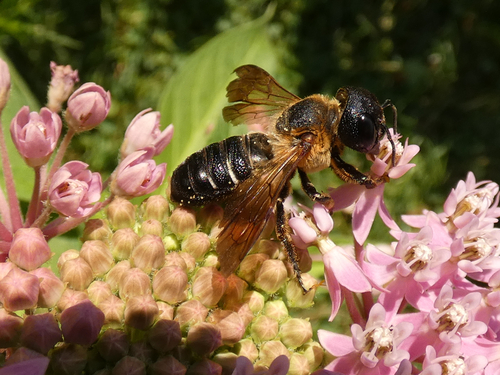
Sculptured Resin Bee
Daily sighting probability ~10% · With luck
at Budapest

In 3 days ~30% in a week ~50%

20 Verified sightings at Budapest
101 In all 5 parks From 2019 to 2026
July Best month
☀️ Diurnal When it's spotted

About the Sculptured Resin Bee

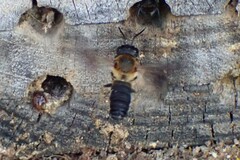
Megachile sculpturalis, known as the giant resin bee and sculptured resin bee, is a species of leafcutting bees belonging to the family Megachilidae. Native to Japan and China, it has been introduced to the Eastern United States and Ontario, Canada in recent times. First established in the United States during the early 1990s, records currently exist from most states east of the Mississippi River. In Europe, it was first observed close to Marseille's (France) port in 2008. Since then, this invasive species has also been recorded in the following European countries: Bosnia & Herzegovina, Germany, Hungary, Italy, Serbia, Slovenia, Spain, and Switzerland.

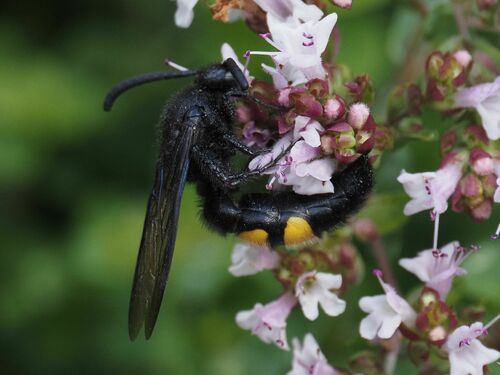
Megachile sculpturalis can reach a body length of about 19–22 mm (0.75–0.87 in) in males, while females usually are larger than males, reaching about 21–25 mm (0.83–0.98 in). It is much bigger than most other leafcutting bees. The body is cylindrical, jaws are large and wings are transparent, with a brown color that darkens toward the tips. Head and abdomen are mainly black, the abdomen is rather shiny and without hairs, while thorax is covered with dense yellowish-brown pubescence. In males the abdomen... Wikipedia →
Global Distribution

Parks Where Found

# Park Country Daily sighting probability
1 Cévennes National Park 🇫🇷 France
~10%
2 Shenandoah National Park 🇺🇸 United States
~10%
3 Point Pelee National Park 🇨🇦 Canada
~10%
4 Great Smoky Mountains National Park 🇺🇸 United States
~10%
5 Pyrénées National Park 🇫🇷 France
~10%

Cities Where Found

# City Country Daily sighting probability
1 Budapest 🇭🇺 Hungary
~10%
2 Barcelona 🇪🇸 Spain
~10%
3 Boston 🇺🇸 United States
~10%
4 Philadelphia 🇺🇸 United States
~10%
5 Bucharest 🇷🇴 Romania
~10%
6 New York City 🇺🇸 United States
~10%
7 Milan 🇮🇹 Italy
~10%
8 Lyon 🇫🇷 France
~10%
9 Vienna 🇦🇹 Austria
~10%
10 Baltimore 🇺🇸 United States
~10%

Before you go

What are the chances of seeing a Sculptured Resin Bee in Budapest?

With luck

About 10% of wildlife watchers report a Sculptured Resin Bee sighting in Budapest on a given day, based on 20 verified sightings from GBIF citizen-science data. It is the 113th most-seen of the 404 insects we can rate there. Over three days the chance rises to about 30%, and over a week to about 50%, if each day is a fresh chance.

When is the best time to see a Sculptured Resin Bee in Budapest?

July

In that month about 30% of wildlife watchers report a Sculptured Resin Bee in Budapest on a given day, against under 5% in September to May, the lowest months.

What time of day is best to see a Sculptured Resin Bee?

Between 2 and 5 pm

Across all the parks we cover, that three-hour window holds the most Sculptured Resin Bee sightings with a recorded time, and about 8 in 10 of them come between 6 am and 6 pm: it is a daytime animal.

Is Budapest the best place to see a Sculptured Resin Bee?

Yes

Of the 24 cities where we can rate Sculptured Resin Bee sightings, Budapest has the highest daily chance: about 10%. Next come Barcelona (Spain, about 10%) and Boston (United States, about 10%).

Which relatives of the Sculptured Resin Bee live in Budapest?

Same family: Megachilidae

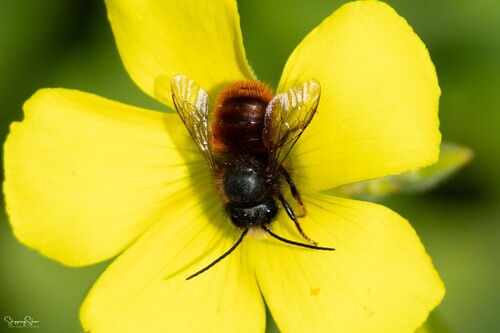
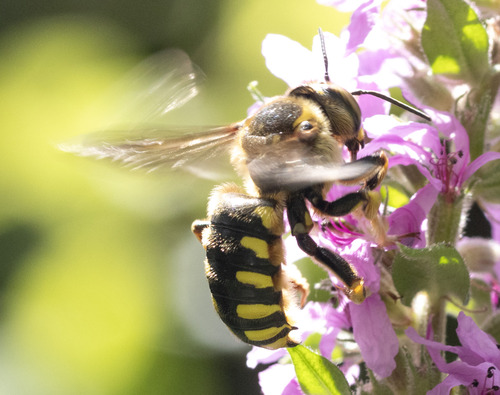
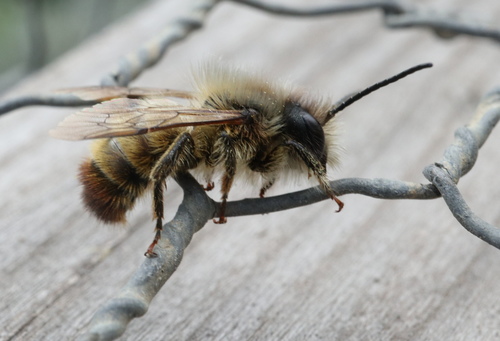
The closest relatives of the Sculptured Resin Bee that you can see in Budapest (family Megachilidae, Mason, Leafcutter, Carder, and Resin Bees) are European Orchard Bee (about 20%), Florentine Woolcarder Bee (about 20%) and Red Mason Bee (about 10%), with each one's daily chance of a sighting.

Where does the Sculptured Resin Bee sighting chance come from?

GBIF citizen-science records

It is estimated from how often the Sculptured Resin Bee is recorded against all the insects logged in Budapest (20 verified sightings), calibrated against known sighting rates. Figures are rounded to the nearest 10% because citizen-science data supports honest approximations, not decimals, and months with records from fewer than five people show "—". How it works.

← Back to Budapest