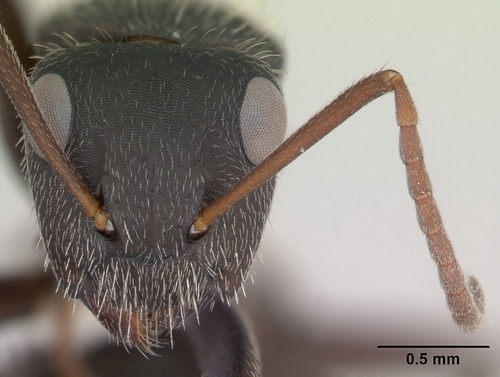
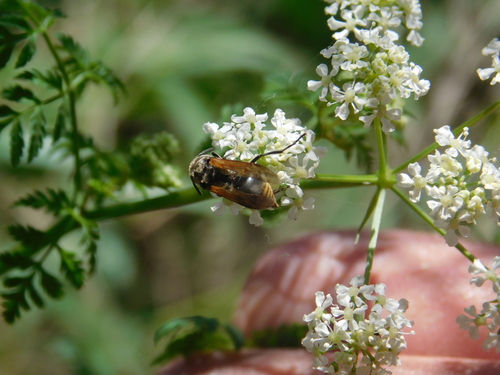
Polybia sericea
Daily sighting probability ~10% · With luck
at Buenos Aires

In 3 days ~20% in a week ~30%

62 Verified sightings at Buenos Aires
November Best month

About the Polybia sericea

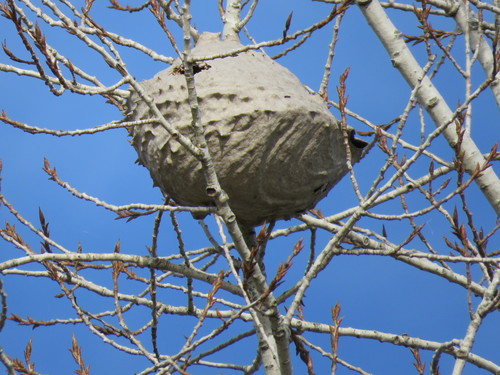
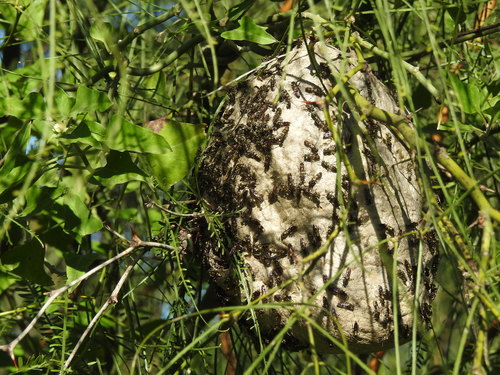
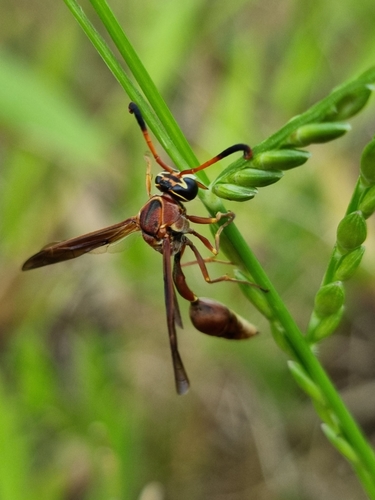
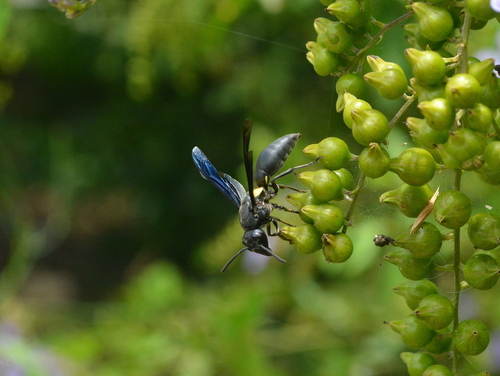
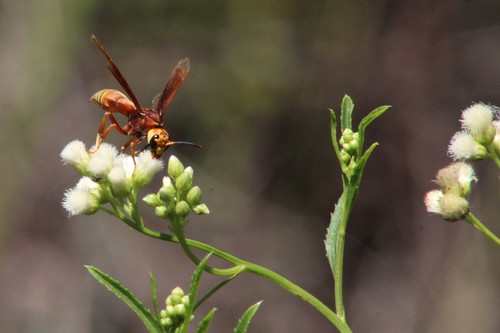
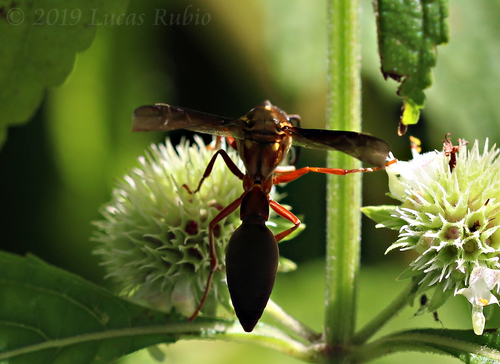
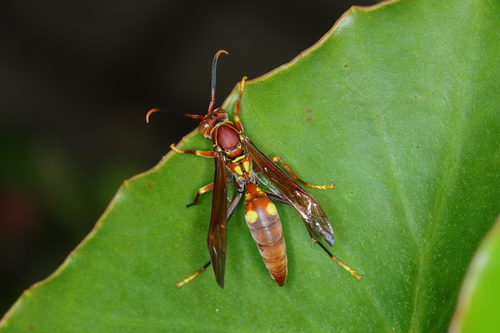
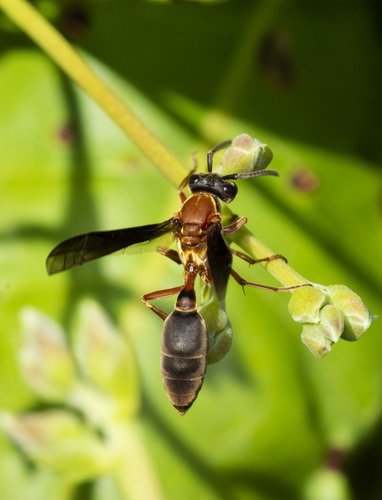
Polybia sericea is a social, tropical wasp of the family Vespidae that can be found in South America. It founds its colonies by swarming migrations, and feeds on nectar and arthropods. P. sericea is medium in size, and has a dark-colored body. The wasps build multitiered nests, and colony size can vary greatly between a few to a few thousand workers. Queens can be distinguished from workers by their greater body size and smaller head size. They tend to be polygynous, meaning that several egg-laying queens are within a nest, with the result that workers are generally less related to each other than in other eusocial species. Workers are responsible for hunting and foraging, while queens are responsible for laying eggs, and have the most developed ovaries. When hunting for prey, workers rely heavily on visual and olfactory cues. Prey include arthropods such as green and brown caterpillars.

P. sericea is a species within the genus Polybia of the subfamily Polistinae. Polybia is the most diversified genus within tribe Epiponini, which is characterized by colony founding via swarming. Placement of Polybia among related genera has fluctuated, and the genus may... Wikipedia →

Global Distribution

Parks Where Found

# Park Country Daily sighting probability

More parks will be added in future updates.

Cities Where Found

# City Country Daily sighting probability
1 São Luís 🇧🇷 Brazil
~40%
2 Manaus 🇧🇷 Brazil
~20%
3 Campo Grande 🇧🇷 Brazil
~10%
4 Fortaleza 🇧🇷 Brazil
~10%
5 Rosario 🇦🇷 Argentina
~10%
6 Caracas 🇻🇪 Venezuela
~10%
7 Porto Alegre 🇧🇷 Brazil
~10%
8 Buenos Aires 🇦🇷 Argentina
~10%
9 São Paulo 🇧🇷 Brazil
<5%

Before you go

What are the chances of seeing a Polybia sericea in Buenos Aires?

With luck

About 10% of wildlife watchers report a Polybia sericea sighting in Buenos Aires on a given day, based on 62 verified sightings from GBIF citizen-science data. It is the 157th most-seen of the 558 insects we can rate there. Over three days the chance rises to about 20%, and over a week to about 30%, if each day is a fresh chance.

When is the best time to see a Polybia sericea in Buenos Aires?

February, May and August–December

In those months about 10% of wildlife watchers report a Polybia sericea in Buenos Aires on a given day, against under 5% in January, March–April and June–July, the lowest months.

Is Buenos Aires the best place to see a Polybia sericea?

8th of 9

Of the 9 cities where we can rate Polybia sericea sightings, Buenos Aires ranks 8th at about 10%. The best odds are in São Luís (Brazil, about 40%), Manaus (Brazil, about 20%) and Campo Grande (Brazil, about 10%).

Which relatives of the Polybia sericea live in Buenos Aires?

Same genus: Polybia

The closest relatives of the Polybia sericea that you can see in Buenos Aires (genus Polybia, Long-waisted Honey Wasps) are Camoati Wasp (about 10%) and Yellow-Banded Polybia Wasp (about 10%), with each one's daily chance of a sighting.

Where does the Polybia sericea sighting chance come from?

GBIF citizen-science records

It is estimated from how often the Polybia sericea is recorded against all the insects logged in Buenos Aires (62 verified sightings), calibrated against known sighting rates. Figures are rounded to the nearest 10% because citizen-science data supports honest approximations, not decimals, and months with records from fewer than five people show "—". How it works.
← Back to Buenos Aires