Yellow-Banded Polybia Wasp

Yellow-Banded Polybia Wasp

Polybia occidentalis

Daily sighting probability ~10% · With luck
at Buenos Aires

In 3 days ~20% in a week ~50%

135 Verified sightings at Buenos Aires
61 In all 7 parks From 2019 to 2026
October Best month
☀️ Diurnal When it's spotted

About the Yellow-Banded Polybia Wasp

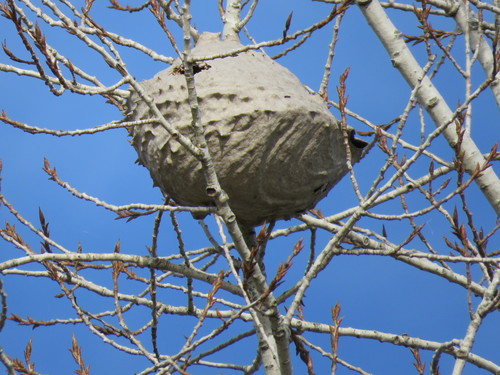
Polybia occidentalis, commonly known as camoati, is a swarm-founding advanced eusocial wasp. Swarm-founding means that a swarm of these wasps find a nesting site and build the nest together. This species can be found in Central and South America. P. occidentalis preys on nectar, insects, and carbohydrate sources, while birds and ants prey on and parasitize them. P. occidentalis workers bite each other to communicate the time to start working.

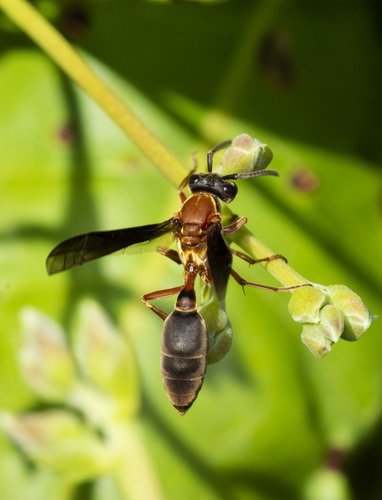
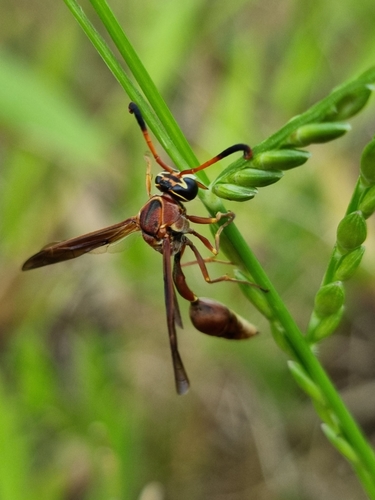
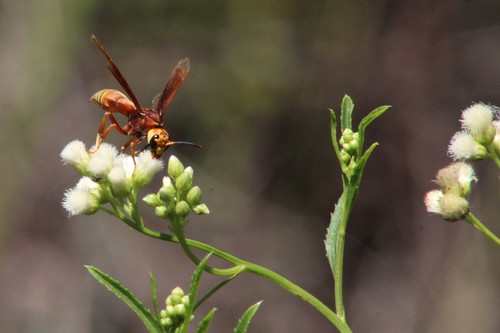
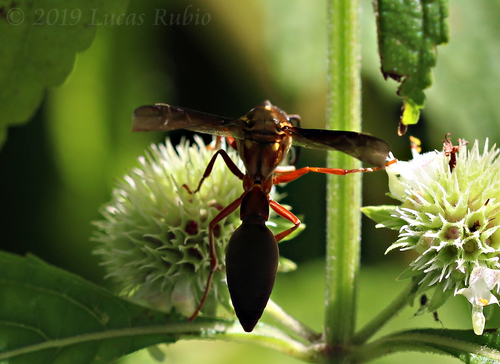
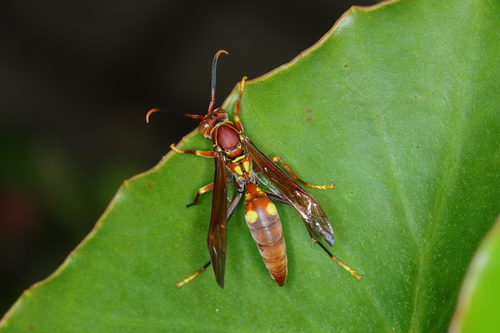
P. occidentalis belongs to the subfamily Polistinae. Polistines are one of six subfamilies of the Vespidae, and the subfamily contains four tribes, with Polybia belonging to the Epiponini. P. occidentalis is a black and yellow wasp - a black base with few yellow stripes on its abdomen. Its wings are thin and the thorax is attached to the abdomen by a long, thin petiole. Workers have a mean dry weight ranging from 3.80 to 6.71 mg. Its costal length ranges from 3.6 to 4.7 mm. Queen wasps are differentiated from workers because they have visibly larger ovaries, which are filled with eggs. Males are differentiated from workers and queens due to their visible testes. Wikipedia →

Global Distribution

Parks Where Found

# Park Country Daily sighting probability
1 Tayrona National Natural Park 🇨🇴 Colombia
~20%
2 Chagres National Park 🇵🇦 Panama
~20%
3 Santa Rosa National Park 🇨🇷 Costa Rica
~10%
4 Las Baulas Marine National Park 🇨🇷 Costa Rica
~10%
5 Soberanía National Park 🇵🇦 Panama
~10%
6 Parque Natural Metropolitano 🇵🇦 Panama
~10%
7 La Amistad International Park (Panama) 🇵🇦 Panama
<5%

Cities Where Found

# City Country Daily sighting probability
1 Valencia 🇻🇪 Venezuela
~40%
2 São Luís 🇧🇷 Brazil
~30%
3 Fortaleza 🇧🇷 Brazil
~30%
4 Managua 🇳🇮 Nicaragua
~20%
5 Rosario 🇦🇷 Argentina
~20%
6 Cali 🇨🇴 Colombia
~10%
7 Tegucigalpa 🇭🇳 Honduras
~10%
8 Panama City 🇵🇦 Panama
~10%
9 Maceió 🇧🇷 Brazil
~10%
10 Buenos Aires 🇦🇷 Argentina
~10%

Before you go

What are the chances of seeing a Yellow-Banded Polybia Wasp in Buenos Aires?

With luck

About 10% of wildlife watchers report a Yellow-Banded Polybia Wasp sighting in Buenos Aires on a given day, based on 135 verified sightings from GBIF citizen-science data. It is the 84th most-seen of the 558 insects we can rate there. Over three days the chance rises to about 20%, and over a week to about 50%, if each day is a fresh chance.

When is the best time to see a Yellow-Banded Polybia Wasp in Buenos Aires?

Any time of year

In every month with enough records, about 10% of wildlife watchers report a Yellow-Banded Polybia Wasp in Buenos Aires on a given day, so our monthly data shows no clear season.

What time of day is best to see a Yellow-Banded Polybia Wasp?

Between 7 and 10 am

Across all the parks we cover, that three-hour window holds the most Yellow-Banded Polybia Wasp sightings with a recorded time, and about 9 in 10 of them come between 6 am and 6 pm: it is a daytime animal.

Is Buenos Aires the best place to see a Yellow-Banded Polybia Wasp?

10th of 14

Of the 14 cities where we can rate Yellow-Banded Polybia Wasp sightings, Buenos Aires ranks 10th at about 10%. The best odds are in Valencia (Venezuela, about 40%), São Luís (Brazil, about 30%) and Fortaleza (Brazil, about 30%).

Which relatives of the Yellow-Banded Polybia Wasp live in Buenos Aires?

Same genus: Polybia

The closest relatives of the Yellow-Banded Polybia Wasp that you can see in Buenos Aires (genus Polybia, Long-waisted Honey Wasps) are Camoati Wasp (about 10%) and Polybia sericea (about 10%), with each one's daily chance of a sighting.

Where does the Yellow-Banded Polybia Wasp sighting chance come from?

GBIF citizen-science records

It is estimated from how often the Yellow-Banded Polybia Wasp is recorded against all the insects logged in Buenos Aires (135 verified sightings), calibrated against known sighting rates. Figures are rounded to the nearest 10% because citizen-science data supports honest approximations, not decimals, and months with records from fewer than five people show "—". How it works.
← Back to Buenos Aires