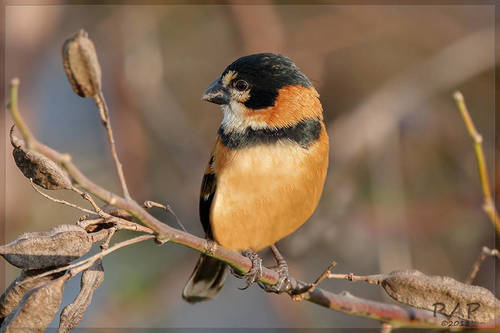
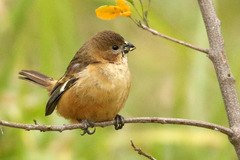
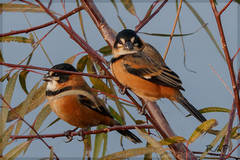

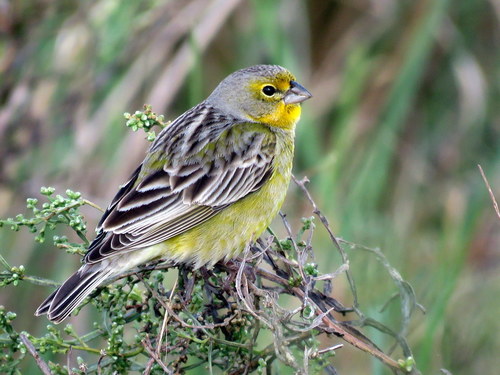
Rusty-collared Seedeater

Rusty-collared Seedeater

Sporophila collaris

Silhouette: Sheatherius · PhyloPic

LCLeast ConcernNTVUENCR
Daily sighting probability <5% · Rare
at Buenos Aires

In 3 days <5%

17 Verified sightings at Buenos Aires
956 In all 4 parks From 2019 to 2026
March Best month
☀️ Diurnal When it's spotted

About the Rusty-collared Seedeater

The rusty-collared seedeater (Sporophila collaris) is a species of bird in the family Thraupidae, formerly placed in the related Emberizidae. It is found in Argentina, Bolivia, Brazil, Paraguay, and Uruguay. Its natural habitats are subtropical or tropical seasonally wet or flooded lowland grassland, swamps, and heavily degraded former forest.

The rusty-collared seedeater was included by the French polymath Georges-Louis Leclerc, Comte de Buffon in 1775 in his Histoire Naturelle des Oiseaux. The bird was also illustrated in a hand-coloured plate engraved by François-Nicolas Martinet in the Planches Enluminées D'Histoire Naturelle which was produced under the supervision of Edme-Louis Daubenton to accompany Buffon's text. Neither the plate caption nor Buffon's description included a scientific name but in 1783 the Dutch naturalist Pieter Boddaert coined the binomial name Loxia collaris in his catalogue of the Planches Enluminées. Buffon mistaken believed that his specimen had come from Angola. In 1904 the Austrian ornithologist Carl Eduard Hellmayr designated the type location as Rio de Janeiro in Brazil. The rusty-collared seedeater is now placed in the genus Sporophila that was introduced by the German ornithologist Jean Cabanis in 1844. The genus name combines the Ancient Greek sporos meaning "seed" and philos meaning "-loving". The specific collaris is Latin for "of the neck".

Three subspecies are recognised: Wikipedia →

Sounds

Song0:34

Brazil · 2025

© JAYRSON ARAUJO DE OLIVEIRA · XC959448 · CC BY-NC-SA 4.0

Call0:30

Brazil · 2015

© Marcelo Villegas · XC286595 · CC BY-NC-SA 4.0

Song0:25

Brazil · 2019

© Benedito Pio da Silva Campos Neto · XC488566 · CC BY-NC-SA 4.0

Global Distribution

Parks Where Found

# Park Country Daily sighting probability
1 Iberá National Park 🇦🇷 Argentina
~30%
2 Parque Estadual Encontro das Águas 🇧🇷 Brazil
~10%
3 Iguaçu National Park 🇧🇷 Brazil
<5%
4 Iguazú National Park 🇦🇷 Argentina
<5%

Cities Where Found

# City Country Daily sighting probability
1 Asuncion 🇵🇾 Paraguay
<5%
2 Santa Cruz de la Sierra 🇧🇴 Bolivia
<5%
3 Rio de Janeiro 🇧🇷 Brazil
<5%
4 Buenos Aires 🇦🇷 Argentina
<5%

Before you go

What are the chances of seeing a Rusty-collared Seedeater in Buenos Aires?

Rare

Under 5% of wildlife watchers report a Rusty-collared Seedeater sighting in Buenos Aires on a given day, based on 17 verified sightings from GBIF citizen-science data. It is the 249th most-seen of the 274 birds we can rate there. Over three days the chance rises to under 5%, if each day is a fresh chance.

When is the best time to see a Rusty-collared Seedeater in Buenos Aires?

Any time of year

In every month with enough records, under 5% of wildlife watchers report a Rusty-collared Seedeater in Buenos Aires on a given day, so our monthly data shows no clear season.

What time of day is best to see a Rusty-collared Seedeater?

Between 8 and 11 am

Across all the parks we cover, that three-hour window holds the most Rusty-collared Seedeater sightings with a recorded time, and about 8 in 10 of them come between 6 am and 6 pm: it is a daytime animal.

Is Buenos Aires the best place to see a Rusty-collared Seedeater?

Among the best

Of the 4 cities where we can rate Rusty-collared Seedeater sightings, Buenos Aires ranks 4th at under 5%, level with the leaders once rounded. The best odds are in Asuncion (Paraguay, under 5%), Santa Cruz de la Sierra (Bolivia, under 5%) and Rio de Janeiro (Brazil, under 5%).

Where does the Rusty-collared Seedeater sighting chance come from?

GBIF citizen-science records

It is estimated from how often the Rusty-collared Seedeater is recorded against all the birds logged in Buenos Aires (17 verified sightings), calibrated against known sighting rates. Figures are rounded to the nearest 10% because citizen-science data supports honest approximations, not decimals, and months with records from fewer than five people show "—". How it works.

← Back to Buenos Aires