Band-tailed Manakin

Band-tailed Manakin

Pipra fasciicauda

Silhouette: Edwin Price · PhyloPic

LCLeast ConcernNTVUENCR
Daily sighting probability <5% · Rare
at Campo Grande

In 3 days ~10% in a week ~20%

28 Verified sightings at Campo Grande
2,646 In all 5 parks From 2019 to 2026
September Best month
☀️ Diurnal When it's spotted

About the Band-tailed Manakin

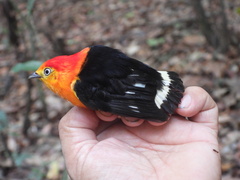
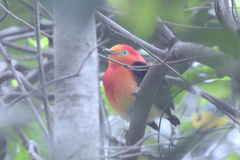
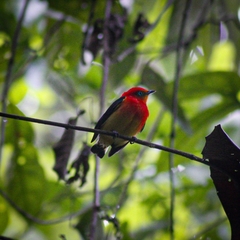
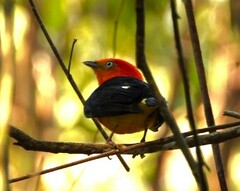
The band-tailed manakin (Pipra fasciicauda) is a species of bird in the family Pipridae. It is a small, frugivorous passerine found in humid montane and lowland tropical forests throughout Argentina, Bolivia, Brazil, Paraguay, and Peru.

The band-tailed manakin forms a superspecies with its two congeners, the wire-tailed manakin (P. filicauda) and crimson-hooded manakin (P. aureola). The species was described to science by Carl Eduard Hellmayr in 1906. Its average generation length is approximately 3.73 years.

The band-tailed manakin is 10 to 11 cm (3.9 to 4.3 in) long and weighs 11.5 to 19 g (0.41 to 0.67 oz). The species is sexually dimorphic. Adult males of the nominate subspecies P. f. fasciicauda have a yellow face and throat; the rest of their head, nape, and upper mantle are red. The rest of their upperparts, wings, and tail are mostly black. They have a white base to the tail and a white patch on the inner webs of the... Wikipedia →

Sounds

Call0:39

Argentina · 2026

© Marcos E. Sosa · XC1142137 · CC BY-NC-SA 4.0

Song0:22

Brazil · 2024

© JAYRSON ARAUJO DE OLIVEIRA · XC932736 · CC BY-NC-SA 4.0

Canto0:55

Brazil · 2014

© Caio Brito · XC427817 · CC BY-NC-SA 4.0

Global Distribution

Parks Where Found

# Park Country Daily sighting probability
1 Tambopata National Reserve 🇵🇪 Peru
~20%
2 Iguaçu National Park 🇧🇷 Brazil
~20%
3 Iguazú National Park 🇦🇷 Argentina
~10%
4 Chapada dos Guimarães National Park 🇧🇷 Brazil
~10%
5 Manu National Park 🇵🇪 Peru
~10%

Cities Where Found

# City Country Daily sighting probability
1 Campo Grande 🇧🇷 Brazil
<5%

Before you go

What are the chances of seeing a Band-tailed Manakin in Campo Grande?

Rare

Under 5% of wildlife watchers report a Band-tailed Manakin sighting in Campo Grande on a given day, based on 28 verified sightings from GBIF citizen-science data. It is the 137th most-seen of the 221 birds we can rate there. Over three days the chance rises to about 10%, and over a week to about 20%, if each day is a fresh chance.

When is the best time to see a Band-tailed Manakin in Campo Grande?

May and September

In those months about 10% of wildlife watchers report a Band-tailed Manakin in Campo Grande on a given day, against under 5% in June–August and October–April, the lowest months.

What time of day is best to see a Band-tailed Manakin?

Between 8 and 11 am

Across all the parks we cover, that three-hour window holds the most Band-tailed Manakin sightings with a recorded time, and about 9 in 10 of them come between 6 am and 6 pm: it is a daytime animal.

Where else can you see a Band-tailed Manakin?

Only Campo Grande, in our data

Campo Grande is the only city on Wallace's Line with enough records to rate Band-tailed Manakin sightings: under 5% of wildlife watchers there report one on a given day.

Which relatives of the Band-tailed Manakin live in Campo Grande?

Same order: Passeriformes

The closest relatives of the Band-tailed Manakin that you can see in Campo Grande (order Passeriformes, Perching Birds) are Great Kiskadee (about 90%), Rufous Hornero (about 80%) and Rufous-bellied Thrush (about 80%), with each one's daily chance of a sighting.

Where does the Band-tailed Manakin sighting chance come from?

GBIF citizen-science records

It is estimated from how often the Band-tailed Manakin is recorded against all the birds logged in Campo Grande (28 verified sightings), calibrated against known sighting rates. Figures are rounded to the nearest 10% because citizen-science data supports honest approximations, not decimals, and months with records from fewer than five people show "—". How it works.

← Back to Campo Grande