

Red-naped Ibis

Red-naped Ibis

Pseudibis papillosa

Silhouette: Sheatherius · PhyloPic

LCLeast ConcernNTVUENCR
Daily sighting probability ~20% · Possible
at Chandigarh

In 3 days ~40% in a week ~70%

131 Verified sightings at Chandigarh
4,555 In all 12 parks From 2019 to 2026
February Best month
🌅 Crepuscular When it's spotted

About the Red-naped Ibis

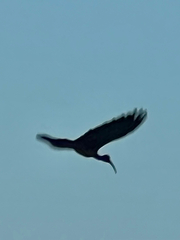
The red-naped ibis (Pseudibis papillosa), also known as the Indian black ibis or black ibis, is a species of ibis found in the plains, agriculture fields and cities of the Indian subcontinent. Unlike other ibises in the region it is not found very often in waterbodies and is often found in dry fields, but are attracted more to areas that have more wetlands. It is usually seen in pairs or loose groups and can be identified by the nearly all dark body with a white patch on the shoulder and a bare dark head with a patch of crimson red warty skin on the crown and nape. It has a loud call and is noisy when breeding. It builds its nest most often on the top of a large tree or palm, and an increasing number of pairs are building on cell phone towers and electricity pillion towers.

The red-naped ibis is a large black bird with long legs and a long downcurved bill. The wing feathers and tail are black with blue-green gloss while the neck and body are brown and without gloss. A white patch on the shoulders stands out and the top of the featherless head is a patch of bright red warty skin. The warty patch, technically a caruncle, is a triangular patch with the apex at the crown... Wikipedia →

Sounds

Call0:14

India · 2020

© Ding Li Yong · XC529008 · CC BY-NC-ND 4.0

Flight call0:29

India · 2014

© Frank Lambert · XC166159 · CC BY-NC-ND 4.0

Flight call0:34

India · 2006

© Mathias Ritschard · XC21871 · CC BY-NC-ND 2.5

Global Distribution

Parks Where Found

# Park Country Daily sighting probability
1 Chitwan National Park 🇳🇵 Nepal
~60%
2 Bandhavgarh National Park 🇮🇳 India
~30%
3 Gir National Park 🇮🇳 India
~30%
4 Royal Bardia National Park 🇳🇵 Nepal
~30%
5 Kanha National Park 🇮🇳 India
~30%
6 Satpura National Park 🇮🇳 India
~30%
7 Nagarhole National Park 🇮🇳 India
~20%
8 Bandipur National Park 🇮🇳 India
~10%
9 Keoladeo National Park 🇮🇳 India
~10%
10 Mudumalai National Park 🇮🇳 India
<5%
11 Ranthambore National Park 🇮🇳 India
<5%
12 Jim Corbett National Park 🇮🇳 India
<5%

Cities Where Found

# City Country Daily sighting probability
1 Vadodara 🇮🇳 India
~40%
2 Rajkot 🇮🇳 India
~40%
3 Ludhiana 🇮🇳 India
~40%
4 Nashik 🇮🇳 India
~30%
5 Ranchi 🇮🇳 India
~30%
6 Ahmedabad 🇮🇳 India
~30%
7 Meerut 🇮🇳 India
~30%
8 New Delhi 🇮🇳 India
~20%
9 Mysuru 🇮🇳 India
~20%
10 Asansol 🇮🇳 India
~20%

Zoos & Centres Where Found

# Zoo / Centre Country
1 Nehru Zoological Park 🇮🇳 India In captivity

Before you go

What are the chances of seeing a Red-naped Ibis in Chandigarh?

Possible

About 20% of wildlife watchers report a Red-naped Ibis sighting in Chandigarh on a given day, based on 131 verified sightings from GBIF citizen-science data. It is the 37th most-seen of the 161 birds we can rate there. Over three days the chance rises to about 40%, and over a week to about 70%, if each day is a fresh chance.

When is the best time to see a Red-naped Ibis in Chandigarh?

February

In that month about 30% of wildlife watchers report a Red-naped Ibis in Chandigarh on a given day, against about 10% in April and November, the lowest months. That is one of Chandigarh's driest months, with about 40 mm of rain against 280 mm in July.

What time of day is best to see a Red-naped Ibis?

Between 3 and 6 am

Across all the parks we cover, that three-hour window holds the most Red-naped Ibis sightings with a recorded time, and about half of them come between 6 am and 6 pm: it is most active around dawn and dusk.

Is Chandigarh the best place to see a Red-naped Ibis?

11th of 33

Of the 33 cities where we can rate Red-naped Ibis sightings, Chandigarh ranks 11th at about 20%. The best odds are in Vadodara (India, about 40%), Rajkot (India, about 40%) and Ludhiana (India, about 40%).

Where does the Red-naped Ibis sighting chance come from?

GBIF citizen-science records

It is estimated from how often the Red-naped Ibis is recorded against all the birds logged in Chandigarh (131 verified sightings), calibrated against known sighting rates. Figures are rounded to the nearest 10% because citizen-science data supports honest approximations, not decimals, and months with records from fewer than five people show "—". How it works.

← Back to Chandigarh