
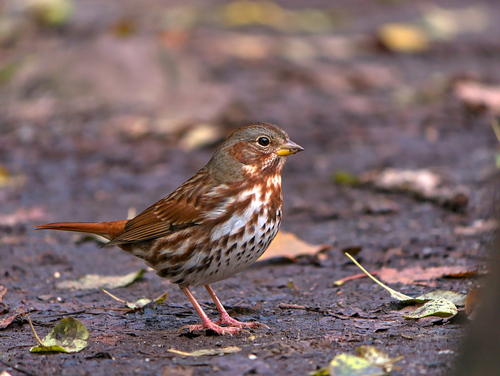
Grasshopper Sparrow

Grasshopper Sparrow

Ammodramus savannarum

Silhouette: Andy Wilson · PhyloPic

LCLeast ConcernNTVUENCR
Daily sighting probability <5% · Rare
at Chicago

In 3 days <5% in a week ~10%

481 Verified sightings at Chicago
1,050 In all 12 parks From 2019 to 2026
July Best month
☀️ Diurnal When it's spotted

About the Grasshopper Sparrow

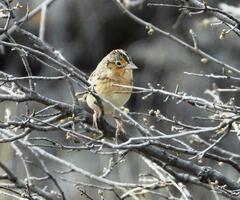
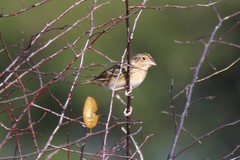
The grasshopper sparrow (Ammodramus savannarum) is a small New World sparrow. It belongs to the genus Ammodramus, which contains three species that inhabit grasslands and prairies. Grasshopper sparrows are sometimes found in crop fields and they will readily colonize reclaimed grassland. In the core of their range, grasshopper sparrows are dependent upon large areas of grassland where they avoid trees and shrubs. They seek out heterogenous patches of prairie that contain clumps of dead grass or other vegetation where they conceal their nest, and also contain barer ground where they forage for insects (especially grasshoppers), spiders, and seeds. Grasshopper sparrows are unusual among New World sparrows in that they sing two distinct song types, the prevalence of which varies with the nesting cycle. The primary male song, a high trill preceded by a stereotyped series of short chips, is reminiscent of the sounds of grasshoppers and is the origin of this species' name. Like some other birds of the central North American grasslands, this species also moves around a lot, not only via annual migrations, but individuals frequently disperse between breeding attempts or breeding seasons. Grasshopper sparrows are in steep decline across their range, even in the core of the breeding distribution in the tallgrass prairies of the central Great Plains. The Florida grasshopper sparrow (Ammodramus savannarum floridanus) is highly endangered. Wikipedia →

Sounds

Song0:27

United States · 2025

© David A. Brinkman · XC1007620 · CC BY-NC-SA 4.0

Nocturnal flight call0:04

Canada · 2021

© Jeff Stewart · XC703544 · CC BY-NC-SA 4.0

Call1:03

United States · 2021

© Christopher McPherson · XC691451 · CC BY-NC-SA 4.0

Global Distribution

Parks Where Found

# Park Country Daily sighting probability
1 Badlands National Park 🇺🇸 United States
~20%
2 Everglades National Park 🇺🇸 United States
~10%
3 Congaree National Park 🇺🇸 United States
<5%
4 Point Pelee National Park 🇨🇦 Canada
<5%
5 Big Cypress National Preserve 🇺🇸 United States
<5%
6 Rincón de la Vieja National Park 🇨🇷 Costa Rica
<5%
7 Death Valley National Park 🇺🇸 United States
<5%
8 Big Bend National Park 🇺🇸 United States
<5%
9 Cumbres de Monterrey National Park 🇲🇽 Mexico
<5%
10 Arrecifes de Cozumel National Park 🇲🇽 Mexico
<5%
11 Tenorio Volcano National Park 🇨🇷 Costa Rica
<5%
12 Channel Islands National Park 🇺🇸 United States
<5%

Cities Where Found

# City Country Daily sighting probability
1 Monterrey 🇲🇽 México
<5%
2 Chicago 🇺🇸 United States
<5%
3 San Antonio 🇺🇸 United States
<5%
4 Austin 🇺🇸 United States
<5%
5 Baltimore 🇺🇸 United States
<5%
6 San José 🇨🇷 Costa Rica
<5%
7 Houston 🇺🇸 United States
<5%
8 Washington 🇺🇸 United States
<5%
9 Mexico City 🇲🇽 México
<5%
10 Dallas 🇺🇸 United States
<5%

Zoos & Centres Where Found

# Zoo / Centre Country
1 National Zoological Park 🇺🇸 United States In captivity
2 Welaka National Fish Hatchery 🇺🇸 United States In captivity

Before you go

What are the chances of seeing a Grasshopper Sparrow in Chicago?

Rare

Under 5% of wildlife watchers report a Grasshopper Sparrow sighting in Chicago on a given day, based on 481 verified sightings from GBIF citizen-science data. It is the 185th most-seen of the 314 birds we can rate there. Over three days the chance rises to under 5%, and over a week to about 10%, if each day is a fresh chance.

When is the best time to see a Grasshopper Sparrow in Chicago?

Any time of year

In every month with enough records, under 5% of wildlife watchers report a Grasshopper Sparrow in Chicago on a given day, so our monthly data shows no clear season.

What time of day is best to see a Grasshopper Sparrow?

Between 8 and 11 am

Across all the parks we cover, that three-hour window holds the most Grasshopper Sparrow sightings with a recorded time, and about 9 in 10 of them come between 6 am and 6 pm: it is a daytime animal.

Is Chicago the best place to see a Grasshopper Sparrow?

Among the best

Of the 21 cities where we can rate Grasshopper Sparrow sightings, Chicago ranks 2nd at under 5%, level with the leaders once rounded. The best odds are in Monterrey (México, under 5%).

Which relatives of the Grasshopper Sparrow live in Chicago?

Same family: Passerellidae

The closest relatives of the Grasshopper Sparrow that you can see in Chicago (family Passerellidae, New World Sparrows) are Song Sparrow (about 40%), Dark-eyed Junco (about 30%) and White-throated Sparrow (about 30%), with each one's daily chance of a sighting.

Where does the Grasshopper Sparrow sighting chance come from?

GBIF citizen-science records

It is estimated from how often the Grasshopper Sparrow is recorded against all the birds logged in Chicago (481 verified sightings), calibrated against known sighting rates. Figures are rounded to the nearest 10% because citizen-science data supports honest approximations, not decimals, and months with records from fewer than five people show "—". How it works.

← Back to Chicago