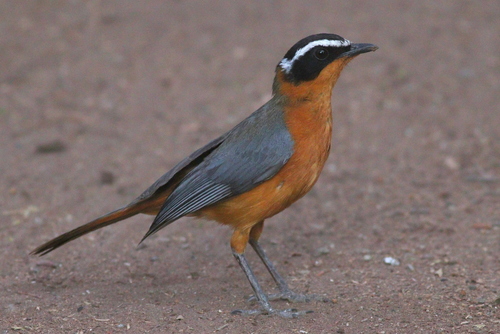
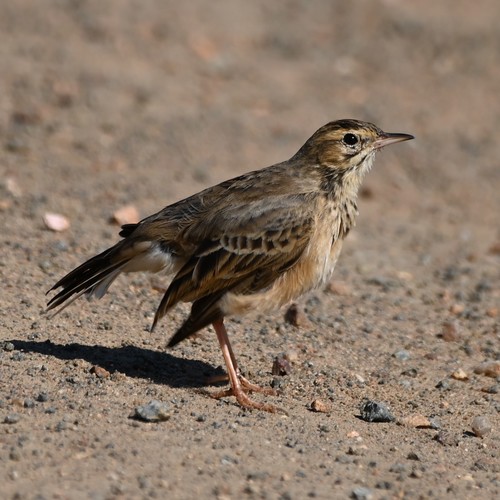
Bearded Scrub Robin

Bearded Scrub Robin

Erythropygia quadrivirgata

Silhouette: Martin Bulla, based on François Desbordes' illustration · PhyloPic

Daily sighting probability ~10% · With luck
at Dar es-Salaam

In 3 days ~20% in a week ~40%

10 Verified sightings at Dar es-Salaam
1,422 In all 16 parks From 2019 to 2026
October Best month
☀️ Diurnal When it's spotted

About the Bearded Scrub Robin

The bearded scrub robin (Tychaedon quadrivirgata), also known as the eastern bearded scrub robin, is a species of bird in the family Muscicapidae. It is found in eastern and southern Africa. This species was formerly placed in the genus Cercotrichas.

This species was described as Thamnobia quadrivirgata by the German ornithologist Anton Reichenow in 1879. It was formerly placed in the genus Erythropygia. It forms a superspecies with the forest scrub robin, miombo scrub robin and brown scrub robin. The specific epithet quadrivirgata means "four-striped" in Latin. The species is so named because of four diagnostic stripes on its face.

Its length is 15–17 cm (5.9–6.7 in), and its weight is approximately 20–31 g (0.71–1.09 oz). The male and female are alike, with the female being slightly smaller. The crown and upperparts are mostly dark olive-brown. The tail is dark brown, with the outer feathers having white tips. The wing coverts are grey-brown with olive-brown edges. The flight feathers are dark brown... Wikipedia →

Sounds

Recording0:05

South Africa · 2024

© Sally Adam · iNaturalist · CC BY-NC 4.0

Recording0:09

Eswatini · 2026

© Phil White · iNaturalist · CC BY-NC 4.0

Recording0:20

South Africa · 2024

© Heinrich Human · iNaturalist · CC BY-NC 4.0

Global Distribution

Parks Where Found

# Park Country Daily sighting probability
1 uMkhuze Game Reserve 🇿🇦 South Africa
~30%
2 Gonarezhou National Park 🇿🇼 Zimbabwe
~20%
3 Mana Pools National Park 🇿🇼 Zimbabwe
~10%
4 Lower Zambezi National Park 🇿🇲 Zambia
~10%
5 Gorongosa National Park 🇲🇿 Mozambique
~10%
6 Kruger National Park 🇿🇦 South Africa
~10%
7 Hluhluwe-Imfolozi Park 🇿🇦 South Africa
~10%
8 Liwonde National Park 🇲🇼 Malawi
~10%
9 iSimangaliso Wetland Park 🇿🇦 South Africa
~10%
10 Ruaha National Park 🇹🇿 Tanzania
<5%
11 Lake Manyara National Park 🇹🇿 Tanzania
<5%
12 Kafue National Park 🇿🇲 Zambia
<5%
13 Mikumi National Park 🇹🇿 Tanzania
<5%
14 Hwange National Park 🇿🇼 Zimbabwe
<5%
15 Tsavo East National Park 🇰🇪 Kenya
<5%
16 Chobe National Park 🇧🇼 Botswana
<5%

Cities Where Found

# City Country Daily sighting probability
1 Mombasa 🇰🇪 Kenya
~20%
2 Dar es-Salaam 🇹🇿 Tanzania
~10%

Before you go

What are the chances of seeing a Bearded Scrub Robin in Dar es-Salaam?

With luck

About 10% of wildlife watchers report a Bearded Scrub Robin sighting in Dar es-Salaam on a given day, based on 10 verified sightings from GBIF citizen-science data. It is the 100th most-seen of the 138 birds we can rate there. Over three days the chance rises to about 20%, and over a week to about 40%, if each day is a fresh chance.

When is the best time to see a Bearded Scrub Robin in Dar es-Salaam?

March, May and August–December

In those months about 10% of wildlife watchers report a Bearded Scrub Robin in Dar es-Salaam on a given day, against under 5% in January–February, April and June–July, the lowest months.

What time of day is best to see a Bearded Scrub Robin?

Between 7 and 10 am

Across all the parks we cover, that three-hour window holds the most Bearded Scrub Robin sightings with a recorded time, and about 8 in 10 of them come between 6 am and 6 pm: it is a daytime animal.

Is Dar es-Salaam the best place to see a Bearded Scrub Robin?

2nd of 2

Of the 2 cities where we can rate Bearded Scrub Robin sightings, Dar es-Salaam ranks 2nd at about 10%. The best odds are in Mombasa (Kenya, about 20%).

Where does the Bearded Scrub Robin sighting chance come from?

GBIF citizen-science records

It is estimated from how often the Bearded Scrub Robin is recorded against all the birds logged in Dar es-Salaam (10 verified sightings), calibrated against known sighting rates. Figures are rounded to the nearest 10% because citizen-science data supports honest approximations, not decimals, and months with records from fewer than five people show "—". How it works.

← Back to Dar es-Salaam