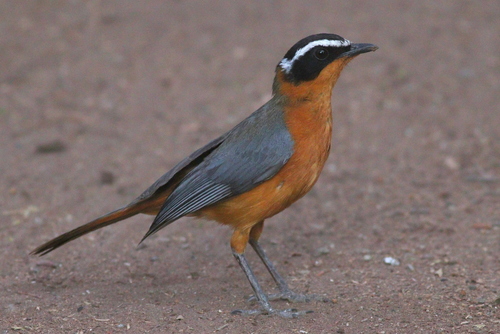
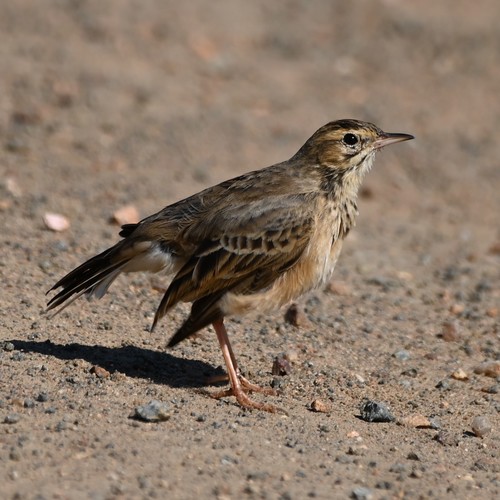
Spotted Morning-Thrush

Spotted Morning-Thrush

Cichladusa guttata

Silhouette: Martin Bulla, based on François Desbordes' illustration · PhyloPic

LCLeast ConcernNTVUENCR
Daily sighting probability ~10% · With luck
at Dar es-Salaam

In 3 days ~30% in a week ~60%

18 Verified sightings at Dar es-Salaam
2,973 In all 16 parks From 2019 to 2026
May Best month
☀️ Diurnal When it's spotted

About the Spotted Morning-Thrush

The spotted palm thrush (Cichladusa guttata), also known as the spotted morning-thrush, is a species of bird in the Muscicapidae family. They are small birds mostly consisting of the colors brown, black, and cream. They can be found in eastern African countries such as Ethiopia, Kenya, Somalia, Sudan, Tanzania, and Uganda. Their natural habitats are subtropical or tropical dry forests, dry savanna, and subtropical or tropical moist shrubland. This bird is a forager that has a diet consisting of invertebrates. These birds create a variety of different vocal duets as a form of communication.

The spotted palm thrush measures around 16-17 centimeters (6.3-6.7 inches) long and weighs around 17-30 grams (<0.1 pounds). This bird features a warm brown color from crown to back and wings, with a dark brown eye stripe, and black-arrowed, creamy white underparts. The males and females are monomorphic, having little variance in their appearance regardless of sex.

The spotted palm thrush is located in most parts of Ethiopia, South Sudan, Uganda, Kenya, Somalia, and Tanzania. They can also be found in the easternmost parts of the Democratic Republic of the Congo, and... Wikipedia →

Sounds

Song0:09

Uganda · 2025

© Bernard BOUSQUET · XC1062522 · CC BY-NC-SA 4.0

Alarm call1:03

Kenya · 2022

© isaac kilusu · XC711701 · CC BY-NC-SA 4.0

Call0:16

Ethiopia · 2019

© Barry Edmonston · XC531230 · CC BY-NC-SA 4.0

Global Distribution

Parks Where Found

# Park Country Daily sighting probability
1 Mkomazi National Park 🇹🇿 Tanzania
~50%
2 Samburu National Reserve 🇰🇪 Kenya
~50%
3 Lake Manyara National Park 🇹🇿 Tanzania
~40%
4 Murchison Falls National Park 🇺🇬 Uganda
~40%
5 Tsavo West National Park 🇰🇪 Kenya
~30%
6 Tsavo East National Park 🇰🇪 Kenya
~30%
7 Amboseli National Park 🇰🇪 Kenya
~30%
8 Tarangire National Park 🇹🇿 Tanzania
~20%
9 Nairobi National Park 🇰🇪 Kenya
~20%
10 Meru National Park 🇰🇪 Kenya
~10%
11 Ruaha National Park 🇹🇿 Tanzania
~10%
12 Kidepo Valley National Park 🇺🇬 Uganda
~10%
13 Mikumi National Park 🇹🇿 Tanzania
~10%
14 Serengeti National Park 🇹🇿 Tanzania
<5%
15 Ngorongoro Conservation Area 🇹🇿 Tanzania
<5%
16 Arusha National Park 🇹🇿 Tanzania
<5%

Cities Where Found

# City Country Daily sighting probability
1 Dar es-Salaam 🇹🇿 Tanzania
~10%
2 Nairobi 🇰🇪 Kenya
<5%

Before you go

What are the chances of seeing a Spotted Morning-Thrush in Dar es-Salaam?

With luck

About 10% of wildlife watchers report a Spotted Morning-Thrush sighting in Dar es-Salaam on a given day, based on 18 verified sightings from GBIF citizen-science data. It is the 76th most-seen of the 138 birds we can rate there. Over three days the chance rises to about 30%, and over a week to about 60%, if each day is a fresh chance.

When is the best time to see a Spotted Morning-Thrush in Dar es-Salaam?

May and July

In those months about 20% of wildlife watchers report a Spotted Morning-Thrush in Dar es-Salaam on a given day, against under 5% in February, the lowest month.

What time of day is best to see a Spotted Morning-Thrush?

Between 9 am and noon

Across all the parks we cover, that three-hour window holds the most Spotted Morning-Thrush sightings with a recorded time, and about 8 in 10 of them come between 6 am and 6 pm: it is a daytime animal.

Is Dar es-Salaam the best place to see a Spotted Morning-Thrush?

Yes

Of the 2 cities where we can rate Spotted Morning-Thrush sightings, Dar es-Salaam has the highest daily chance: about 10%. Next come Nairobi (Kenya, under 5%).

Which relatives of the Spotted Morning-Thrush live in Dar es-Salaam?

Same family: Muscicapidae

The closest relatives of the Spotted Morning-Thrush that you can see in Dar es-Salaam (family Muscicapidae, Old World Flycatchers, Robins, and Chats) are White-browed Robin-Chat (about 20%) and Bearded Scrub Robin (about 10%), with each one's daily chance of a sighting.

Where does the Spotted Morning-Thrush sighting chance come from?

GBIF citizen-science records

It is estimated from how often the Spotted Morning-Thrush is recorded against all the birds logged in Dar es-Salaam (18 verified sightings), calibrated against known sighting rates. Figures are rounded to the nearest 10% because citizen-science data supports honest approximations, not decimals, and months with records from fewer than five people show "—". How it works.

← Back to Dar es-Salaam