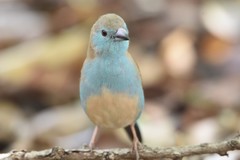
About the Blue-breasted Cordonbleu
The blue waxbill (Uraeginthus angolensis), also called southern blue waxbill, blue-breasted waxbill, southern cordon-bleu, blue-cheeked cordon-bleu, blue-breasted cordon-bleu and Angola cordon-bleu, is a common species of estrildid finch found in Southern Africa. It is also relatively commonly kept as an aviary bird.
The blue waxbill was formally described by the Swedish naturalist Carl Linnaeus in 1758 in the tenth edition of his Systema Naturae under the binomial name Fringilla angolensis. Linnaeus based his description on the "Blue-Belly'd Finch" that had been described and illustrated in 1750 by the English naturalist George Edwards in his A Natural History of Uncommon Birds. Edwards had viewed a caged bird in London that had come from Angola. This species is now placed in the genus Uraeginthus that was introduced by the German ornithologist Jean Cabanis in 1851.
Three subspecies are recognized: The blue waxbill has powder-blue face, breast, rump, and flanks with pale brown upperparts. The female is paler than the male and the blue is confined to the rump, tail, head, and upper breast, with the rest of the underparts being buffy brown. They measure... Wikipedia →