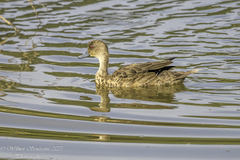
Sunda Teal

Sunda Teal

Anas gibberifrons

Silhouette: Sheatherius · PhyloPic

LCLeast ConcernNTVUENCR
Daily sighting probability ~30% · Possible
at Denpasar

In 3 days ~70% in a week ~90%

254 Verified sightings at Denpasar
141 In all 4 parks From 2019 to 2026
June Best month
☀️ Diurnal When it's spotted

About the Sunda Teal

The Sunda teal (Anas gibberifrons), also known as the Bebek cokelat or Itik benjut, is a dabbling duck found in open wetlands in Indonesia and Timor-Leste. The species formerly included the Andaman teal Anas albogularis and the grey teal, Anas gracilis as subspecies, but is currently considered monotypic.

A molecular phylogentic study published in 2009 that compared mitochondrial DNA sequences from ducks, geese and swans in the family Anatidae found that the Sunda teal is a sister species of the chestnut teal (Anas castanea) native to Australia.

This is a mottled brown duck with white and green flashes on its wings. The male and female Sunda teal share the same colouration, in contrast to the related chestnut teal, whose male and female are strikingly different. The nominate Sunda teal has almost identical colouration to the female chestnut teal and can only be distinguished by its lighter coloured neck, paler face and especially the bulging forehead. The Andaman teal has a variable amount of white on the forehead and around the eyes. The Rennell Island teal looked like a smaller version of the nominate subspecies, with a stubbier bill. Juveniles are paler than adults, especially on the head.

The Sunda teal nests near its favoured freshwater lakes and marshes, usually on the ground, but also in tree holes or rabbit burrows. This is a vocal duck, especially at night. The male gives a soft peep, and the female has a loud quack. Wikipedia →

Sounds

Call0:20

Indonesia · 2023

© Chi-Hsuan Shao · XC791755 · CC BY-NC-SA 4.0

Alarm call0:05

Indonesia · 2017

© Bruno Durand · XC358925 · CC BY-NC-SA 4.0

Call0:25

Indonesia · 2015

© Mike Nelson · XC293215 · CC BY-NC-SA 4.0

Global Distribution

Parks Where Found

# Park Country Daily sighting probability
1 Bali Barat National Park 🇮🇩 Indonesia
~10%
2 Komodo National Park 🇮🇩 Indonesia
<5%
3 Way Kambas National Park 🇮🇩 Indonesia
<5%
4 Tangkoko Nature Reserve 🇮🇩 Indonesia
<5%

Cities Where Found

# City Country Daily sighting probability
1 Denpasar 🇮🇩 Indonesia
~30%
2 Jakarta 🇮🇩 Indonesia
~30%
3 Makassar 🇮🇩 Indonesia
~10%

Zoos & Centres Where Found

# Zoo / Centre Country
1 Gembira Loka Zoo 🇮🇩 Indonesia In captivity
2 Mořský svět 🇨🇿 Czechia In captivity
3 Vogelpark Bali 🇮🇩 Indonesia In captivity

Before you go

What are the chances of seeing a Sunda Teal in Denpasar?

Possible

About 30% of wildlife watchers report a Sunda Teal sighting in Denpasar on a given day, based on 254 verified sightings from GBIF citizen-science data. It is the 26th most-seen of the 109 birds we can rate there. Over three days the chance rises to about 70%, and over a week to about 90%, if each day is a fresh chance.

When is the best time to see a Sunda Teal in Denpasar?

January and June–July

In those months about 40% of wildlife watchers report a Sunda Teal in Denpasar on a given day, against about 20% in October, the lowest month.

What time of day is best to see a Sunda Teal?

Between 7 and 10 am

Across all the parks we cover, that three-hour window holds the most Sunda Teal sightings with a recorded time, and about 9 in 10 of them come between 6 am and 6 pm: it is a daytime animal.

Is Denpasar the best place to see a Sunda Teal?

Yes

Of the 3 cities where we can rate Sunda Teal sightings, Denpasar has the highest daily chance: about 30%. Next come Jakarta (Indonesia, about 30%) and Makassar (Indonesia, about 10%).

Where does the Sunda Teal sighting chance come from?

GBIF citizen-science records

It is estimated from how often the Sunda Teal is recorded against all the birds logged in Denpasar (254 verified sightings), calibrated against known sighting rates. Figures are rounded to the nearest 10% because citizen-science data supports honest approximations, not decimals, and months with records from fewer than five people show "—". How it works.

← Back to Denpasar