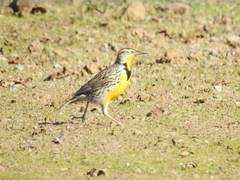

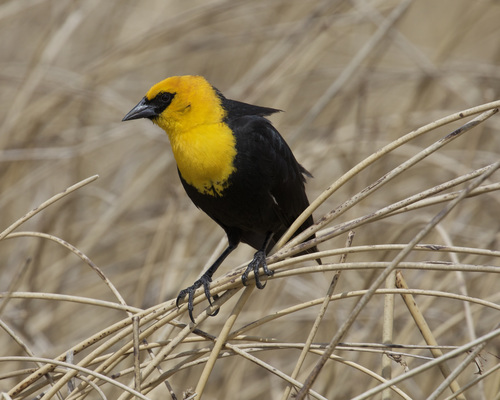
Western Meadowlark

Western Meadowlark

Sturnella neglecta

Silhouette: Sheatherius · PhyloPic

LCLeast ConcernNTVUENCR
Daily sighting probability ~10% · With luck
at Denver

In 3 days ~30% in a week ~50%

5,280 Verified sightings at Denver
5,757 In all 20 parks From 2019 to 2026
May Best month
☀️ Diurnal When it's spotted

About the Western Meadowlark

The western meadowlark (Sturnella neglecta) is a medium-sized icterid bird, about 20 cm (7.9 in) in length. It is found across western and central North America and is a partial migrant, breeding in western Canada and western United States west of the Great Lakes, and in northern Mexico. In the northern half of the breeding range, the birds migrate south for the winter, while further south they are resident all year. The winter range also extends south and southeast of the breeding range, as far as central Mexico, and east to western Florida. The western meadowlark nests on the ground in open grasslands and shrublands. It feeds on bugs and seeds. The western meadowlark has distinctive calls described as watery or flute-like, which distinguish it from the closely related eastern meadowlark. The western meadowlark is the state bird of six states; in Kansas, Montana, Nebraska, North Dakota, Oregon, and Wyoming.

The western meadowlark was formally described in 1844 by the American ornithologist John James Audubon under its current binomial name Sturnella neglecta. The specific epithet is from the Latin neglectus meaning "ignored", "overlooked", "neglected" or "disregarded... Wikipedia →

Sounds

Song1:23

United States · 2026

© Michael Collins · XC1145456 · CC BY-NC-SA 4.0

Duet0:18

United States · 2026

© Ed Pandolfino · XC1087853 · CC BY-NC-SA 4.0

Call0:37

Canada · 2024

© Brian Cox · XC939198 · CC BY-NC-SA 4.0

Global Distribution

Parks Where Found

# Park Country Daily sighting probability
1 Badlands National Park 🇺🇸 United States
~90%
2 Death Valley National Park 🇺🇸 United States
~20%
3 El Vizcaíno Biosphere Reserve 🇲🇽 Mexico
~20%
4 Redwood National Park 🇺🇸 United States
~10%
5 Yellowstone National Park 🇺🇸 United States
~10%
6 Channel Islands National Park 🇺🇸 United States
~10%
7 Grand Teton National Park 🇺🇸 United States
~10%
8 Joshua Tree National Park 🇺🇸 United States
~10%
9 Riding Mountain National Park 🇨🇦 Canada
~10%
10 Zion National Park 🇺🇸 United States
~10%
11 Big Bend National Park 🇺🇸 United States
<5%
12 Pacific Rim National Park Reserve 🇨🇦 Canada
<5%
13 Rocky Mountain National Park 🇺🇸 United States
<5%
14 Guadalupe Mountains National Park 🇺🇸 United States
<5%
15 Saguaro National Park 🇺🇸 United States
<5%
16 Olympic National Park 🇺🇸 United States
<5%
17 Yosemite National Park 🇺🇸 United States
<5%
18 Padre Island National Seashore 🇺🇸 United States
<5%
19 Grand Canyon National Park 🇺🇸 United States
<5%
20 Glacier National Park 🇺🇸 United States
<5%

Cities Where Found

# City Country Daily sighting probability
1 Denver 🇺🇸 United States
~10%
2 San Francisco 🇺🇸 United States
~10%
3 Sacramento 🇺🇸 United States
~10%
4 Los Angeles 🇺🇸 United States
<5%
5 Las Vegas 🇺🇸 United States
<5%
6 San Diego 🇺🇸 United States
<5%
7 Phoenix 🇺🇸 United States
<5%
8 Salt Lake City 🇺🇸 United States
<5%
9 Mesa 🇺🇸 United States
<5%
10 Seattle 🇺🇸 United States
<5%

Before you go

What are the chances of seeing a Western Meadowlark in Denver?

With luck

About 10% of wildlife watchers report a Western Meadowlark sighting in Denver on a given day, based on 5,280 verified sightings from GBIF citizen-science data. It is the 57th most-seen of the 299 birds we can rate there. Over three days the chance rises to about 30%, and over a week to about 50%, if each day is a fresh chance.

When is the best time to see a Western Meadowlark in Denver?

April to June

In those months about 20% of wildlife watchers report a Western Meadowlark in Denver on a given day, against under 5% in November to February, the lowest months.

What time of day is best to see a Western Meadowlark?

Between 3 and 6 pm

Across all the parks we cover, that three-hour window holds the most Western Meadowlark sightings with a recorded time, and about 9 in 10 of them come between 6 am and 6 pm: it is a daytime animal.

Is Denver the best place to see a Western Meadowlark?

Yes

Of the 20 cities where we can rate Western Meadowlark sightings, Denver has the highest daily chance: about 10%. Next come San Francisco (United States, about 10%) and Sacramento (United States, about 10%).

Which relatives of the Western Meadowlark live in Denver?

Same family: Icteridae

The closest relatives of the Western Meadowlark that you can see in Denver (family Icteridae, New World Blackbirds and Orioles) are Red-winged Blackbird (about 60%), Common Grackle (about 30%) and Brown-headed Cowbird (about 10%), with each one's daily chance of a sighting.

Where does the Western Meadowlark sighting chance come from?

GBIF citizen-science records

It is estimated from how often the Western Meadowlark is recorded against all the birds logged in Denver (5,280 verified sightings), calibrated against known sighting rates. Figures are rounded to the nearest 10% because citizen-science data supports honest approximations, not decimals, and months with records from fewer than five people show "—". How it works.

← Back to Denver