American Bullfrog

American Bullfrog

Lithobates catesbeianus

Silhouette: Chuanixn Yu · PhyloPic

Daily sighting probability ~20% · Possible
at Detroit

In 3 days ~60% in a week ~90%

60 Verified sightings at Detroit
990 In all 12 parks From 2019 to 2026
August Best month
☀️🌙 Day & Night When it's spotted

About the American Bullfrog

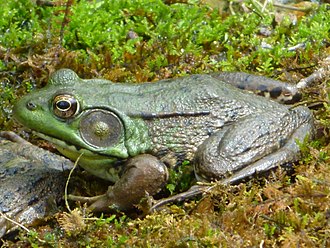
The American bullfrog (Lithobates catesbeianus), often simply known as the bullfrog in Canada and the United States, is a species of large frog in the family Ranidae (true frogs). The species is native to eastern North America. It typically inhabits large permanent water bodies such as swamps, ponds, and lakes. The bullfrog can also be found in manmade habitats such as pools, koi ponds, canals, ditches, reservoirs and culverts. The bullfrog gets its common name from the sound the male makes during the breeding season, which sounds similar to a bull bellowing. It is a generalist carnivore, consuming a wide variety of prey. In turn, it is eaten by predators such as alligators, snakes, and birds.

The bullfrog is large and is commonly eaten by humans throughout its range, especially in the southern United States where it is plentiful. Its use as a food source has led to the bullfrog being introduced outside of its native range. The bullfrog has been introduced in more than 40 countries and many continents including the Western United States, the Caribbean, South America, Western Europe, Belgium, Italy, Spain, Greece, China, Japan, South Korea, Malaysia, Southeast Asia, and more. In these places it is considered an invasive species due to its voracious appetite and the large number of eggs it produces, which has a negative effect on native amphibians, certain insects and other fauna. The bullfrog is very skittish, which can make its capture difficult, and thus it often becomes established.

Other than for food, the bullfrog is also used for dissection in science classes. Albino bullfrogs are sometimes kept as pets, and bullfrog tadpoles are often sold at ponds or fish stores. Wikipedia →

Sounds

Recording0:29

United States · 2025

© lisagpetrie · iNaturalist · CC BY-NC 4.0

Recording0:16

United States · 2025

Alan Weakley · iNaturalist · CC0

Recording0:09

Canada · 2025

© JP Hebert · iNaturalist · CC BY-NC 4.0

Global Distribution

Parks Where Found

# Park Country Daily sighting probability
1 Acadia National Park 🇺🇸 United States
~70%
2 Sequoia and Kings Canyon National Parks 🇺🇸 United States
~20%
3 Shenandoah National Park 🇺🇸 United States
~10%
4 Death Valley National Park 🇺🇸 United States
~10%
5 El Vizcaíno Biosphere Reserve 🇲🇽 Mexico
~10%
6 Big Bend National Park 🇺🇸 United States
~10%
7 Great Smoky Mountains National Park 🇺🇸 United States
~10%
8 Point Pelee National Park 🇨🇦 Canada
~10%
9 Yosemite National Park 🇺🇸 United States
~10%
10 Redwood National Park 🇺🇸 United States
~10%
11 Grand Teton National Park 🇺🇸 United States
~10%
12 Saguaro National Park 🇺🇸 United States
~10%

Cities Where Found

# City Country Daily sighting probability
1 Washington 🇺🇸 United States
~30%
2 Nagoya 🇯🇵 Japan
~30%
3 Chengdu 🇨🇳 China
~30%
4 Osaka 🇯🇵 Japan
~20%
5 Detroit 🇺🇸 United States
~20%
6 Portland 🇺🇸 United States
~20%
7 Houston 🇺🇸 United States
~20%
8 Denver 🇺🇸 United States
~20%
9 Seattle 🇺🇸 United States
~20%
10 Baltimore 🇺🇸 United States
~20%

Zoos & Centres Where Found

# Zoo / Centre Country
1 National Zoological Park 🇺🇸 United States In captivity
2 Bali Zoo 🇮🇩 Indonesia In captivity
3 Ecomuseum Zoo 🇨🇦 Canada In captivity
4 Chengdu Research Base of Giant Panda Breeding 🇨🇳 China In captivity
5 Beijing Wildlife Park 🇨🇳 China In captivity
6 Minnesota Zoo 🇺🇸 United States In captivity
7 Sedgwick County Zoo 🇺🇸 United States In captivity
8 Parque Zoológico de León - Zooleón 🇲🇽 Mexico In captivity
9 Ukumarí Biopark 🇨🇴 Colombia In captivity
10 Night Safari 🇸🇬 Singapore In captivity
11 Oregon Zoo 🇺🇸 United States In captivity
12 Singapore Zoo 🇸🇬 Singapore In captivity
13 Gembira Loka Zoo 🇮🇩 Indonesia In captivity
14 Rio de Janeiro Zoological Garden 🇧🇷 Brazil In captivity
15 Amaru 🇪🇨 Ecuador In captivity
16 River Wonders 🇸🇬 Singapore In captivity
17 Mystic Aquarium & Institute for Exploration 🇺🇸 United States In captivity
18 The Living Planet Aquarium 🇺🇸 United States In captivity
19 Trailside Museum & Zoo 🇺🇸 United States In captivity
20 Vancouver Aquarium 🇨🇦 Canada In captivity
21 Oklahoma Aquarium 🇺🇸 United States In captivity
22 Ralph Perkins II Wildlife Center and Woods Garden 🇺🇸 United States In captivity
23 Ripley's Aquarium of Myrtle Beach 🇺🇸 United States In captivity
24 Acuario Michin Guadalajara 🇲🇽 Mexico In captivity
25 Maritime Aquarium at Norwalk 🇺🇸 United States In captivity
26 Albuquerque Aquarium 🇺🇸 United States In captivity
27 South Carolina Aquarium 🇺🇸 United States In captivity
28 Downtown Aquarium, Houston 🇺🇸 United States In captivity
29 National Aquarium 🇺🇸 United States In captivity
30 Jenkinson's Aquarium 🇺🇸 United States In captivity
31 Schramm Education Center 🇺🇸 United States In captivity
32 Belle Isle Nature Center 🇨🇦 Canada In captivity
33 Medicine Park Aquarium & Natural Sciences Center 🇺🇸 United States In captivity
34 Rio Grande Botanic Garden 🇺🇸 United States In captivity
35 Zooparque Itatiba 🇧🇷 Brazil In captivity

Before you go

What are the chances of seeing an American Bullfrog in Detroit?

Possible

About 20% of wildlife watchers report an American Bullfrog sighting in Detroit on a given day, based on 60 verified sightings from GBIF citizen-science data. It is the 2nd most-seen of the 5 amphibians we can rate there. Over three days the chance rises to about 60%, and over a week to about 90%, if each day is a fresh chance.

When is the best time to see an American Bullfrog in Detroit?

May–June and August–September

In those months about 30% of wildlife watchers report an American Bullfrog in Detroit on a given day, against under 5% in February–March and November–December, the lowest months.

What time of day is best to see an American Bullfrog?

Between 8 and 11 am

Across all the parks we cover, that three-hour window holds the most American Bullfrog sightings with a recorded time, and about 7 in 10 of them come between 6 am and 6 pm: it is seen both by day and at night.

Is Detroit the best place to see an American Bullfrog?

5th of 41

Of the 41 cities where we can rate American Bullfrog sightings, Detroit ranks 5th at about 20%. The best odds are in Washington (United States, about 30%), Nagoya (Japan, about 30%) and Chengdu (China, about 30%).

Which relatives of the American Bullfrog live in Detroit?

Same genus: Lithobates

The closest relatives of the American Bullfrog that you can see in Detroit (genus Lithobates, American Water Frogs) are Green Frog (about 20%) and Northern Leopard Frog (about 10%), with each one's daily chance of a sighting.

Where does the American Bullfrog sighting chance come from?

GBIF citizen-science records

It is estimated from how often the American Bullfrog is recorded against all the amphibians logged in Detroit (60 verified sightings), calibrated against known sighting rates. Figures are rounded to the nearest 10% because citizen-science data supports honest approximations, not decimals, and months with records from fewer than five people show "—". How it works.

← Back to Detroit