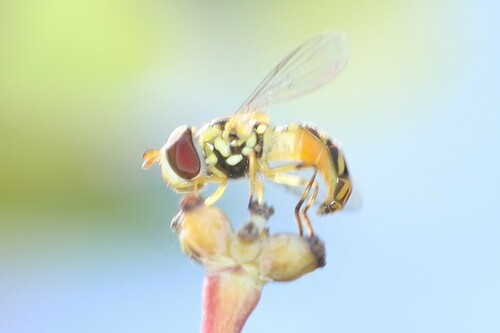
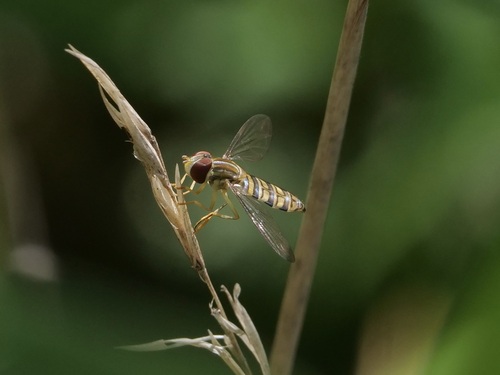
Transverse-Banded Flower Fly

Transverse-Banded Flower Fly

Eristalis transversa

Daily sighting probability ~10% · With luck
at Detroit

In 3 days ~30% in a week ~50%

32 Verified sightings at Detroit
169 In all 4 parks From 2019 to 2026
September Best month
☀️ Diurnal When it's spotted

About the Transverse-Banded Flower Fly

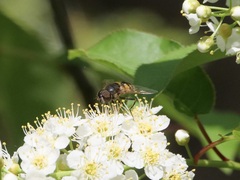
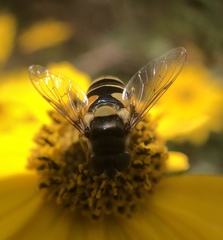
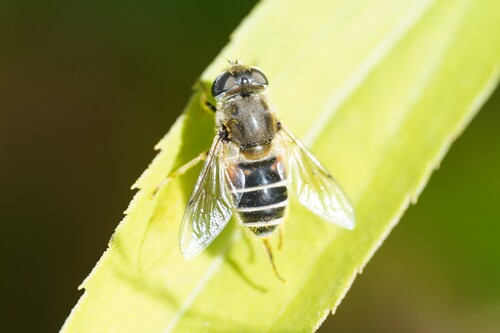
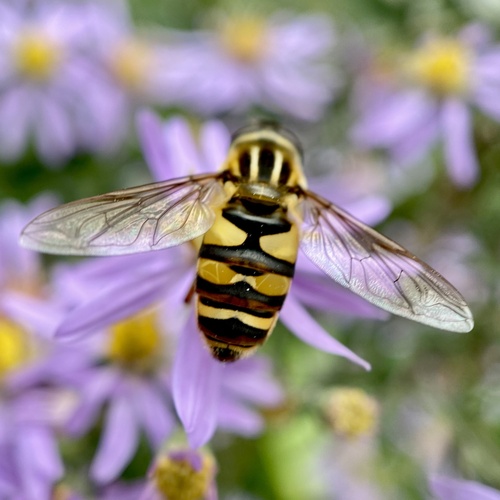
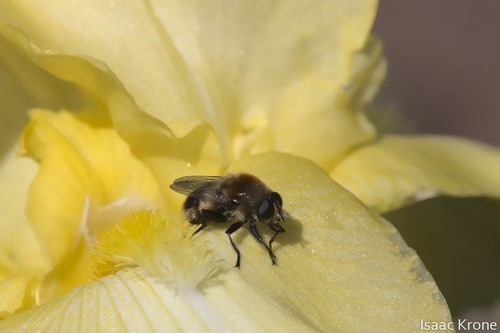
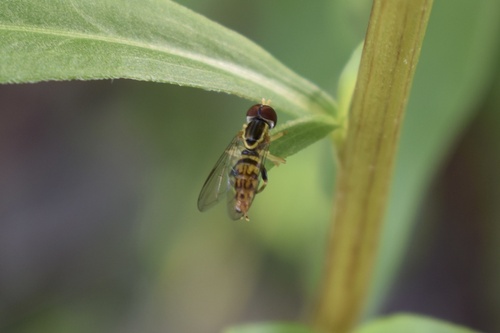
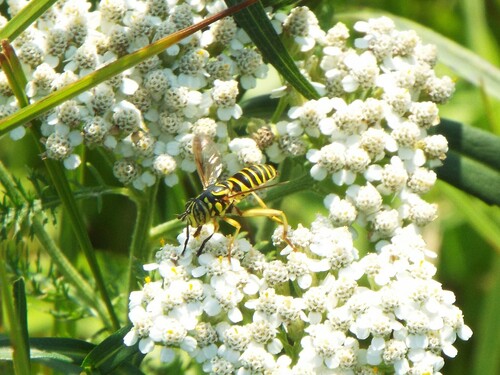
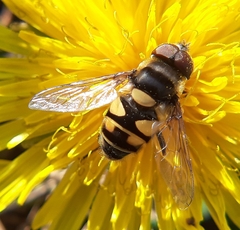
Eristalis transversa, the transverse banded drone fly, is a common species of hoverfly first officially described by Wiedemann in 1830. Hoverflies get their names from the ability to remain nearly motionless while in flight. The adults are also known as flower flies for they are commonly found around and on flowers, from which they get both energy-giving nectar and protein-rich pollen. The larvae are rat-tailed type but larvae of this specific species has not been reported.

external map Species reported from North America east of the Mississippi River and into Southeastern Canada. For terms see Morphology of Diptera. external images Size 7–12 mm (0.28–0.47 in) Head The eyes are pilose on upper half and broadly contiguous in the male. The front is black, shining in the middle, black pile on the sides. The female also with black pile, narrowed above but on the lower two-thirds reddish pollinose. The antennae are reddish yellow. The basal portion of arista sparsely plumose. The sides of the face covered with dense whitish pollen and whitish pile, the median stripe (tubercle) and cheeks are shining black.

Thorax The notum is opaque black, with three... Wikipedia →

Global Distribution

Parks Where Found

# Park Country Daily sighting probability
1 Acadia National Park 🇺🇸 United States
~20%
2 Point Pelee National Park 🇨🇦 Canada
~10%
3 Shenandoah National Park 🇺🇸 United States
~10%
4 Great Smoky Mountains National Park 🇺🇸 United States
~10%

Cities Where Found

# City Country Daily sighting probability
1 Boston 🇺🇸 United States
~10%
2 Minneapolis [Saint Paul] 🇺🇸 United States
~10%
3 Toronto 🇨🇦 Canada
~10%
4 New York City 🇺🇸 United States
~10%
5 Washington 🇺🇸 United States
~10%
6 Detroit 🇺🇸 United States
~10%
7 Philadelphia 🇺🇸 United States
~10%
8 Chicago 🇺🇸 United States
~10%
9 Montreal 🇨🇦 Canada
~10%
10 Baltimore 🇺🇸 United States
~10%

Before you go

What are the chances of seeing a Transverse-Banded Flower Fly in Detroit?

With luck

About 10% of wildlife watchers report a Transverse-Banded Flower Fly sighting in Detroit on a given day, based on 32 verified sightings from GBIF citizen-science data. It is the 66th most-seen of the 268 insects we can rate there. Over three days the chance rises to about 30%, and over a week to about 50%, if each day is a fresh chance.

When is the best time to see a Transverse-Banded Flower Fly in Detroit?

May to September

In those months about 10% of wildlife watchers report a Transverse-Banded Flower Fly in Detroit on a given day, against under 5% in October to April, the lowest months.

What time of day is best to see a Transverse-Banded Flower Fly?

Between 11 am and 2 pm

Across all the parks we cover, that three-hour window holds the most Transverse-Banded Flower Fly sightings with a recorded time, and nearly all of them come between 6 am and 6 pm: it is a daytime animal.

Is Detroit the best place to see a Transverse-Banded Flower Fly?

Among the best

Of the 11 cities where we can rate Transverse-Banded Flower Fly sightings, Detroit ranks 6th at about 10%, level with the leaders once rounded. The best odds are in Boston (United States, about 10%), Minneapolis [Saint Paul] (United States, about 10%) and Toronto (Canada, about 10%).

Which relatives of the Transverse-Banded Flower Fly live in Detroit?

Same genus: Eristalis

The closest relatives of the Transverse-Banded Flower Fly that you can see in Detroit (genus Eristalis, Drone Flies) are Eurasian Drone Fly (about 10%) and Common Drone Fly (about 10%), with each one's daily chance of a sighting.

Where does the Transverse-Banded Flower Fly sighting chance come from?

GBIF citizen-science records

It is estimated from how often the Transverse-Banded Flower Fly is recorded against all the insects logged in Detroit (32 verified sightings), calibrated against known sighting rates. Figures are rounded to the nearest 10% because citizen-science data supports honest approximations, not decimals, and months with records from fewer than five people show "—". How it works.
← Back to Detroit