White-browed Wagtail

White-browed Wagtail

Motacilla maderaspatensis

Silhouette: Martin Bulla, based on Ren Hathway's illustration · PhyloPic

LCLeast ConcernNTVUENCR
Daily sighting probability ~10% · With luck
at Durg

In 3 days ~20% in a week ~50%

9 Verified sightings at Durg
6,074 In all 16 parks From 2019 to 2026
April Best month
☀️ Diurnal When it's spotted

About the White-browed Wagtail

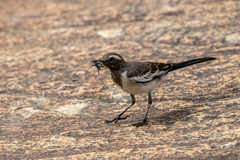
The white-browed wagtail or large pied wagtail (Motacilla maderaspatensis) is a medium-sized bird and is the largest member of the wagtail family. They are conspicuously patterned with black above and white below, a prominent white brow, shoulder stripe and outer tail feathers. White-browed wagtails are native to the Indian subcontinent, common near small water bodies and have adapted to urban environments where they often nest on roof tops. The specific name is derived from the Indian city of Madras (now Chennai).

The white-browed wagtail was formally described in 1789 by the German naturalist Johann Friedrich Gmelin in his revised and expanded edition of Carl Linnaeus's Systema Naturae. He placed it with the wagtails in the genus Motacilla and coined the binomial name Motacilla maderaspatensis. The specific epithet is Modern Latin for the locality, Madras (or Madraspattanam and now Chennai) in southern India. Gmelin's account was based on the "black and white wagtail" that had been described and illustrated in 1713 by the English naturalist John Ray. The species is monotypic: no subspecies are recognised.

The white-browed wagtail is the largest species... Wikipedia →

Sounds

Call0:07

India · 2019

© Sandip das · XC633431 · CC BY-NC-SA 4.0

Duet0:37

India · 2020

© Sreekumar Chirukandoth · XC590564 · CC BY-NC-SA 4.0

Song0:40

India · 2011

© Rajgopal Patil · XC575105 · CC BY-NC-SA 4.0

Global Distribution

Parks Where Found

# Park Country Daily sighting probability
1 Chitwan National Park 🇳🇵 Nepal
~50%
2 Mudumalai National Park 🇮🇳 India
~40%
3 Bandipur National Park 🇮🇳 India
~40%
4 Royal Bardia National Park 🇳🇵 Nepal
~40%
5 Nagarhole National Park 🇮🇳 India
~40%
6 Jim Corbett National Park 🇮🇳 India
~30%
7 Satpura National Park 🇮🇳 India
~30%
8 Eravikulam National Park 🇮🇳 India
~30%
9 Ranthambore National Park 🇮🇳 India
~30%
10 Periyar National Park 🇮🇳 India
~20%
11 Gir National Park 🇮🇳 India
~20%
12 Keoladeo National Park 🇮🇳 India
~10%
13 Kanha National Park 🇮🇳 India
~10%
14 Bandhavgarh National Park 🇮🇳 India
~10%
15 Royal Manas National Park 🇧🇹 Bhutan
<5%
16 Manas National Park 🇮🇳 India
<5%

Cities Where Found

# City Country Daily sighting probability
1 Bengaluru 🇮🇳 India
~40%
2 Hajipur 🇮🇳 India
~40%
3 Vijayawada 🇮🇳 India
~30%
4 Hyderabad 🇮🇳 India
~30%
5 Coimbatore 🇮🇳 India
~30%
6 Tiruchirappalli 🇮🇳 India
~30%
7 Lucknow 🇮🇳 India
~30%
8 Patna 🇮🇳 India
~30%
9 Islamabad 🇵🇰 Pakistan
~20%
10 Jamshedpur 🇮🇳 India
~20%

Before you go

What are the chances of seeing a White-browed Wagtail in Durg?

With luck

About 10% of wildlife watchers report a White-browed Wagtail sighting in Durg on a given day, based on 9 verified sightings from GBIF citizen-science data. It is the 61st most-seen of the 77 birds we can rate there. Over three days the chance rises to about 20%, and over a week to about 50%, if each day is a fresh chance.

When is the best time to see a White-browed Wagtail in Durg?

April

In that month about 30% of wildlife watchers report a White-browed Wagtail in Durg on a given day, against under 5% in June–July and December, the lowest months. That is one of Durg's driest months, with about 20 mm of rain against 380 mm in July. August has too few records to rate.

What time of day is best to see a White-browed Wagtail?

Between 7 and 10 am

Across all the parks we cover, that three-hour window holds the most White-browed Wagtail sightings with a recorded time, and about 9 in 10 of them come between 6 am and 6 pm: it is a daytime animal.

Is Durg the best place to see a White-browed Wagtail?

33rd of 60

Of the 60 cities where we can rate White-browed Wagtail sightings, Durg ranks 33rd at about 10%. The best odds are in Bengaluru (India, about 40%), Hajipur (India, about 40%) and Vijayawada (India, about 30%).

Where does the White-browed Wagtail sighting chance come from?

GBIF citizen-science records

It is estimated from how often the White-browed Wagtail is recorded against all the birds logged in Durg (9 verified sightings), calibrated against known sighting rates. Figures are rounded to the nearest 10% because citizen-science data supports honest approximations, not decimals, and months with records from fewer than five people show "—". How it works.

← Back to Durg