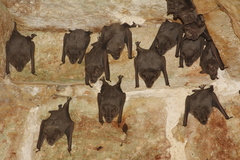
Jamaican Fruit-eating Bat

Jamaican Fruit-eating Bat

Artibeus jamaicensis

Silhouette: Jorge D. Carballo-Morales, based on a photo by Mario Barroso · PhyloPic

LCLeast ConcernNTVUENCR
Daily sighting probability ~10% · With luck
at Guatemala City

In 3 days ~20% in a week ~50%

7 Verified sightings at Guatemala City
80 In all 7 parks From 2019 to 2026
November Best month
☀️🌙 Day & Night When it's spotted

About the Jamaican Fruit-eating Bat

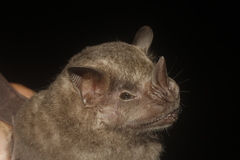
The Jamaican fruit bat (Artibeus jamaicensis) is a frugivorous bat species native to the Neotropics. The Jamaican fruit bat is a medium-sized bat, having a total length of 78–89 mm (3.1–3.5 in) with a 96–150 mm (3.8–5.9 in) wingspan and weighing 40 to 60 g (1.4 to 2.1 oz). It has broad but pointed and ridged ears with a serrated tragus. Its prominent noseleaf has an array of sebaceous glands. The lower lip is littered with warts with a relatively large one in the center. Sebaceous holocrine glands can be found in both lips. On the back the fur is an ashy-shade of gray or brown with visible white hair bases and variable fur patterning on the face. The wings of the fruit bat are broad and dark gray in color. The underfur is paler in color. The fruit bat has no external tail. It has broad dark grey wings and a narrow hairless interfemoral membrane with a short calcar. The distinctive features of the Jamaican fruit bat (which however are shared by some of its relatives) include the absence of an external tail and a minimal, U-shaped interfemoral membrane.

A transcriptome dataset is available with more than 25,000 annotated transcripts that are directly searchable by... Wikipedia →

Sounds

Recording0:10

Mexico · 2019

© Thomas Brooks · iNaturalist · CC BY-NC-SA 4.0

Global Distribution

Parks Where Found

# Park Country Daily sighting probability
1 Main Ridge Forest Reserve 🇹🇹 Trinidad and Tobago
~20%
2 Bastimentos Island National Marine Park 🇵🇦 Panama
~20%
3 Calakmul Biosphere Reserve 🇲🇽 Mexico
~10%
4 La Amistad International Park (Panama) 🇵🇦 Panama
~10%
5 Soberanía National Park 🇵🇦 Panama
~10%
6 Monteverde Cloud Forest Reserve 🇨🇷 Costa Rica
~10%
7 Parque Natural Metropolitano 🇵🇦 Panama
<5%

Cities Where Found

# City Country Daily sighting probability
1 Santo Domingo 🇩🇴 Dominican Republic
~20%
2 Guatemala City 🇬🇹 Guatemala
~10%
3 Guadalajara 🇲🇽 México
<5%

Zoos & Centres Where Found

# Zoo / Centre Country
1 Edmonton Valley Zoo 🇨🇦 Canada In captivity
2 Mesker Park Zoo and Botanic Garden 🇺🇸 United States In captivity
3 Pittsburgh Zoo & Aquarium 🇺🇸 United States In captivity
4 Vancouver Aquarium 🇨🇦 Canada In captivity
5 Montreal Biodome 🇨🇦 Canada In captivity

Before you go

What are the chances of seeing a Jamaican Fruit-eating Bat in Guatemala City?

With luck

About 10% of wildlife watchers report a Jamaican Fruit-eating Bat sighting in Guatemala City on a given day, based on 7 verified sightings from GBIF citizen-science data. It is the 7th most-seen of the 7 mammals we can rate there. Over three days the chance rises to about 20%, and over a week to about 50%, if each day is a fresh chance.

When is the best time to see a Jamaican Fruit-eating Bat in Guatemala City?

November

In that month about 30% of wildlife watchers report a Jamaican Fruit-eating Bat in Guatemala City on a given day, against under 5% in June, August–October and December–March, the lowest months. That is one of Guatemala City's driest months, with about 45 mm of rain against 240 mm in September.

What time of day is best to see a Jamaican Fruit-eating Bat?

Between 6 and 9 pm

Across all the parks we cover, that three-hour window holds the most Jamaican Fruit-eating Bat sightings with a recorded time, and about 6 in 10 of them come between 6 am and 6 pm: it is seen both by day and at night.

Is Guatemala City the best place to see a Jamaican Fruit-eating Bat?

2nd of 3

Of the 3 cities where we can rate Jamaican Fruit-eating Bat sightings, Guatemala City ranks 2nd at about 10%. The best odds are in Santo Domingo (Dominican Republic, about 20%).

Where does the Jamaican Fruit-eating Bat sighting chance come from?

GBIF citizen-science records

It is estimated from how often the Jamaican Fruit-eating Bat is recorded against all the mammals logged in Guatemala City (7 verified sightings), calibrated against known sighting rates. Figures are rounded to the nearest 10% because citizen-science data supports honest approximations, not decimals, and months with records from fewer than five people show "—". How it works.

← Back to Guatemala City