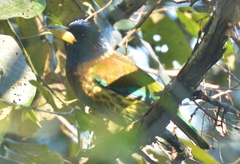
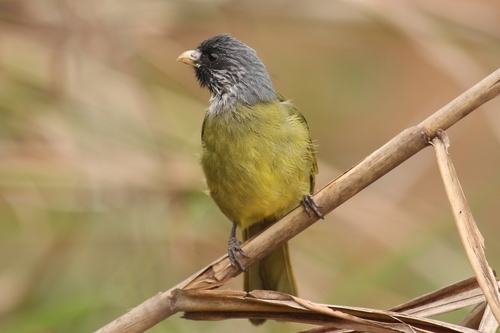
Great Barbet

Great Barbet

Psilopogon virens

Silhouette: Vijay Cavale (photo), John E. McCormack, Michael G. Harvey, Brant C. Faircloth, Nicholas G. Crawford, Travis C. Glenn, Robb T. Brumfield & T. Michael Keesey · PhyloPic

LCLeast ConcernNTVUENCR
Daily sighting probability ~30% · Possible
at Guiyang

In 3 days ~60% in a week ~90%

21 Verified sightings at Guiyang
2,971 In all 8 parks From 2019 to 2026
April Best month
🌅 Crepuscular When it's spotted

About the Great Barbet

The great barbet (Psilopogon virens) is an Asian barbet native to the Indian sub-continent and Southeast Asia, where it inhabits forests up to 3,000 m (9,800 ft) altitude. It has been listed as Least Concern on the IUCN Red List since 2004 because of its wide distribution.

Bucco virens was the scientific name proposed by Pieter Boddaert in 1783 for a great barbet that had been described by Georges-Louis Leclerc, Comte de Buffon in 1781 based on a specimen collected in China. It was illustrated in a hand-coloured plate engraved by François-Nicolas Martinet.

It was placed in the genus Megalaima proposed by George Robert Gray in 1842 who suggested to use this name instead of Bucco. In the 19th and 20th centuries, the following great barbet zoological specimens were described:

Megalaema marshallorum proposed by Robert Swinhoe in 1870 was based on a great barbet from the Himalayas. Megalaima virens magnifica proposed by E. C. Stuart Baker in 1926 was a male barbet from Machi, Manipur. Megalaima virens clamator proposed by Ernst Mayr in 1941 was a bird collected in northern Myanmar.

Molecular phylogenetic research of barbets revealed that the birds in the genus Megalaima... Wikipedia →

Sounds

Duet0:16

China · 2026

© Stephen Matthews · XC1087013 · CC BY-NC-SA 4.0

Song0:10

China · 2025

© Feather V · XC992118 · CC BY-NC-SA 4.0

Call0:16

China · 2020

© Geoff Carey · XC881687 · CC BY-NC-SA 4.0

Global Distribution

Parks Where Found

# Park Country Daily sighting probability
1 Royal Manas National Park 🇧🇹 Bhutan
~50%
2 Namdapha National Park 🇮🇳 India
~40%
3 Doi Inthanon National Park 🇹🇭 Thailand
~20%
4 Langtang National Park 🇳🇵 Nepal
~10%
5 Jim Corbett National Park 🇮🇳 India
~10%
6 Kaeng Krachan National Park 🇹🇭 Thailand
~10%
7 Manas National Park 🇮🇳 India
~10%
8 Chitwan National Park 🇳🇵 Nepal
<5%

Cities Where Found

# City Country Daily sighting probability
1 Guiyang 🇨🇳 China
~30%
2 Kathmandu 🇳🇵 Nepal
~20%
3 Guangzhou 🇨🇳 China
~20%
4 Nanjing 🇨🇳 China
~10%
5 Hangzhou 🇨🇳 China
<5%
6 Dehradun 🇮🇳 India
<5%
7 Hong Kong 🇨🇳 China
<5%
8 Tuen Mun 🇨🇳 China
<5%
9 Islamabad 🇵🇰 Pakistan
<5%
10 Guwahati 🇮🇳 India
<5%

Before you go

What are the chances of seeing a Great Barbet in Guiyang?

Possible

About 30% of wildlife watchers report a Great Barbet sighting in Guiyang on a given day, based on 21 verified sightings from GBIF citizen-science data. It is the 31st most-seen of the 79 birds we can rate there. Over three days the chance rises to about 60%, and over a week to about 90%, if each day is a fresh chance.

When is the best time to see a Great Barbet in Guiyang?

April and September–October

In those months about 40% of wildlife watchers report a Great Barbet in Guiyang on a given day, against about 20% in May, July–August and December–January, the lowest months. February has too few records to rate.

What time of day is best to see a Great Barbet?

Between 3 and 6 am

Across all the parks we cover, that three-hour window holds the most Great Barbet sightings with a recorded time, and about 6 in 10 of them come between 6 am and 6 pm: it is most active around dawn and dusk.

Is Guiyang the best place to see a Great Barbet?

Yes

Of the 10 cities where we can rate Great Barbet sightings, Guiyang has the highest daily chance: about 30%. Next come Kathmandu (Nepal, about 20%) and Guangzhou (China, about 20%).

Where does the Great Barbet sighting chance come from?

GBIF citizen-science records

It is estimated from how often the Great Barbet is recorded against all the birds logged in Guiyang (21 verified sightings), calibrated against known sighting rates. Figures are rounded to the nearest 10% because citizen-science data supports honest approximations, not decimals, and months with records from fewer than five people show "—". How it works.

← Back to Guiyang