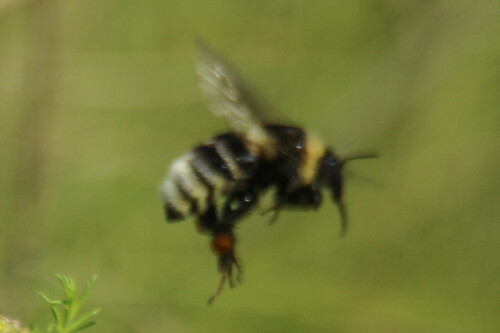
European Woolcarder Bee

European Woolcarder Bee

Anthidium manicatum

Daily sighting probability ~10% · With luck
at Helsinki

In 3 days ~20% in a week ~30%

23 Verified sightings at Helsinki
87 In all 7 parks From 2019 to 2026
July Best month
☀️ Diurnal When it's spotted

About the European Woolcarder Bee

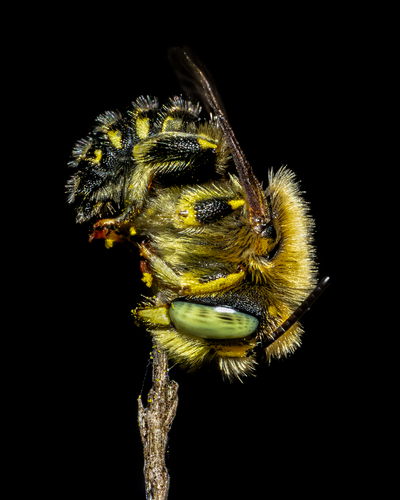
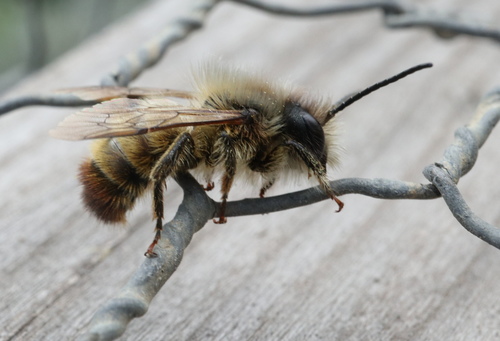
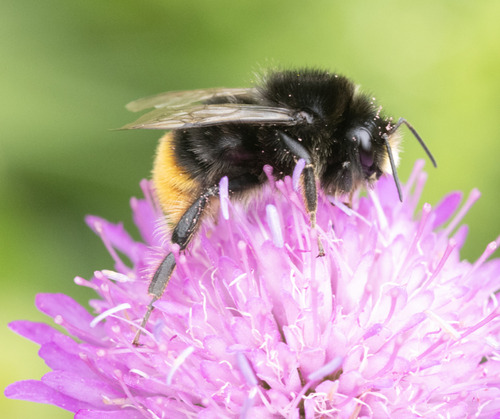
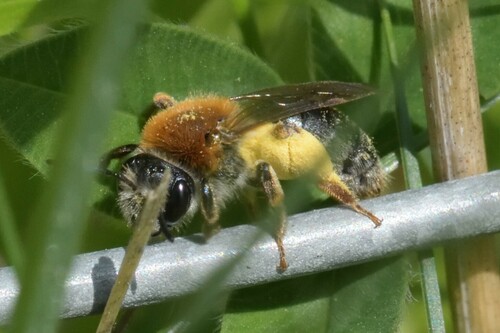
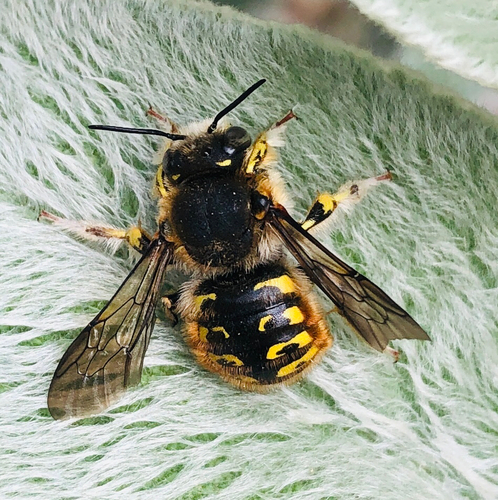
Anthidium manicatum, commonly called the European wool carder bee, is a species of bee in the family Megachilidae, the leaf-cutter bees and mason bees. They get the name "carder" from their behaviour of scraping hair from leaves such as lamb's ears (Stachys byzantina), similar to the way textile workers card fibers. They carry this hair bundled beneath their bodies to be used as a nest lining. Like other members of the tribe Anthidiini, these bees do not cut leaves or petals as is typical for megachilids. The males engage in territorial behaviour, aggressively chasing other males and pollinators from their territory.

This bee is native to Europe, Asia, and North Africa. It was accidentally introduced into North America from Europe some time in the mid-20th century, first seen in 1963 near Ithaca, New York, and has become an invasive pest. It is now also found in regions of South America, New Zealand, and the Canary Islands. They are generalists, and do not seem to prefer any plant genera for foraging, although in New Zealand, native plants are visited less frequently.

This bee is in the Anthidium genus, known as the carder bees or potter bees, and consisting... Wikipedia →
Global Distribution

Parks Where Found

# Park Country Daily sighting probability
1 Bavarian Forest National Park 🇩🇪 Germany
~10%
2 Acadia National Park 🇺🇸 United States
~10%
3 Great Bear Rainforest 🇨🇦 Canada
~10%
4 Cévennes National Park 🇫🇷 France
<5%
5 Pyrénées National Park 🇫🇷 France
<5%
6 Olympic National Park 🇺🇸 United States
<5%
7 Wadden Sea National Park 🇩🇪 Germany
<5%

Cities Where Found

# City Country Daily sighting probability
1 Warsaw 🇵🇱 Poland
~20%
2 Sacramento 🇺🇸 United States
~20%
3 Santiago 🇨🇱 Chile
~20%
4 Boston 🇺🇸 United States
~10%
5 Salt Lake City 🇺🇸 United States
~10%
6 Auckland 🇳🇿 New Zealand
~10%
7 Munich 🇩🇪 Germany
~10%
8 Portland 🇺🇸 United States
~10%
9 Denver 🇺🇸 United States
~10%
10 Philadelphia 🇺🇸 United States
~10%

Before you go

What are the chances of seeing a European Woolcarder Bee in Helsinki?

With luck

About 10% of wildlife watchers report a European Woolcarder Bee sighting in Helsinki on a given day, based on 23 verified sightings from GBIF citizen-science data. It is the 251st most-seen of the 838 insects we can rate there. Over three days the chance rises to about 20%, and over a week to about 30%, if each day is a fresh chance.

When is the best time to see a European Woolcarder Bee in Helsinki?

June to August

In those months about 10% of wildlife watchers report a European Woolcarder Bee in Helsinki on a given day, against under 5% in September to May, the lowest months.

What time of day is best to see a European Woolcarder Bee?

Between 1 and 4 pm

Across all the parks we cover, that three-hour window holds the most European Woolcarder Bee sightings with a recorded time, and about 8 in 10 of them come between 6 am and 6 pm: it is a daytime animal.

Is Helsinki the best place to see a European Woolcarder Bee?

26th of 42

Of the 42 cities where we can rate European Woolcarder Bee sightings, Helsinki ranks 26th at about 10%. The best odds are in Warsaw (Poland, about 20%), Sacramento (United States, about 20%) and Santiago (Chile, about 20%).

Where does the European Woolcarder Bee sighting chance come from?

GBIF citizen-science records

It is estimated from how often the European Woolcarder Bee is recorded against all the insects logged in Helsinki (23 verified sightings), calibrated against known sighting rates. Figures are rounded to the nearest 10% because citizen-science data supports honest approximations, not decimals, and months with records from fewer than five people show "—". How it works.

← Back to Helsinki