Square-Spot Rustic

Square-Spot Rustic

Xestia xanthographa

Daily sighting probability ~10% · With luck
at Helsinki

In 3 days ~20% in a week ~40%

27 Verified sightings at Helsinki
222 In all 7 parks From 2019 to 2026
August Best month
🌅 Crepuscular When it's spotted

About the Square-Spot Rustic

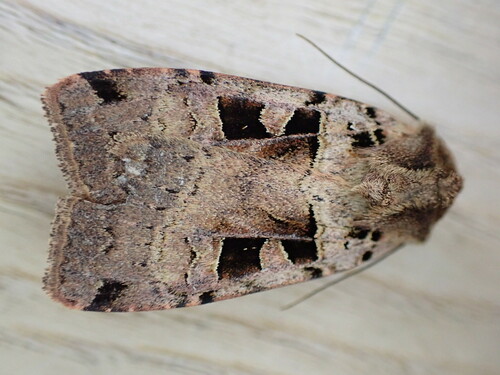
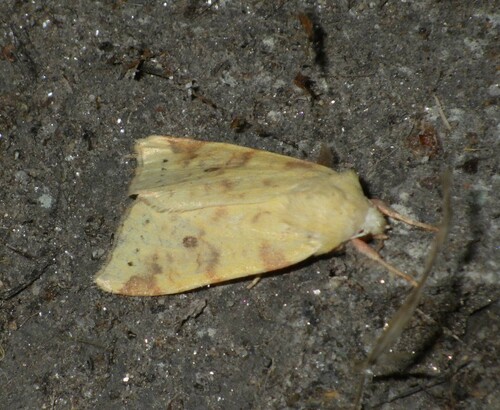
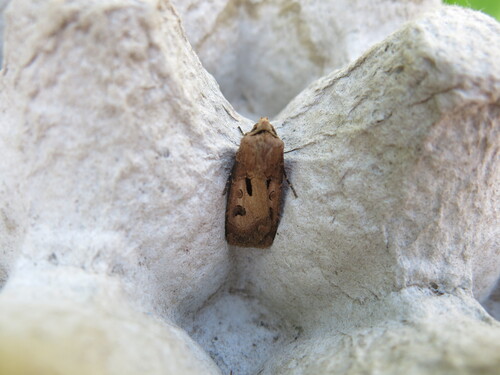
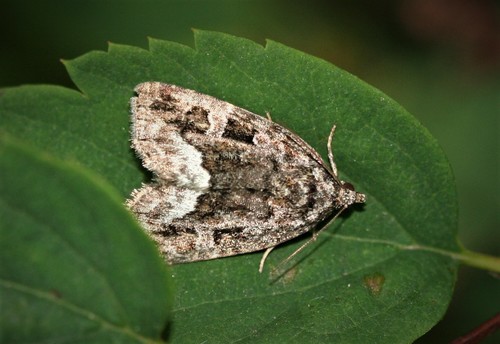
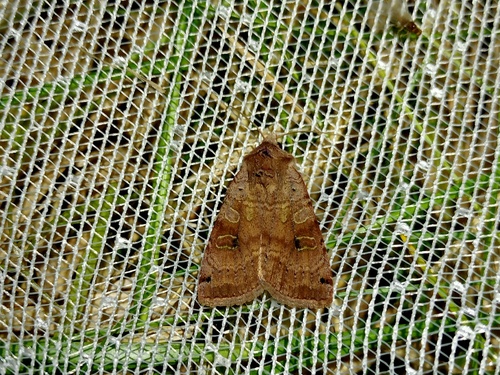
The square-spot rustic (Xestia xanthographa) is a moth of the family Noctuidae. It is found in Europe, North Africa and east across the Palearctic (excluding China) and in North America. The species is quite variable in appearance, the forewings occurring in various shades of grey or brown, with melanic forms common in parts of its range. The best identifying feature is the large, pale, squarish stigma which gives the species its common name. The hindwings are pale to dark grey with a whitish fringe. The wingspan is 30–40 mm.

Forewing dull brown; the upper stigmata with pale annuli, the reniform sometimes wholly pale, the orbicular round; claviform absent; hindwing ochreous white, suffused with fuscous towards termen only in male, more broadly in female; in ab. budensis Frr. the ground colour is grey; in ab. elutior Alph. the forewings are more brightly coloured, being cinnamon brown or yellowish grey; and in ab. palaestinensis Kalchb. [Now full species Xestia palaestinensis (Kalchberg, 1897)], while the ground colour is paler, all the markings are more distinct. – ab. obscura Tutt and ab. nigra Tutt represent the reddish black and greyish... Wikipedia →
Global Distribution

Parks Where Found

# Park Country Daily sighting probability
1 Snowdonia National Park 🇬🇧 United Kingdom
~10%
2 Cairngorms National Park 🇬🇧 United Kingdom
~10%
3 Wadden Sea National Park 🇩🇪 Germany
~10%
4 Pyrénées National Park 🇫🇷 France
~10%
5 Sierra de Guadarrama National Park 🇪🇸 Spain
~10%
6 Bavarian Forest National Park 🇩🇪 Germany
~10%
7 Cévennes National Park 🇫🇷 France
<5%

Cities Where Found

# City Country Daily sighting probability
1 Liverpool 🇬🇧 United Kingdom
~40%
2 London 🇬🇧 United Kingdom
~20%
3 Manchester 🇬🇧 United Kingdom
~20%
4 Birmingham 🇬🇧 United Kingdom
~20%
5 Dublin 🇮🇪 Ireland
~10%
6 Leeds 🇬🇧 United Kingdom
~10%
7 Porto 🇵🇹 Portugal
~10%
8 Helsinki 🇫🇮 Finland
~10%
9 Paris 🇫🇷 France
~10%
10 Lyon 🇫🇷 France
~10%

Before you go

What are the chances of seeing a Square-Spot Rustic in Helsinki?

With luck

About 10% of wildlife watchers report a Square-Spot Rustic sighting in Helsinki on a given day, based on 27 verified sightings from GBIF citizen-science data. It is the 223rd most-seen of the 838 insects we can rate there. Over three days the chance rises to about 20%, and over a week to about 40%, if each day is a fresh chance.

When is the best time to see a Square-Spot Rustic in Helsinki?

August

In that month about 20% of wildlife watchers report a Square-Spot Rustic in Helsinki on a given day, against under 5% in October to July, the lowest months.

What time of day is best to see a Square-Spot Rustic?

Between 7 and 10 am

Across all the parks we cover, that three-hour window holds the most Square-Spot Rustic sightings with a recorded time, and about 6 in 10 of them come between 6 am and 6 pm: it is most active around dawn and dusk.

Is Helsinki the best place to see a Square-Spot Rustic?

8th of 22

Of the 22 cities where we can rate Square-Spot Rustic sightings, Helsinki ranks 8th at about 10%. The best odds are in Liverpool (United Kingdom, about 40%), London (United Kingdom, about 20%) and Manchester (United Kingdom, about 20%).

Which relatives of the Square-Spot Rustic live in Helsinki?

Same genus: Xestia

The closest relatives of the Square-Spot Rustic that you can see in Helsinki (genus Xestia) are Dotted Clay (about 10%), Double Square-Spot (about 10%) and Setaceous Hebrew Character (about 10%), with each one's daily chance of a sighting.

Where does the Square-Spot Rustic sighting chance come from?

GBIF citizen-science records

It is estimated from how often the Square-Spot Rustic is recorded against all the insects logged in Helsinki (27 verified sightings), calibrated against known sighting rates. Figures are rounded to the nearest 10% because citizen-science data supports honest approximations, not decimals, and months with records from fewer than five people show "—". How it works.

← Back to Helsinki