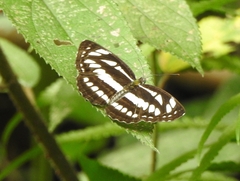
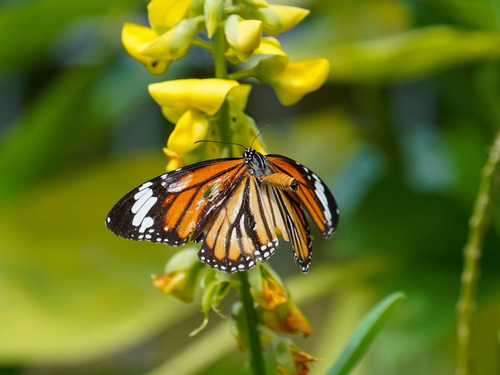
Common Sailer
Daily sighting probability ~30% · Possible
at Jabalpur

In 3 days ~70% in a week ~90%

14 Verified sightings at Jabalpur
84 In all 10 parks From 2019 to 2026
February Best month
☀️ Diurnal When it's spotted

About the Common Sailer

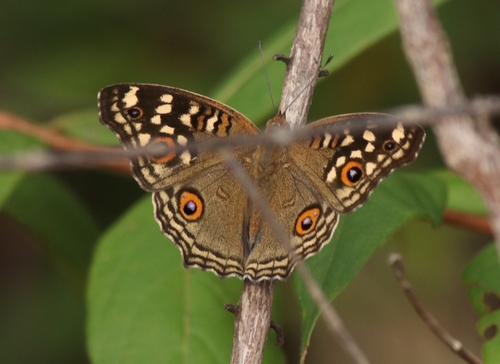
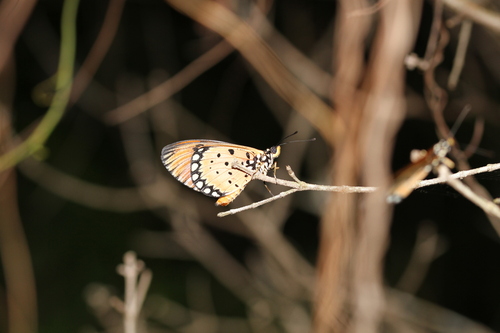
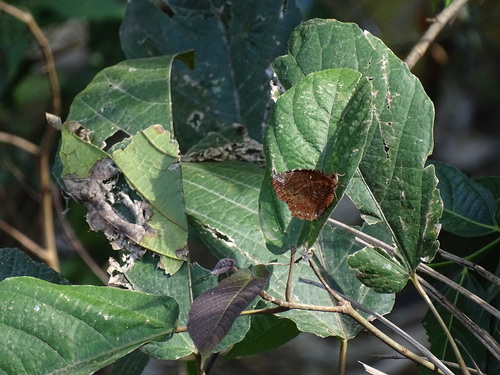
Neptis hylas, the common sailor, is a species of nymphalid butterfly found in the Indian subcontinent and southeast Asia. It has a characteristic stiff gliding flight achieved by short and shallow wingbeats just above the horizontal. It is also present in Italy in a humid limited zone near Gorizia and Slovenia.

Bengali name: চরবাতাসি Dry-season form - Upperside black, with pure white markings. Forewing discoidal streak clavate (club shaped), apically truncate, subapically either notched or sometimes indistinctly divided; triangular spot beyond broad, well defined, acute at apex, but not elongate; discal series of spots separate, not connate (united), each about twice as long as broad; postdiscal transverse series of small spots incomplete, but some are always present. Hindwing: subbasal band of even or nearly oven width; discal and subterminal pale lines obscure; postdiscal series of spots well separated, quadrate or subquadrate, very seldom narrow. Underside from pale golden ochraceous to dark ochraceous almost chocolate; white markings as on the upperside, but broader and defined in black. Forewing: interspaces 1a and 1 from base to near the apex shaded with black... Wikipedia →
Global Distribution

Parks Where Found

# Park Country Daily sighting probability
1 Kanha National Park 🇮🇳 India
~30%
2 Bandhavgarh National Park 🇮🇳 India
~30%
3 Periyar National Park 🇮🇳 India
~30%
4 Udawalawe National Park 🇱🇰 Sri Lanka
~20%
5 Nagarhole National Park 🇮🇳 India
~20%
6 Minneriya National Park 🇱🇰 Sri Lanka
~20%
7 Sinharaja Forest Reserve 🇱🇰 Sri Lanka
~10%
8 Cat Tien National Park 🇻🇳 Vietnam
~10%
9 Khao Yai National Park 🇹🇭 Thailand
~10%
10 Kaeng Krachan National Park 🇹🇭 Thailand
~10%

Cities Where Found

# City Country Daily sighting probability
1 Salem 🇮🇳 India
~30%
2 Jabalpur 🇮🇳 India
~30%
3 Jamshedpur 🇮🇳 India
~30%
4 Tuen Mun 🇨🇳 China
~30%
5 Visakhapatnam 🇮🇳 India
~20%
6 Naha 🇯🇵 Japan
~20%
7 Kozhikode 🇮🇳 India
~20%
8 Kalyan-Dombivli 🇮🇳 India
~20%
9 Ponnani 🇮🇳 India
~20%
10 Yogyakarta 🇮🇩 Indonesia
~20%

Before you go

What are the chances of seeing a Common Sailer in Jabalpur?

Possible

About 30% of wildlife watchers report a Common Sailer sighting in Jabalpur on a given day, based on 14 verified sightings from GBIF citizen-science data. It is the 24th most-seen of the 88 insects we can rate there. Over three days the chance rises to about 70%, and over a week to about 90%, if each day is a fresh chance.

When is the best time to see a Common Sailer in Jabalpur?

January–February and October

In those months about 50% of wildlife watchers report a Common Sailer in Jabalpur on a given day, against under 5% in March and May–August, the lowest months. Those are among Jabalpur's driest months, with about 25 mm of rain a month against 410 mm in July.

What time of day is best to see a Common Sailer?

Between 10 am and 1 pm

Across all the parks we cover, that three-hour window holds the most Common Sailer sightings with a recorded time, and about 9 in 10 of them come between 6 am and 6 pm: it is a daytime animal.

Is Jabalpur the best place to see a Common Sailer?

Among the best

Of the 35 cities where we can rate Common Sailer sightings, Jabalpur ranks 2nd at about 30%, level with the leaders once rounded. The best odds are in Salem (India, about 30%).

Which relatives of the Common Sailer live in Jabalpur?

Same family: Nymphalidae

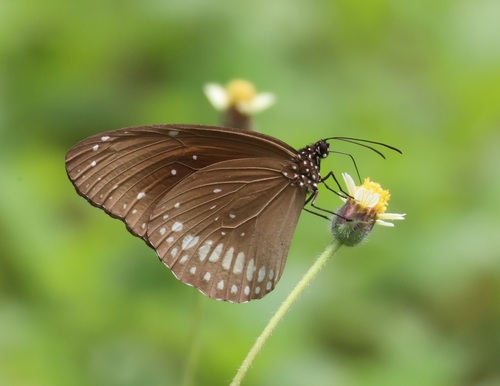
The closest relatives of the Common Sailer that you can see in Jabalpur (family Nymphalidae, Brush-footed Butterflies) are Great Eggfly (about 40%), Plain Tiger Butterfly (about 40%) and Common Crow (about 40%), with each one's daily chance of a sighting.

Where does the Common Sailer sighting chance come from?

GBIF citizen-science records

It is estimated from how often the Common Sailer is recorded against all the insects logged in Jabalpur (14 verified sightings), calibrated against known sighting rates. Figures are rounded to the nearest 10% because citizen-science data supports honest approximations, not decimals, and months with records from fewer than five people show "—". How it works.

← Back to Jabalpur