


Blue-Eyed Ensign Wasp

Blue-Eyed Ensign Wasp

Evania appendigaster

Daily sighting probability ~10% · With luck
at Jerusalem

In 3 days ~30% in a week ~60%

7 Verified sightings at Jerusalem
63 In all 6 parks From 2019 to 2026
August Best month
☀️ Diurnal When it's spotted

About the Blue-Eyed Ensign Wasp

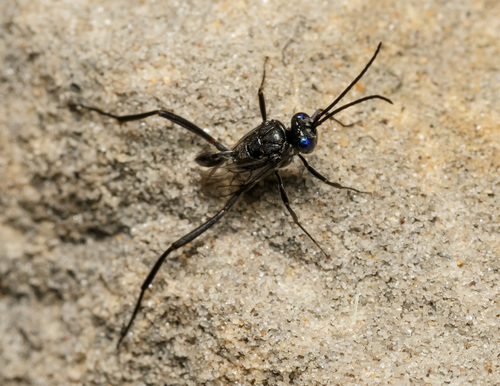
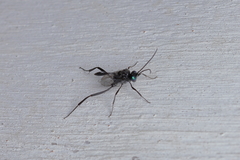
Evania appendigaster, also known as the blue-eyed ensign wasp, is a species of wasp in the family Evaniidae. Its native range is not known, but it likely originated in Asia (Specifically tropical or oriental regions). Today it occurs throughout the tropics and subtropics and in many temperate regions. As with the rest of its family, the blue-eyed ensign wasp is a parasitoid known for specializing on cockroach eggs.

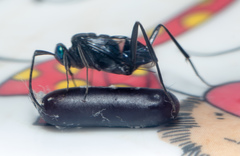
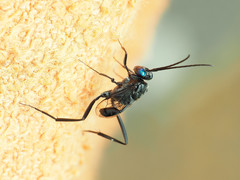
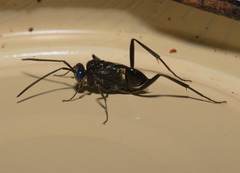
This is one of the larger ensign wasps, with forewings up to about 7 millimeters long. It is distinguished from other species by the wide separation of the first and second sections of the coxa, the segment of the leg that attaches to the body. Its body is black in color with contrasting blue eyes. The abdominal petiole, the constricted stalk that holds the posterior section of the abdomen, or gaster, is attached high on the body. The gaster is laterally compressed and oval to nearly triangular in shape, held in a flaglike fashion and resembling an ensign, a characteristic of the family that inspired the common name ensign wasp.

This wasp reproduces by laying eggs into egg cases, or oothecae, of cockroaches. The wasp larvae use the cockroach... Wikipedia →

Global Distribution

Parks Where Found

# Park Country Daily sighting probability
1 Tijuca National Park 🇧🇷 Brazil
~10%
2 Cumbres de Monterrey National Park 🇲🇽 Mexico
~10%
3 iSimangaliso Wetland Park 🇿🇦 South Africa
<5%
4 Galápagos Islands 🇪🇨 Ecuador
<5%
5 Saguaro National Park 🇺🇸 United States
<5%
6 Table Mountain National Park 🇿🇦 South Africa
<5%

Cities Where Found

# City Country Daily sighting probability
1 Casablanca 🇲🇦 Morocco
~30%
2 Davao City 🇵🇭 Philippines
~30%
3 Karachi 🇵🇰 Pakistan
~20%
4 São Luís 🇧🇷 Brazil
~20%
5 Valencia 🇪🇸 Spain
~20%
6 Mendoza 🇦🇷 Argentina
~20%
7 Santo Domingo 🇩🇴 Dominican Republic
~20%
8 Manaus 🇧🇷 Brazil
~20%
9 Valencia 🇻🇪 Venezuela
~20%
10 Dhaka 🇧🇩 Bangladesh
~20%

Before you go

What are the chances of seeing a Blue-Eyed Ensign Wasp in Jerusalem?

With luck

About 10% of wildlife watchers report a Blue-Eyed Ensign Wasp sighting in Jerusalem on a given day, based on 7 verified sightings from GBIF citizen-science data. It is the 82nd most-seen of the 137 insects we can rate there. Over three days the chance rises to about 30%, and over a week to about 60%, if each day is a fresh chance.

When is the best time to see a Blue-Eyed Ensign Wasp in Jerusalem?

July to September

In those months about 30% of wildlife watchers report a Blue-Eyed Ensign Wasp in Jerusalem on a given day, against under 5% in October to June, the lowest months. Those are among Jerusalem's driest months, with almost no rain against 90 mm in January.

What time of day is best to see a Blue-Eyed Ensign Wasp?

Between 7 and 10 am

Across all the parks we cover, that three-hour window holds the most Blue-Eyed Ensign Wasp sightings with a recorded time, and about 9 in 10 of them come between 6 am and 6 pm: it is a daytime animal.

Is Jerusalem the best place to see a Blue-Eyed Ensign Wasp?

26th of 84

Of the 84 cities where we can rate Blue-Eyed Ensign Wasp sightings, Jerusalem ranks 26th at about 10%. The best odds are in Casablanca (Morocco, about 30%), Davao City (Philippines, about 30%) and Karachi (Pakistan, about 20%).

Which relatives of the Blue-Eyed Ensign Wasp live in Jerusalem?

Same order: Hymenoptera

The closest relatives of the Blue-Eyed Ensign Wasp that you can see in Jerusalem (order Hymenoptera, Ants, Bees, Wasps, and Sawflies) are Buff-Tailed Bumble Bee (about 20%), Oriental Hornet (about 20%) and Violet Carpenter Bee (about 20%), with each one's daily chance of a sighting.

Where does the Blue-Eyed Ensign Wasp sighting chance come from?

GBIF citizen-science records

It is estimated from how often the Blue-Eyed Ensign Wasp is recorded against all the insects logged in Jerusalem (7 verified sightings), calibrated against known sighting rates. Figures are rounded to the nearest 10% because citizen-science data supports honest approximations, not decimals, and months with records from fewer than five people show "—". How it works.

← Back to Jerusalem