Indian Golden Oriole

Indian Golden Oriole

Oriolus kundoo

Silhouette: L. Shyamal · PhyloPic

LCLeast ConcernNTVUENCR
Daily sighting probability <5% · Rare
at Kathmandu

In 3 days ~10% in a week ~30%

244 Verified sightings at Kathmandu
4,326 In all 15 parks From 2019 to 2026
April Best month
🌅 Crepuscular When it's spotted

About the Indian Golden Oriole

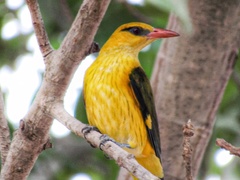
The Indian golden oriole (Oriolus kundoo) is a species of oriole found in the Indian subcontinent and Central Asia. The species was formerly considered to be a subspecies of the Eurasian golden oriole, but is now considered a full species. Adults can be told apart from the Eurasian golden oriole by the black of the eye stripe extending behind the eye.

The Indian golden oriole was described by the English naturalist William Henry Sykes in 1832 and given the binomial name Oriolus kundoo. Although initially described as a separate species, the Indian golden oriole was usually treated as a subspecies of the Eurasian golden oriole. In 2005, the ornithologists Pamela Rasmussen and John Anderton in their Birds of South Asia decided to treat the two varieties as separate species based on the differences in morphology, plumage, calls and the fact that the two varieties do not intergrade. Support for this split was provided by a molecular phylogenetic study published in 2010, and most ornithologists now treat the Indian golden oriole as a separate species. The race baltistanicus was judged by Charles Vaurie to be indistinguishable from the nominate subspecies and... Wikipedia →

Sounds

Call0:31

India · 2025

© Viral Patel &amp; Pankaj Maheria · XC1004400 · CC BY-NC-SA 4.0

Song1:01

India · 2023

© Jairam Vijayan · XC872517 · CC BY-SA 4.0

Call1:02

Kazakhstan · 2023

© Ding Li Yong · XC808777 · CC BY-NC-ND 4.0

Global Distribution

Parks Where Found

# Park Country Daily sighting probability
1 Nagarhole National Park 🇮🇳 India
~30%
2 Periyar National Park 🇮🇳 India
~20%
3 Keoladeo National Park 🇮🇳 India
~20%
4 Bandhavgarh National Park 🇮🇳 India
~20%
5 Ranthambore National Park 🇮🇳 India
~20%
6 Kanha National Park 🇮🇳 India
~20%
7 Chitwan National Park 🇳🇵 Nepal
~10%
8 Satpura National Park 🇮🇳 India
~10%
9 Bandipur National Park 🇮🇳 India
~10%
10 Royal Bardia National Park 🇳🇵 Nepal
~10%
11 Mudumalai National Park 🇮🇳 India
~10%
12 Gir National Park 🇮🇳 India
~10%
13 Jim Corbett National Park 🇮🇳 India
<5%
14 Sundarbans National Park 🇮🇳 India
<5%
15 Eravikulam National Park 🇮🇳 India
<5%

Cities Where Found

# City Country Daily sighting probability
1 Jabalpur 🇮🇳 India
~50%
2 Asansol 🇮🇳 India
~40%
3 Kalyan-Dombivli 🇮🇳 India
~40%
4 Bhubaneshwar 🇮🇳 India
~30%
5 Thrissur 🇮🇳 India
~30%
6 Vasai-Virar 🇮🇳 India
~30%
7 Mumbai 🇮🇳 India
~30%
8 Durg 🇮🇳 India
~30%
9 Surat 🇮🇳 India
~30%
10 Bhopal 🇮🇳 India
~30%

Zoos & Centres Where Found

# Zoo / Centre Country
1 Santa Fe College Teaching Zoo 🇺🇸 United States In captivity

Before you go

What are the chances of seeing an Indian Golden Oriole in Kathmandu?

Rare

Under 5% of wildlife watchers report an Indian Golden Oriole sighting in Kathmandu on a given day, based on 244 verified sightings from GBIF citizen-science data. It is the 91st most-seen of the 312 birds we can rate there. Over three days the chance rises to about 10%, and over a week to about 30%, if each day is a fresh chance.

When is the best time to see an Indian Golden Oriole in Kathmandu?

April

In that month about 20% of wildlife watchers report an Indian Golden Oriole in Kathmandu on a given day, against under 5% in August to March, the lowest months. That is one of Kathmandu's driest months, with about 35 mm of rain against 280 mm in July.

What time of day is best to see an Indian Golden Oriole?

Between 3 and 6 am

Across all the parks we cover, that three-hour window holds the most Indian Golden Oriole sightings with a recorded time, and about half of them come between 6 pm and 6 am: it is most active around dawn and dusk.

Is Kathmandu the best place to see an Indian Golden Oriole?

53rd of 65

Of the 65 cities where we can rate Indian Golden Oriole sightings, Kathmandu ranks 53rd at under 5%. The best odds are in Jabalpur (India, about 50%), Asansol (India, about 40%) and Kalyan-Dombivli (India, about 40%).

Where does the Indian Golden Oriole sighting chance come from?

GBIF citizen-science records

It is estimated from how often the Indian Golden Oriole is recorded against all the birds logged in Kathmandu (244 verified sightings), calibrated against known sighting rates. Figures are rounded to the nearest 10% because citizen-science data supports honest approximations, not decimals, and months with records from fewer than five people show "—". How it works.

← Back to Kathmandu