Marbled White

Marbled White

Melanargia galathea

Daily sighting probability <5% · Rare
at Kazan

In 3 days ~10% in a week ~20%

5 Verified sightings at Kazan
1,148 In all 16 parks From 2019 to 2026
June Best month
☀️ Diurnal When it's spotted

About the Marbled White

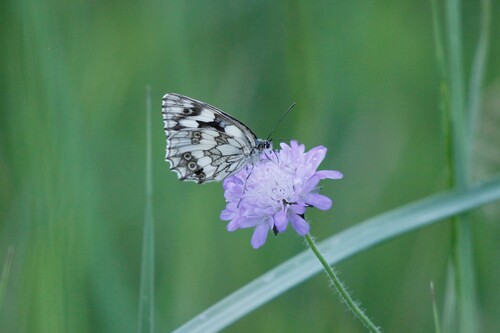
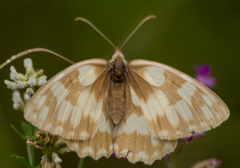
Melanargia galathea, the marbled white, is a medium-sized butterfly in the family Nymphalidae. The marbled white was described in 1666 by C Merrett, and in 1695 James Petiver found a specimen in a wood near Hampstead and called it Papilio leucomelanus, our half-Mourner, to distinguish it from the Bath White, which Vernon (1702) had called the half-Mourner. It was also known as The Marmoris by Benjamin Wilkes and The Marmoress by Moses Harris. The butterfly was, also described in 1758, by the Swedish biologist and physician, Carl Linnaeus who formalised binomial nomenclature. Despite its common name and appearance, this butterfly is one of the "browns", of the subfamily Satyrinae.

This species can be found across most of Europe, southern Russia, Asia Minor and Iran. It is found in forest clearings and edges, meadows and steppe where it occurs up to 1,500–1,700 metres (4,900–5,600 ft) above sea level. The caterpillars feed on various grasses.

Melanargia galathea has a wingspan of 46–56 millimetres (1.8–2.2 in). In these medium-sized butterflies the upper side of the wings is decorated with white and gray-black or dark brown markings, but it is always gray-black... Wikipedia →
Global Distribution

Parks Where Found

# Park Country Daily sighting probability
1 Picos de Europa National Park 🇪🇸 Spain
~40%
2 Triglav National Park 🇸🇮 Slovenia
~40%
3 Ecrins National Park 🇫🇷 France
~40%
4 Aigüestortes National Park 🇪🇸 Spain
~40%
5 Mercantour National Park 🇫🇷 France
~40%
6 Vanoise National Park 🇫🇷 France
~40%
7 Kiskunság National Park 🇭🇺 Hungary
~30%
8 Cévennes National Park 🇫🇷 France
~30%
9 Hohe Tauern National Park 🇦🇹 Austria
~20%
10 Pyrénées National Park 🇫🇷 France
~20%
11 Bavarian Forest National Park 🇩🇪 Germany
~20%
12 Fertő-Hanság National Park 🇭🇺 Hungary
~20%
13 Ordesa y Monte Perdido National Park 🇪🇸 Spain
~20%
14 Plitvice Lakes National Park 🇭🇷 Croatia
~20%
15 Tatra National Park 🇸🇰 Slovakia
~10%
16 Białowieża National Park 🇵🇱 Poland
~10%

Cities Where Found

# City Country Daily sighting probability
1 Prague 🇨🇿 Czechia
~20%
2 London 🇬🇧 United Kingdom
~20%
3 Kharkiv 🇺🇦 Ukraine
~20%
4 Budapest 🇭🇺 Hungary
~10%
5 Warsaw 🇵🇱 Poland
~10%
6 Vienna 🇦🇹 Austria
~10%
7 Birmingham 🇬🇧 United Kingdom
~10%
8 Berlin 🇩🇪 Germany
~10%
9 Munich 🇩🇪 Germany
~10%
10 Paris 🇫🇷 France
~10%

Before you go

What are the chances of seeing a Marbled White in Kazan?

Rare

Under 5% of wildlife watchers report a Marbled White sighting in Kazan on a given day, based on 5 verified sightings from GBIF citizen-science data. It is the 147th most-seen of the 183 insects we can rate there. Over three days the chance rises to about 10%, and over a week to about 20%, if each day is a fresh chance.

When is the best time to see a Marbled White in Kazan?

June

In that month about 10% of wildlife watchers report a Marbled White in Kazan on a given day, against under 5% in July to May, the lowest months.

What time of day is best to see a Marbled White?

Between 10 am and 1 pm

Across all the parks we cover, that three-hour window holds the most Marbled White sightings with a recorded time, and about 9 in 10 of them come between 6 am and 6 pm: it is a daytime animal.

Is Kazan the best place to see a Marbled White?

13th of 14

Of the 14 cities where we can rate Marbled White sightings, Kazan ranks 13th at under 5%. The best odds are in Prague (Czechia, about 20%), London (United Kingdom, about 20%) and Kharkiv (Ukraine, about 20%).

Where does the Marbled White sighting chance come from?

GBIF citizen-science records

It is estimated from how often the Marbled White is recorded against all the insects logged in Kazan (5 verified sightings), calibrated against known sighting rates. Figures are rounded to the nearest 10% because citizen-science data supports honest approximations, not decimals, and months with records from fewer than five people show "—". How it works.

← Back to Kazan