


Completed
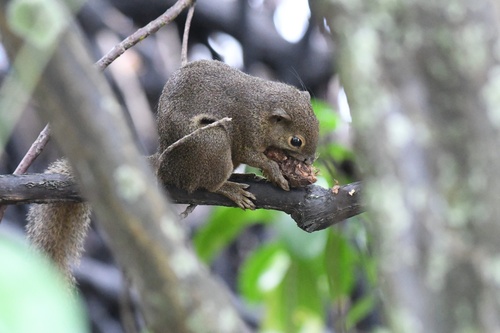
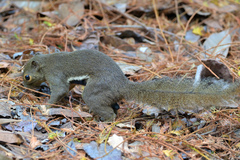


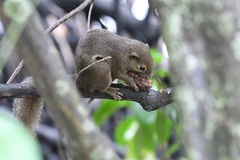
Plantain Squirrel
Callosciurus notatus
Silhouette: Kai Caspar · PhyloPic
- KingdomAnimalia (Animals)
- PhylumChordata (Chordates)
- ClassMammalia (Mammals)
- OrderRodentia (Rodents)
- FamilySciuridae (Squirrels)
- GenusCallosciurus (Beautiful Squirrels)
- SpeciesCallosciurus notatus (Plantain Squirrel)
In 3 days ~80% in a week >90%
27 Verified sightings at Kuching
202 In all 8 parks From 2019 to 2026
February Best month
🌅 Crepuscular When it's spotted
About the Plantain Squirrel
The plantain squirrel, oriental squirrel or tricoloured squirrel (Callosciurus notatus) is a species of rodent in the family Sciuridae found in Indonesia, Malaysia, Singapore, and Thailand in a wide range of habitats: forests, mangroves, parks, gardens, and agricultural areas. Fruit farmers consider them to be pests.
Its body is about 20–30 cm (8–12 in) long with a similar-sized tail. Its weight can vary from 160 to 259 g (5.6 to 9.1 oz). It is greyish/brown with a chestnut belly and a black and white stripe on the side. It is very quick and agile in trees, able to jump a few metres between trees, and rarely wanders on the ground.
Like all rodents, it has two large upper and lower incisors. Its chestnut belly easily distinguishes it from the similar black-striped squirrel, which has a grey belly. The plantain squirrel is diurnal. It is either solitary or social in small groups, wherein squirrels communicate with shrill chirps and chattering while showing off their tails. These high calls may be alarms responding to the presence of a predator. Different types of predators prompt different calls and elicit different responses in the squirrel. A snake... Wikipedia →
Recent sightings of Plantain Squirrel in Kuching
LIVEiNaturalistGlobal Distribution
Parks Where Found
| # | Park | Country | Daily sighting probability |
|---|---|---|---|
| 1 | Bako National Park | 🇲🇾 Malaysia | |
| 2 | Bali Barat National Park | 🇮🇩 Indonesia | |
| 3 | Tanjung Puting National Park | 🇮🇩 Indonesia | |
| 4 | Kinabatangan Wildlife Sanctuary | 🇲🇾 Malaysia | |
| 5 | Taman Negara National Park | 🇲🇾 Malaysia | |
| 6 | Sepilok | 🇲🇾 Malaysia | |
| 7 | Gunung Leuser National Park | 🇮🇩 Indonesia | |
| 8 | Kinabalu Park | 🇲🇾 Malaysia |
Cities Where Found
| # | City | Country | Daily sighting probability |
|---|---|---|---|
| 1 | Denpasar | 🇮🇩 Indonesia | |
| 2 | Kuching | 🇲🇾 Malaysia | |
| 3 | Singapore | 🇸🇬 Singapore | |
| 4 | Johor Bahru | 🇲🇾 Malaysia | |
| 5 | Surabaya | 🇮🇩 Indonesia | |
| 6 | Yogyakarta | 🇮🇩 Indonesia | |
| 7 | Kuala Lumpur | 🇲🇾 Malaysia | |
| 8 | Jakarta | 🇮🇩 Indonesia | |
| 9 | Bandung | 🇮🇩 Indonesia |
Zoos & Centres Where Found
| # | Zoo / Centre | Country | |
|---|---|---|---|
| 1 | Hong Kong Zoological and Botanical Gardens | 🇨🇳 China | |
| 2 | Prospect Park Zoo | 🇺🇸 United States | |
| 3 | Bergen Aquarium | 🇳🇴 Norway | |
| 4 | Edward Youde Aviary | 🇭🇰 Hong Kong SAR China |
Before you go
What are the chances of seeing a Plantain Squirrel in Kuching?
Likely
About 50% of wildlife watchers report a Plantain Squirrel sighting in Kuching on a given day, based on 27 verified sightings from GBIF citizen-science data. Over three days the chance rises to about 80%, and over a week to over 90%, if each day is a fresh chance.
When is the best time to see a Plantain Squirrel in Kuching?
January–February and May
In those months about 60% of wildlife watchers report a Plantain Squirrel in Kuching on a given day, against about 10% in April and October–December, the lowest months.
What time of day is best to see a Plantain Squirrel?
Between 2 and 5 am
Across all the parks we cover, that three-hour window holds the most Plantain Squirrel sightings with a recorded time, and about 7 in 10 of them come between 6 pm and 6 am: it is most active around dawn and dusk.
Is Kuching the best place to see a Plantain Squirrel?
2nd of 9
Of the 9 cities where we can rate Plantain Squirrel sightings, Kuching ranks 2nd at about 50%. The best odds are in Denpasar (Indonesia, about 80%).
Where does the Plantain Squirrel sighting chance come from?
GBIF citizen-science records
It is estimated from how often the Plantain Squirrel is recorded against all the mammals logged in Kuching (27 verified sightings), calibrated against known sighting rates. Figures are rounded to the nearest 10% because citizen-science data supports honest approximations, not decimals, and months with records from fewer than five people show "—". How it works.
