Caspian Gull

Caspian Gull

Larus cachinnans

Silhouette: Sharon Wegner-Larsen · PhyloPic

LCLeast ConcernNTVUENCR
Daily sighting probability ~10% · With luck
at Kuwait City

In 3 days ~40% in a week ~60%

69 Verified sightings at Kuwait City
1,248 In all 7 parks From 2019 to 2026
February Best month
☀️ Diurnal When it's spotted

About the Caspian Gull

The Caspian gull (Larus cachinnans) is a large gull and a member of the herring and lesser black-backed gull complex. The scientific name is from Latin. Larus appears to have referred to a gull or other large seabird, and cachinnans means 'laughing', from cachinnare 'to laugh'.

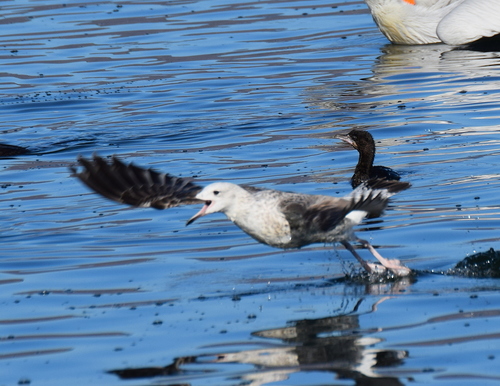
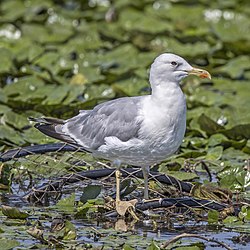
It is a large gull at 56–68 cm (22–27 in) long, with a 137 to 155 cm (54 to 61 in) wingspan and a body mass of 680–1,590 g (1.50–3.51 lb). Among standard measurements, the wing chord is 38.5 to 48 cm (15.2 to 18.9 in), the bill is 4.6 to 6.4 cm (1.8 to 2.5 in) and the tarsus is 5.8 to 7.7 cm (2.3 to 3.0 in). The Caspian gull has a long, slender bill, accentuated by the sloping forehead. The legs, wings, and neck are longer than those of the herring gull and yellow-legged gull. The eye is small and often dark, and the legs vary from pale pink to a pale yellowish colour. The back and wings are a slightly darker shade of grey than the herring gull, but slightly paler than the yellow-legged gull. The outermost primary feather has a large white tip and a white tongue running up the inner web.

First-winter birds have a pale head with dark streaking on the back of the neck. The underparts are pale... Wikipedia →

Sounds

Flight call0:53

Kazakhstan · 2025

© Frank Lambert · XC1030318 · CC BY-NC-ND 4.0

Alarm call0:17

Russian Federation · 2025

© Albert Lastukhin · XC1001272 · CC BY-NC-ND 4.0

Call0:32

France · 2023

© Stanislas Wroza · XC780305 · CC BY-NC-SA 4.0

Global Distribution

Parks Where Found

# Park Country Daily sighting probability
1 Hortobágy National Park 🇭🇺 Hungary
~50%
2 Kiskunság National Park 🇭🇺 Hungary
~40%
3 Fertő-Hanság National Park 🇭🇺 Hungary
~10%
4 Białowieża National Park 🇵🇱 Poland
<5%
5 Biebrza National Park 🇵🇱 Poland
<5%
6 Wadden Sea National Park 🇩🇪 Germany
<5%
7 Bavarian Forest National Park 🇩🇪 Germany
<5%

Cities Where Found

# City Country Daily sighting probability
1 Kyiv 🇺🇦 Ukraine
~40%
2 Kharkiv 🇺🇦 Ukraine
~30%
3 Prague 🇨🇿 Czechia
~20%
4 Warsaw 🇵🇱 Poland
~20%
5 Minsk 🇧🇾 Belarus
~20%
6 Baku 🇦🇿 Azerbaijan
~10%
7 Kuwait City 🇰🇼 Kuwait
~10%
8 Bucharest 🇷🇴 Romania
~10%
9 Karachi 🇵🇰 Pakistan
~10%
10 Astana 🇰🇿 Kazakhstan
~10%

Zoos & Centres Where Found

# Zoo / Centre Country
1 Kharkiv Zoo 🇺🇦 Ukraine In captivity
2 Kharkiv Dolphinarium 🇺🇦 Ukraine In captivity

Before you go

What are the chances of seeing a Caspian Gull in Kuwait City?

With luck

About 10% of wildlife watchers report a Caspian Gull sighting in Kuwait City on a given day, based on 69 verified sightings from GBIF citizen-science data. It is the 53rd most-seen of the 157 birds we can rate there. Over three days the chance rises to about 40%, and over a week to about 60%, if each day is a fresh chance.

When is the best time to see a Caspian Gull in Kuwait City?

January and February

In those months about 30% of wildlife watchers report a Caspian Gull in Kuwait City on a given day, against under 5% in March–May and August, the lowest months.

What time of day is best to see a Caspian Gull?

Between 8 and 11 am

Across all the parks we cover, that three-hour window holds the most Caspian Gull sightings with a recorded time, and about 8 in 10 of them come between 6 am and 6 pm: it is a daytime animal.

Is Kuwait City the best place to see a Caspian Gull?

7th of 35

Of the 35 cities where we can rate Caspian Gull sightings, Kuwait City ranks 7th at about 10%. The best odds are in Kyiv (Ukraine, about 40%), Kharkiv (Ukraine, about 30%) and Prague (Czechia, about 20%).

Which relatives of the Caspian Gull live in Kuwait City?

Same genus: Larus

The closest relatives of the Caspian Gull that you can see in Kuwait City (genus Larus, Large White-headed Gulls) are Lesser Black-backed Gull (about 40%) and Armenian Gull (about 10%), with each one's daily chance of a sighting.

Where does the Caspian Gull sighting chance come from?

GBIF citizen-science records

It is estimated from how often the Caspian Gull is recorded against all the birds logged in Kuwait City (69 verified sightings), calibrated against known sighting rates. Figures are rounded to the nearest 10% because citizen-science data supports honest approximations, not decimals, and months with records from fewer than five people show "—". How it works.

← Back to Kuwait City