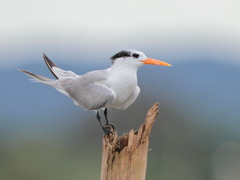
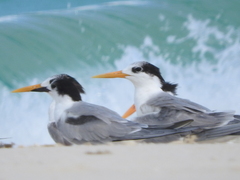
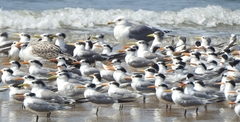
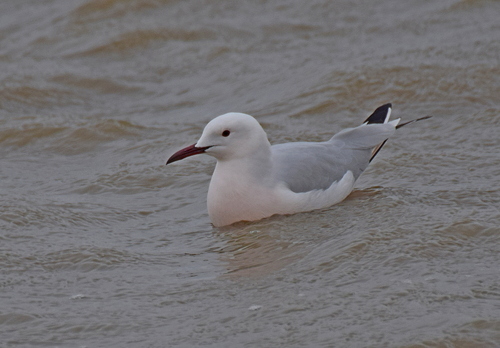
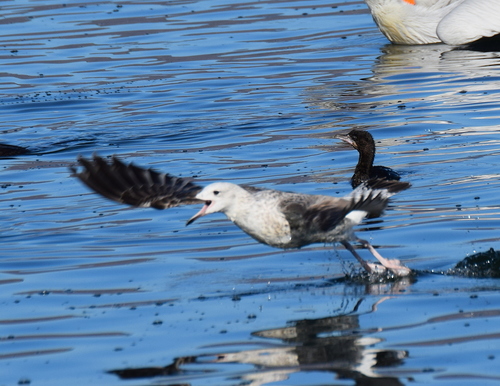
Lesser Crested Tern

Lesser Crested Tern

Thalasseus bengalensis

Silhouette: JJ Harrison (vectorized by T. Michael Keesey) · PhyloPic

LCLeast ConcernNTVUENCR
Daily sighting probability ~20% · Possible
at Kuwait City

In 3 days ~50% in a week ~80%

106 Verified sightings at Kuwait City
334 In all 9 parks From 2019 to 2026
June Best month
☀️ Diurnal When it's spotted

About the Lesser Crested Tern

The lesser crested tern (Thalasseus bengalensis) is a tern in the family Laridae. The genus name is from Ancient Greek Thalasseus, "fisherman" from thalassa, "sea". The specific bengalensis means "of Bengal", the type locality, historically referring to Bangladesh and part of Northeast India.

It breeds in subtropical coastal parts of the world mainly from the Red Sea across the Indian Ocean to the western Pacific, and Australia, with a significant population on the southern coast of the Mediterranean on two islands off the Libyan coast. It is an occasional vagrant to Europe, where it has been known to breed in pure and mixed (with Sandwich tern) pairs. The Australian birds are probably sedentary, but other populations are migratory, wintering south to South Africa.

Pale grey above (only marginally darker than Sandwich tern); slightly larger. Wikipedia →

Sounds

Alarm call0:18

Malaysia · 2024

© Lim Ying Hien · XC864400 · CC BY-NC-ND 4.0

Call1:12

Saudi Arabia · 2021

© Frank Lambert · XC740767 · CC BY-NC-ND 4.0

Flight call0:15

Bahrain · 2021

© David Darrell-Lambert · XC665566 · CC BY-NC-SA 4.0

Global Distribution

Parks Where Found

# Park Country Daily sighting probability
1 Ningaloo Marine Park 🇦🇺 Australia
~20%
2 Cape Range 🇦🇺 Australia
~20%
3 Komodo National Park 🇮🇩 Indonesia
~10%
4 iSimangaliso Wetland Park 🇿🇦 South Africa
~10%
5 Yala National Park 🇱🇰 Sri Lanka
<5%
6 Bali Barat National Park 🇮🇩 Indonesia
<5%
7 Raja Ampat 🇮🇩 Indonesia
<5%
8 Lake Nakuru National Park 🇰🇪 Kenya
<5%
9 Daintree National Park 🇦🇺 Australia
<5%

Cities Where Found

# City Country Daily sighting probability
1 Zanzibar City 🇹🇿 Tanzania
~40%
2 Dakar 🇸🇳 Senegal
~30%
3 Kuwait City 🇰🇼 Kuwait
~20%
4 Dar es-Salaam 🇹🇿 Tanzania
~20%
5 Jeddah 🇸🇦 Saudi Arabia
~10%
6 Manama 🇧🇭 Bahrain
~10%
7 Kozhikode 🇮🇳 India
~10%
8 Dammam 🇸🇦 Saudi Arabia
~10%
9 Algiers 🇩🇿 Algeria
~10%
10 Kollam 🇮🇳 India
~10%

Before you go

What are the chances of seeing a Lesser Crested Tern in Kuwait City?

Possible

About 20% of wildlife watchers report a Lesser Crested Tern sighting in Kuwait City on a given day, based on 106 verified sightings from GBIF citizen-science data. It is the 39th most-seen of the 157 birds we can rate there. Over three days the chance rises to about 50%, and over a week to about 80%, if each day is a fresh chance.

When is the best time to see a Lesser Crested Tern in Kuwait City?

April–July and November

In those months about 30% of wildlife watchers report a Lesser Crested Tern in Kuwait City on a given day, against about 10% in March, September and December, the lowest months.

What time of day is best to see a Lesser Crested Tern?

Between 7 and 10 am

Across all the parks we cover, that three-hour window holds the most Lesser Crested Tern sightings with a recorded time, and about 9 in 10 of them come between 6 am and 6 pm: it is a daytime animal.

Is Kuwait City the best place to see a Lesser Crested Tern?

3rd of 22

Of the 22 cities where we can rate Lesser Crested Tern sightings, Kuwait City ranks 3rd at about 20%. The best odds are in Zanzibar City (Tanzania, about 40%) and Dakar (Senegal, about 30%).

Which relatives of the Lesser Crested Tern live in Kuwait City?

Same genus: Thalasseus

The closest relatives of the Lesser Crested Tern that you can see in Kuwait City (genus Thalasseus, Crested Terns) are Crested Tern (about 10%) and Sandwich Tern (about 10%), with each one's daily chance of a sighting.

Where does the Lesser Crested Tern sighting chance come from?

GBIF citizen-science records

It is estimated from how often the Lesser Crested Tern is recorded against all the birds logged in Kuwait City (106 verified sightings), calibrated against known sighting rates. Figures are rounded to the nearest 10% because citizen-science data supports honest approximations, not decimals, and months with records from fewer than five people show "—". How it works.

← Back to Kuwait City