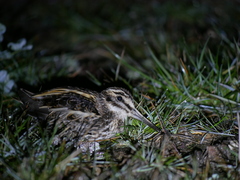
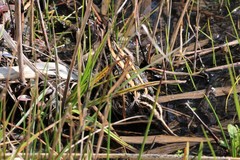
Jack Snipe

Jack Snipe

Lymnocryptes minimus

Silhouette: Sheatherius · PhyloPic

LCLeast ConcernNTVUENCR
Daily sighting probability <5% · Rare
at Liverpool

In 3 days ~10%

55 Verified sightings at Liverpool
139 In all 9 parks From 2019 to 2026
November Best month
☀️ Diurnal When it's spotted

About the Jack Snipe

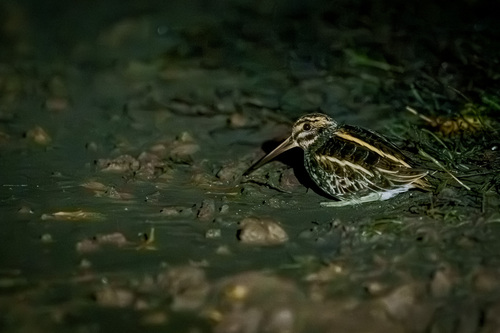
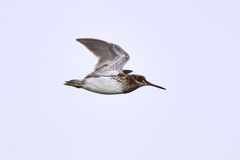
The jack snipe or jacksnipe (Lymnocryptes minimus) is a small stocky wader. It is the smallest snipe, and the only member of the genus Lymnocryptes. Features such as its sternum and its continuous 'bobbing up and down' make it quite distinct from other snipes or woodcocks.

The jack snipe was formally described in 1764 by the Danish zoologist Morten Thrane Brünnich under the binomial name Scolopax minima. He specified the type locality as the Danish island of Christiansø. Brünnich based his account on "La petite béccassine" that had been described and illustrated in 1760 by the French zoologist Mathurin Jacques Brisson. The jack snipe is now the only species placed in the genus Lymnocryptes that was introduced in 1826 by the German zoologist Friedrich Boie. The species is considered to be monotypic: no subspecies are recognised. The genus name Lymnocryptes is from Ancient Greek limne, "marsh" and kruptos, "hidden". The species name minimus is from Latin and means "smallest".

The common name has been said to come from the Welsh word for a snipe, giach (pronounced with a hard g), but modern dictionaries say it comes from the masculine name Jack. Alfred Newton hypothesized... Wikipedia →

Sounds

Song0:30

Sweden · 2026

© Lars Edenius · XC1106774 · CC BY-NC-SA 4.0

Flight call0:10

Poland · 2013

© Jarek Matusiak · XC130281 · CC BY-NC-SA 3.0

Call0:19

France · 2025

© Nicolas Martinez · XC982106 · CC BY-NC-SA 4.0

Global Distribution

Parks Where Found

# Park Country Daily sighting probability
1 Vatnajokull National Park 🇮🇸 Iceland
<5%
2 Sierra Nevada National Park 🇪🇸 Spain
<5%
3 Hortobágy National Park 🇭🇺 Hungary
<5%
4 Monfragüe National Park 🇪🇸 Spain
<5%
5 Wadden Sea National Park 🇩🇪 Germany
<5%
6 Kiskunság National Park 🇭🇺 Hungary
<5%
7 Camargue 🇫🇷 France
<5%
8 Biebrza National Park 🇵🇱 Poland
<5%
9 Keoladeo National Park 🇮🇳 India
<5%

Cities Where Found

# City Country Daily sighting probability
1 Minsk 🇧🇾 Belarus
~10%
2 Jammu 🇮🇳 India
<5%
3 Liverpool 🇬🇧 United Kingdom
<5%
4 Jerusalem 🇮🇱 Israel
<5%
5 London 🇬🇧 United Kingdom
<5%
6 Madrid 🇪🇸 Spain
<5%
7 Barcelona 🇪🇸 Spain
<5%
8 Manchester 🇬🇧 United Kingdom
<5%
9 Helsinki 🇫🇮 Finland
<5%
10 Birmingham 🇬🇧 United Kingdom
<5%

Before you go

What are the chances of seeing a Jack Snipe in Liverpool?

Rare

Under 5% of wildlife watchers report a Jack Snipe sighting in Liverpool on a given day, based on 55 verified sightings from GBIF citizen-science data. It is the 114th most-seen of the 168 birds we can rate there. Over three days the chance rises to about 10%, if each day is a fresh chance.

When is the best time to see a Jack Snipe in Liverpool?

November

In that month about 10% of wildlife watchers report a Jack Snipe in Liverpool on a given day, against under 5% in December to October, the lowest months.

What time of day is best to see a Jack Snipe?

Between 11 am and 2 pm

Across all the parks we cover, that three-hour window holds the most Jack Snipe sightings with a recorded time, and about 9 in 10 of them come between 6 am and 6 pm: it is a daytime animal.

Is Liverpool the best place to see a Jack Snipe?

3rd of 12

Of the 12 cities where we can rate Jack Snipe sightings, Liverpool ranks 3rd at under 5%. The best odds are in Minsk (Belarus, about 10%) and Jammu (India, under 5%).

Which relatives of the Jack Snipe live in Liverpool?

Same family: Scolopacidae

The closest relatives of the Jack Snipe that you can see in Liverpool (family Scolopacidae, Sandpipers and Allies) are Common Redshank (about 50%), Bar-tailed Godwit (about 40%) and Dunlin (about 40%), with each one's daily chance of a sighting.

Where does the Jack Snipe sighting chance come from?

GBIF citizen-science records

It is estimated from how often the Jack Snipe is recorded against all the birds logged in Liverpool (55 verified sightings), calibrated against known sighting rates. Figures are rounded to the nearest 10% because citizen-science data supports honest approximations, not decimals, and months with records from fewer than five people show "—". How it works.
← Back to Liverpool