Rook

Rook

Corvus frugilegus

Silhouette: Steven Traver · PhyloPic

LCLeast ConcernNTVUENCR
Daily sighting probability <5% · Rare
at London

In 3 days ~10%

697 Verified sightings at London
3,880 In all 10 parks From 2019 to 2026
April Best month
☀️ Diurnal When it's spotted

About the Rook

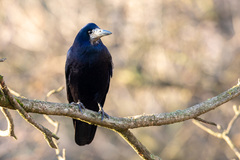
The rook (Corvus frugilegus) is a member of the family Corvidae in the passerine order of birds. It is found in the Palearctic, its range extending from Scandinavia and western Europe to eastern Siberia. It is a large, gregarious, black-feathered bird, distinguished from similar species by the whitish featherless area on the face. Rooks nest collectively in the tops of tall trees, often close to farms or villages; the groups of nests are known as rookeries.

Rooks are mainly resident birds, but the northernmost populations may migrate southwards to avoid the harshest winter conditions. The birds form flocks in winter, often in the company of other Corvus species or jackdaws. They return to their rookeries, and breeding takes place in spring. They forage on arable land and pasture, probing the ground with their strong bills and feeding largely on grubs and soil-based invertebrates, but they also consume cereals and other plant material. Historically, farmers have accused the birds of damaging their crops and have made efforts to drive them away or kill them. Like other corvids, they are intelligent birds with complex behavioural traits and an ability to solve simple problems. Wikipedia →

Sounds

Call0:08

United Kingdom · 2026

© Anthony McGeehan · XC1186960 · CC BY-NC-SA 4.0

Begging call0:33

Sweden · 2024

© Lennart Jeppsson · XC911573 · CC BY-NC-SA 4.0

Alarm call0:27

Sweden · 2022

© Lars Edenius · XC745457 · CC BY-NC-SA 4.0

Global Distribution

Parks Where Found

# Park Country Daily sighting probability
1 Hortobágy National Park 🇭🇺 Hungary
~70%
2 Kiskunság National Park 🇭🇺 Hungary
~70%
3 Cairngorms National Park 🇬🇧 United Kingdom
~30%
4 Fertő-Hanság National Park 🇭🇺 Hungary
~20%
5 Biebrza National Park 🇵🇱 Poland
~10%
6 Snowdonia National Park 🇬🇧 United Kingdom
~10%
7 Wadden Sea National Park 🇩🇪 Germany
~10%
8 Bavarian Forest National Park 🇩🇪 Germany
<5%
9 Gauja National Park 🇱🇻 Latvia
<5%
10 Białowieża National Park 🇵🇱 Poland
<5%

Cities Where Found

# City Country Daily sighting probability
1 Belgrade 🇷🇸 Serbia
~60%
2 Mashhad 🇮🇷 Iran
~60%
3 Karaj 🇮🇷 Iran
~60%
4 Kharkiv 🇺🇦 Ukraine
~50%
5 Warsaw 🇵🇱 Poland
~50%
6 Bishkek 🇰🇬 Kyrgyzstan
~50%
7 Bucharest 🇷🇴 Romania
~40%
8 Rostov-on-Don 🇷🇺 Russia
~40%
9 Minsk 🇧🇾 Belarus
~40%
10 Ulaanbaatar 🇲🇳 Mongolia
~40%

Zoos & Centres Where Found

# Zoo / Centre Country
1 Tallinn Zoo 🇪🇪 Estonia In captivity
2 Marwell Zoo 🇬🇧 United Kingdom In captivity
3 Staglands Wildlife Reserve 🇳🇿 New Zealand In captivity
4 Leningrad Zoo 🇷🇺 Russia In captivity
5 Willowbank Wildlife Reserve 🇳🇿 New Zealand In captivity
6 Observatoire aquatique 🇫🇷 France In captivity
7 Ogród Zoologiczny w Katowicach 🇵🇱 Poland In captivity

Before you go

What are the chances of seeing a Rook in London?

Rare

Under 5% of wildlife watchers report a Rook sighting in London on a given day, based on 697 verified sightings from GBIF citizen-science data. It is the 100th most-seen of the 203 birds we can rate there. Over three days the chance rises to about 10%, if each day is a fresh chance.

When is the best time to see a Rook in London?

Any time of year

In every month with enough records, under 5% of wildlife watchers report a Rook in London on a given day, so our monthly data shows no clear season.

What time of day is best to see a Rook?

Between noon and 3 pm

Across all the parks we cover, that three-hour window holds the most Rook sightings with a recorded time, and about 8 in 10 of them come between 6 am and 6 pm: it is a daytime animal.

Is London the best place to see a Rook?

48th of 60

Of the 60 cities where we can rate Rook sightings, London ranks 48th at under 5%. The best odds are in Belgrade (Serbia, about 60%), Mashhad (Iran, about 60%) and Karaj (Iran, about 60%).

Where does the Rook sighting chance come from?

GBIF citizen-science records

It is estimated from how often the Rook is recorded against all the birds logged in London (697 verified sightings), calibrated against known sighting rates. Figures are rounded to the nearest 10% because citizen-science data supports honest approximations, not decimals, and months with records from fewer than five people show "—". How it works.

← Back to London

