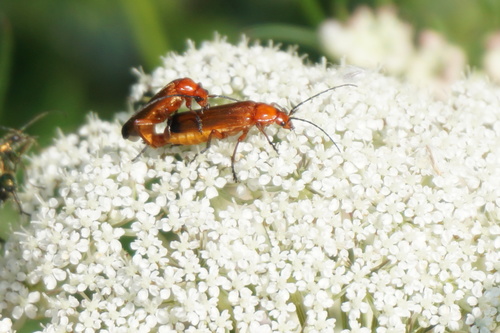
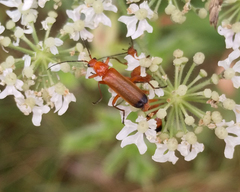
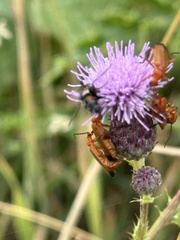
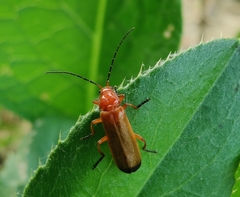


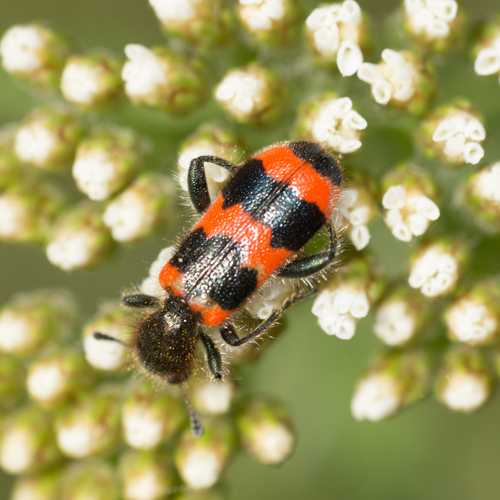
Common Red Soldier Beetle

Common Red Soldier Beetle

Rhagonycha fulva

Daily sighting probability ~20% · Possible
at Lyon

In 3 days ~50% in a week ~80%

94 Verified sightings at Lyon
473 In all 15 parks From 2019 to 2026
June Best month
☀️ Diurnal When it's spotted

About the Common Red Soldier Beetle

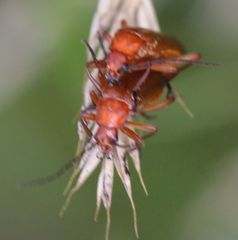
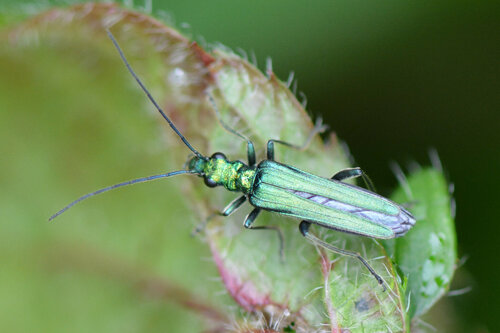
Rhagonycha fulva, the common red soldier beetle, also misleadingly known as the bloodsucker beetle, and popularly known in England as the hogweed bonking beetle is a species of soldier beetle (Cantharidae). Rhagonycha fulva was first described by Giovanni Antonio Scopoli in 1763 in Entomologia Carniolica as Cantharis fulva.

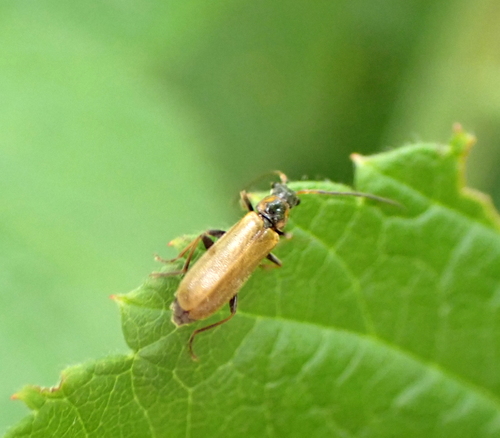
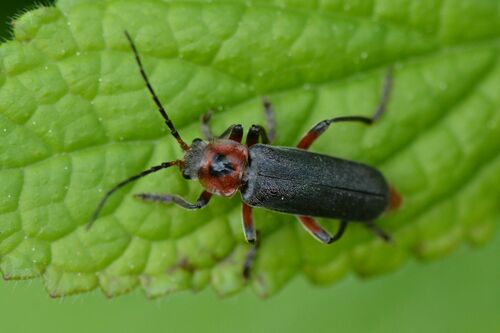
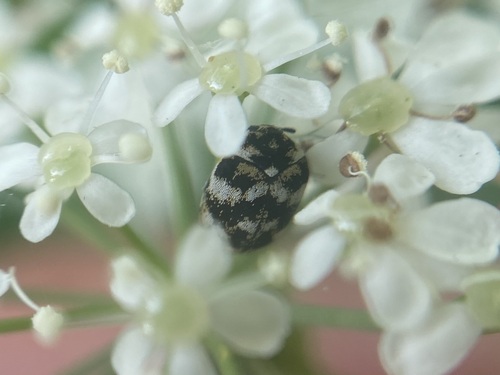
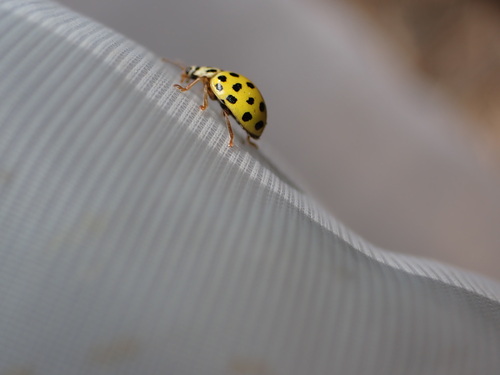
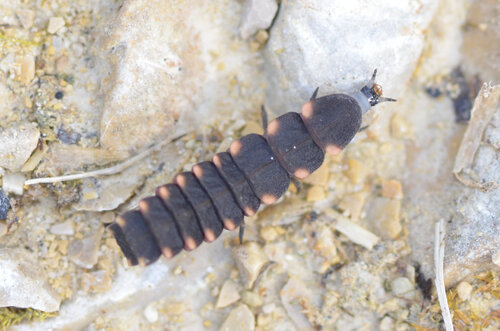
Rhagonycha fulva measures 8–10 millimetres (0.31–0.39 in) in length. Its antennae are black, occasionally the first segment is orange. The head and pronotum are orange and shiny, with fine pubescence visible on the head. The shape of the pronotum is variable, but it narrows towards the head. The elytra cover the wings and most of the abdomen and are a dark shiny red, and terminate in a clearly visible black patch on the apical end – this is one of the key identifying features. The femora and tibiae are orange, but the tarsi are black; the third segment of the tarsi is simple rather than bilobed.

All soldier beetles are soft-bodied, resulting in the German name of this species as Roter Weichkäfer (meaning "red soft beetle"). This beetle is very common in Europe and Anatolia. Introduced to North America, it is well... Wikipedia →

Global Distribution

Parks Where Found

# Park Country Daily sighting probability
1 Snowdonia National Park 🇬🇧 United Kingdom
~20%
2 Cairngorms National Park 🇬🇧 United Kingdom
~20%
3 Aigüestortes National Park 🇪🇸 Spain
~20%
4 Triglav National Park 🇸🇮 Slovenia
~20%
5 Picos de Europa National Park 🇪🇸 Spain
~20%
6 Sierra Nevada National Park 🇪🇸 Spain
~20%
7 Białowieża National Park 🇵🇱 Poland
~10%
8 Bavarian Forest National Park 🇩🇪 Germany
~10%
9 Cévennes National Park 🇫🇷 France
~10%
10 Pyrénées National Park 🇫🇷 France
~10%
11 Fertő-Hanság National Park 🇭🇺 Hungary
~10%
12 Wadden Sea National Park 🇩🇪 Germany
~10%
13 Hohe Tauern National Park 🇦🇹 Austria
~10%
14 Ecrins National Park 🇫🇷 France
~10%
15 Sierra de Guadarrama National Park 🇪🇸 Spain
<5%

Cities Where Found

# City Country Daily sighting probability
1 Liverpool 🇬🇧 United Kingdom
~30%
2 Manchester 🇬🇧 United Kingdom
~30%
3 Helsinki 🇫🇮 Finland
~20%
4 Birmingham 🇬🇧 United Kingdom
~20%
5 Lyon 🇫🇷 France
~20%
6 Amsterdam 🇳🇱 Netherlands
~20%
7 London 🇬🇧 United Kingdom
~20%
8 Rome 🇮🇹 Italy
~20%
9 Rotterdam [The Hague] 🇳🇱 Netherlands
~20%
10 Seattle 🇺🇸 United States
~20%

Before you go

What are the chances of seeing a Common Red Soldier Beetle in Lyon?

Possible

About 20% of wildlife watchers report a Common Red Soldier Beetle sighting in Lyon on a given day, based on 94 verified sightings from GBIF citizen-science data. It is the 10th most-seen of the 411 insects we can rate there. Over three days the chance rises to about 50%, and over a week to about 80%, if each day is a fresh chance.

When is the best time to see a Common Red Soldier Beetle in Lyon?

June

In that month about 40% of wildlife watchers report a Common Red Soldier Beetle in Lyon on a given day, against under 5% in August to April, the lowest months.

What time of day is best to see a Common Red Soldier Beetle?

Between 3 and 6 pm

Across all the parks we cover, that three-hour window holds the most Common Red Soldier Beetle sightings with a recorded time, and about 8 in 10 of them come between 6 am and 6 pm: it is a daytime animal.

Is Lyon the best place to see a Common Red Soldier Beetle?

5th of 45

Of the 45 cities where we can rate Common Red Soldier Beetle sightings, Lyon ranks 5th at about 20%. The best odds are in Liverpool (United Kingdom, about 30%), Manchester (United Kingdom, about 30%) and Helsinki (Finland, about 20%).

Where does the Common Red Soldier Beetle sighting chance come from?

GBIF citizen-science records

It is estimated from how often the Common Red Soldier Beetle is recorded against all the insects logged in Lyon (94 verified sightings), calibrated against known sighting rates. Figures are rounded to the nearest 10% because citizen-science data supports honest approximations, not decimals, and months with records from fewer than five people show "—". How it works.

← Back to Lyon