Banded Wren

Banded Wren

Thryophilus pleurostictus

Silhouette: Matt Wilkins · PhyloPic

LCLeast ConcernNTVUENCR
Daily sighting probability <5% · Rare
at Managua

In 3 days ~10%

47 Verified sightings at Managua
2,415 In all 11 parks From 2019 to 2026
March Best month
☀️ Diurnal When it's spotted

About the Banded Wren

The banded wren (Thryophilus pleurostictus) is a small songbird of the wren family. It is a resident breeding species from central Mexico to Costa Rica. It was formerly placed in the genus Thryothorus (Mann et al., 2006).

This wren breeds in lowlands and foothills from sea level up to 800 m altitude in open or scrubby woodland, including forest clearings and second growth. It mainly occurs on the Pacific side of the central mountain ranges. Its flask-shaped nest has a long entrance tube angled downward and is lined with fine grasses. It is constructed 1–2.5 m high in a fork of a thorny tree or shrub, often close to a wasp nest. The female alone incubates the three or four unspotted white or pale greenish-blue eggs for about two weeks to hatching, and the young fledge in about the same length of time again.

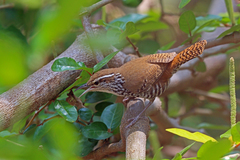
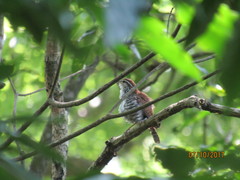
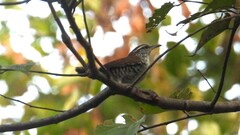
The adult banded wren is 13.5 cm long and weighs 20 g. It has chestnut brown upperparts, strong white supercilia, a brown stripe through the eye and black streaking on the white cheeks. The underparts are white with much black barring on the lower belly and flanks. The wings and tail are barred with black. Young birds have duller upperparts and dull white underparts, faintly mottled with dusky brown.

The call of this species is a nasal cherrrt or a rattle and roll, kert rrruk kert rrruk, and the melodious and complex song is a mix of clear whistles and musical trills. The banded wren forages actively in low vegetation or sometimes on the ground in pairs or family groups. It eats mainly eats insects, spiders and other invertebrates. Wikipedia →

Sounds

Song0:25

Costa Rica · 2013

© Albert Lastukhin · XC1101670 · CC BY-NC-ND 4.0

Alarm call0:11

Mexico · 2024

© Étienne Leroy · XC956891 · CC BY-NC-SA 4.0

Call0:35

Mexico · 2022

© Sue Riffe · XC773883 · CC BY-NC-SA 4.0

Global Distribution

Parks Where Found

# Park Country Daily sighting probability
1 Santa Rosa National Park 🇨🇷 Costa Rica
~60%
2 Cañón del Sumidero National Park 🇲🇽 Mexico
~40%
3 Rincón de la Vieja National Park 🇨🇷 Costa Rica
~40%
4 Ostional Wildlife Refuge 🇨🇷 Costa Rica
~30%
5 Las Baulas Marine National Park 🇨🇷 Costa Rica
~30%
6 El Triunfo 🇲🇽 Mexico
~30%
7 Cabo Blanco Absolute Nature Reserve 🇨🇷 Costa Rica
~30%
8 Palo Verde National Park 🇨🇷 Costa Rica
~10%
9 Carara National Park 🇨🇷 Costa Rica
<5%
10 Masaya Volcano National Park 🇳🇮 Nicaragua
<5%
11 Tenorio Volcano National Park 🇨🇷 Costa Rica
<5%

Cities Where Found

# City Country Daily sighting probability
1 Managua 🇳🇮 Nicaragua
<5%
2 San Salvador 🇸🇻 El Salvador
<5%
3 San José 🇨🇷 Costa Rica
<5%

Before you go

What are the chances of seeing a Banded Wren in Managua?

Rare

Under 5% of wildlife watchers report a Banded Wren sighting in Managua on a given day, based on 47 verified sightings from GBIF citizen-science data. It is the 65th most-seen of the 132 birds we can rate there. Over three days the chance rises to about 10%, if each day is a fresh chance.

When is the best time to see a Banded Wren in Managua?

March

In that month about 10% of wildlife watchers report a Banded Wren in Managua on a given day, against under 5% in April to February, the lowest months. That is one of Managua's driest months, with about 5 mm of rain against 310 mm in October.

What time of day is best to see a Banded Wren?

Between 7 and 10 am

Across all the parks we cover, that three-hour window holds the most Banded Wren sightings with a recorded time, and about 9 in 10 of them come between 6 am and 6 pm: it is a daytime animal.

Is Managua the best place to see a Banded Wren?

Yes

Of the 3 cities where we can rate Banded Wren sightings, Managua has the highest daily chance: under 5%. Next come San Salvador (El Salvador, under 5%) and San José (Costa Rica, under 5%).

Where does the Banded Wren sighting chance come from?

GBIF citizen-science records

It is estimated from how often the Banded Wren is recorded against all the birds logged in Managua (47 verified sightings), calibrated against known sighting rates. Figures are rounded to the nearest 10% because citizen-science data supports honest approximations, not decimals, and months with records from fewer than five people show "—". How it works.

← Back to Managua