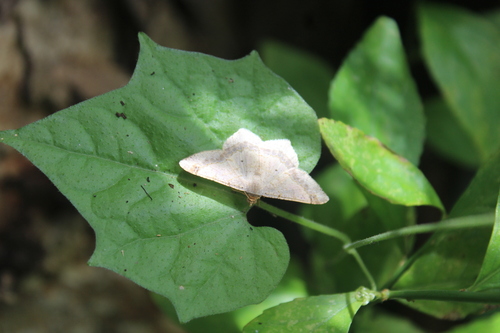
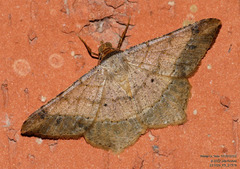
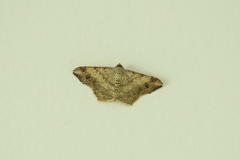
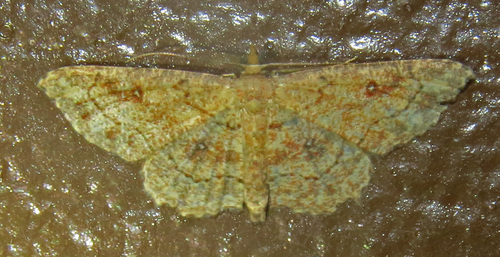
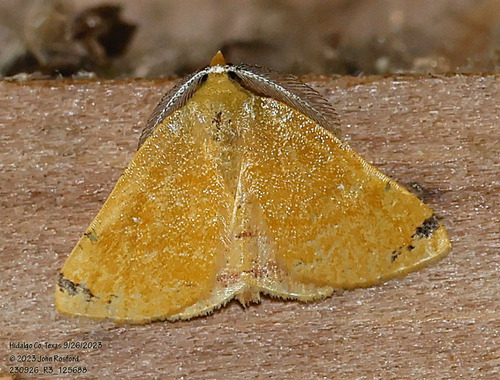
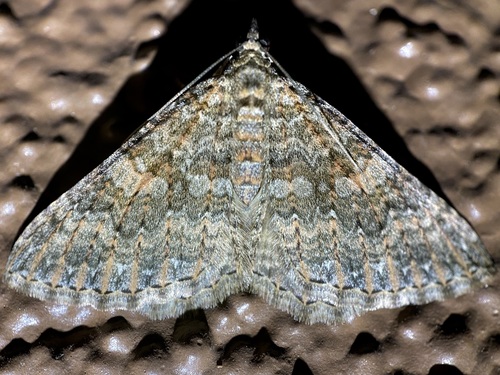



Dot-Lined Angle

Dot-Lined Angle

Macaria abydata

Daily sighting probability ~10% · With luck
at Mesa

In 3 days ~20% in a week ~50%

31 Verified sightings at Mesa
28 In all 2 parks From 2019 to 2026
May Best month
🌙 Nocturnal When it's spotted

About the Dot-Lined Angle

Macaria abydata, commonly known as the dot-lined angle, is a moth of the family Geometridae. It is native from northern Argentina to the Caribbean and southern United States (southern states from Arizona to Florida, regularly wandering north to Colorado, Kentucky and other more northern states). It has been introduced to the Pacific and has spread rapidly since. The first introduction occurred in Hawaii in 1970 (recorded from all the main islands in 1984). Further spread occurred as follows:

The phrase "dot-lined" comes from the evidence of small dots along the postmedial and sometimes median line of both forewing and hindwing(anterior of the marginal band). Recorded host plants for larvae in its natural range are Vachellia farnesiana, Cassia, Sesbania, Parkinsonia aculeata and Glycine max. Larvae have been observed on Acacia koa and introduced Lysiloma latisiliquum and Litchi chinensis in Hawaii. In the Indo-Australian tropics it has been reared from Leucaena and Mimosa diplotricha. Wikipedia →

Global Distribution

Parks Where Found

# Park Country Daily sighting probability
1 Main Ridge Forest Reserve 🇹🇹 Trinidad and Tobago
~20%
2 Cumbres de Monterrey National Park 🇲🇽 Mexico
<5%

Cities Where Found

# City Country Daily sighting probability
1 Austin 🇺🇸 United States
~10%
2 Tuen Mun 🇨🇳 China
~10%
3 Mesa 🇺🇸 United States
~10%
4 Monterrey 🇲🇽 México
~10%
5 Brasilia 🇧🇷 Brazil
~10%
6 Hong Kong 🇨🇳 China
~10%
7 San Antonio 🇺🇸 United States
~10%
8 Phoenix 🇺🇸 United States
<5%
9 Dallas 🇺🇸 United States
<5%
10 Houston 🇺🇸 United States
<5%

Before you go

What are the chances of seeing a Dot-Lined Angle in Mesa?

With luck

About 10% of wildlife watchers report a Dot-Lined Angle sighting in Mesa on a given day, based on 31 verified sightings from GBIF citizen-science data. It is the 64th most-seen of the 232 insects we can rate there. Over three days the chance rises to about 20%, and over a week to about 50%, if each day is a fresh chance.

When is the best time to see a Dot-Lined Angle in Mesa?

May

In that month about 20% of wildlife watchers report a Dot-Lined Angle in Mesa on a given day, against under 5% in February, September and December, the lowest months. That is one of Mesa's driest months, with about 5 mm of rain against 35 mm in January.

What time of day is best to see a Dot-Lined Angle?

Between 9 pm and midnight

Across all the parks we cover, that three-hour window holds the most Dot-Lined Angle sightings with a recorded time, and about 8 in 10 of them come between 6 pm and 6 am: it is mostly seen at night.

Is Mesa the best place to see a Dot-Lined Angle?

Among the best

Of the 14 cities where we can rate Dot-Lined Angle sightings, Mesa ranks 3rd at about 10%, level with the leaders once rounded. The best odds are in Austin (United States, about 10%) and Tuen Mun (China, about 10%).

Which relatives of the Dot-Lined Angle live in Mesa?

Same family: Geometridae

The closest relatives of the Dot-Lined Angle that you can see in Mesa (family Geometridae, Geometer Moths) are Creosote Moth (about 10%) and Dwarf Tawny Wave (about 10%), with each one's daily chance of a sighting.

Where does the Dot-Lined Angle sighting chance come from?

GBIF citizen-science records

It is estimated from how often the Dot-Lined Angle is recorded against all the insects logged in Mesa (31 verified sightings), calibrated against known sighting rates. Figures are rounded to the nearest 10% because citizen-science data supports honest approximations, not decimals, and months with records from fewer than five people show "—". How it works.

← Back to Mesa