Cinnamon Teal

Cinnamon Teal

Spatula cyanoptera

Silhouette: Sheatherius · PhyloPic

LCLeast ConcernNTVUENCR
Daily sighting probability ~10% · With luck
at Mexico City

In 3 days ~30% in a week ~60%

1,466 Verified sightings at Mexico City
3,286 In all 18 parks From 2019 to 2026
January Best month
☀️ Diurnal When it's spotted

About the Cinnamon Teal

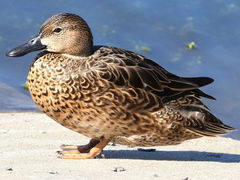
The cinnamon teal (Spatula cyanoptera) is a species of duck found in western North and South America. It is a small dabbling duck, with bright reddish plumage on the male and duller brown plumage on the female. It lives in marshes and ponds, and feeds mostly on plants.

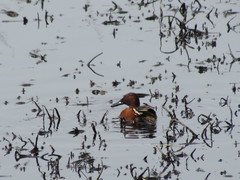
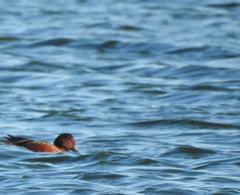
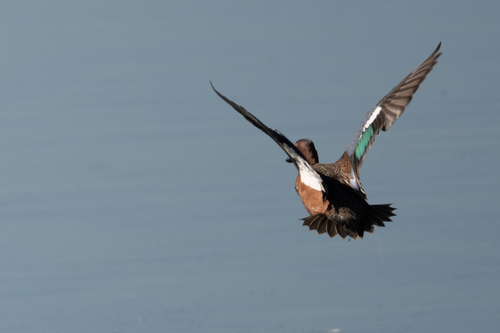
The adult male has a cinnamon-red head and body with a brown back, a red eye and a dark bill. The adult female has a mottled brown body, a pale brown head, brown eyes and a grey bill and is very similar in appearance to a female blue-winged teal; however, its overall color is richer, the lores, eye line, and eye ring are less distinct. Its bill is longer and more spatulate. Male juvenile resembles a female cinnamon or blue-winged teal but their eyes are red. They are 16 in (41 cm) long, have a 22-inch (560 mm) wingspan, and weigh 14 oz (400 g). They have 2 adult molts per year and a third molt in their first year.

Their breeding habitat is marshes and ponds in western United States and extreme southwestern Canada, and are rare visitors to the eastern United States. One young male duck was spotted in Grimsby, Ontario, and became a tourist attraction due to its rarity outside of western... Wikipedia →
Sounds

Call0:20

Argentina

© Bernabe Lopez-Lanus · XC48339 · CC BY-NC-SA 3.0

Flight call0:08

United States · 2020

© Richard E. Webster · XC611977 · CC BY-NC-SA 4.0

Alarm call1:09

United States · 2019

© Bobby Wilcox · XC510630 · CC BY-NC-SA 4.0

Global Distribution

Parks Where Found

# Park Country Daily sighting probability
1 Channel Islands National Park 🇺🇸 United States
~20%
2 El Vizcaíno Biosphere Reserve 🇲🇽 Mexico
~20%
3 Yellowstone National Park 🇺🇸 United States
~20%
4 Death Valley National Park 🇺🇸 United States
~20%
5 Bahía de Loreto National Park 🇲🇽 Mexico
~10%
6 Lauca National Park 🇨🇱 Chile
<5%
7 Grand Teton National Park 🇺🇸 United States
<5%
8 Elk Island National Park 🇨🇦 Canada
<5%
9 Big Bend National Park 🇺🇸 United States
<5%
10 Banff National Park 🇨🇦 Canada
<5%
11 Saguaro National Park 🇺🇸 United States
<5%
12 Grand Canyon National Park 🇺🇸 United States
<5%
13 Merritt Island National Wildlife Refuge 🇺🇸 United States
<5%
14 Zion National Park 🇺🇸 United States
<5%
15 Jasper National Park 🇨🇦 Canada
<5%
16 Torres del Paine National Park 🇨🇱 Chile
<5%
17 Rocky Mountain National Park 🇺🇸 United States
<5%
18 Redwood National Park 🇺🇸 United States
<5%

Cities Where Found

# City Country Daily sighting probability
1 Cochabamba 🇧🇴 Bolivia
~30%
2 Lima 🇵🇪 Peru
~30%
3 Mesa 🇺🇸 United States
~20%
4 León 🇲🇽 México
~20%
5 Los Angeles 🇺🇸 United States
~10%
6 Mexico City 🇲🇽 México
~10%
7 San Luis Potosí 🇲🇽 México
~10%
8 San Diego 🇺🇸 United States
~10%
9 Ciudad Juárez 🇲🇽 México
~10%
10 La Paz 🇧🇴 Bolivia
~10%

Zoos & Centres Where Found

# Zoo / Centre Country
1 SeaWorld Orlando 🇺🇸 United States In captivity
2 Busch Gardens Tampa 🇺🇸 United States In captivity
3 Zürich Zoo 🇨🇭 Switzerland In captivity
4 Dresden Zoo 🇩🇪 Germany In captivity
5 Jihlava Zoo 🇨🇿 Czechia In captivity
6 Sedgwick County Zoo 🇺🇸 United States In captivity
7 Phoenix Zoo 🇺🇸 United States In captivity
8 Cape May County Park & Zoo 🇺🇸 United States In captivity
9 Xcaret 🇲🇽 Mexico In captivity
10 Paignton Zoo 🇬🇧 United Kingdom In captivity
11 Cologne Zoological Garden 🇩🇪 Germany In captivity
12 Mesker Park Zoo and Botanic Garden 🇺🇸 United States In captivity
13 Bioparque Educativo Quillón 🇨🇱 Chile In captivity
14 Vogelpark Avifauna 🇳🇱 Netherlands In captivity
15 Van Blanckendaell Park 🇳🇱 Netherlands In captivity
16 Discovery Cove 🇺🇸 United States In captivity
17 Queens Zoo 🇺🇸 United States In captivity
18 Zoologischer Garten Halle 🇩🇪 Germany In captivity
19 Zoológico de Concepción 🇨🇱 Chile In captivity
20 Zoo Lagos 🇵🇹 Portugal In captivity
21 Avifauna 🇪🇸 Spain In captivity
22 The Wildlife Habitat 🇺🇸 United States In captivity
23 Cologne Zoo Aquarium 🇩🇪 Germany In captivity
24 Domaine des Oiseaux 🇫🇷 France In captivity
25 The Mirage Aquarium 🇺🇸 United States In captivity

Before you go

What are the chances of seeing a Cinnamon Teal in Mexico City?

With luck

About 10% of wildlife watchers report a Cinnamon Teal sighting in Mexico City on a given day, based on 1,466 verified sightings from GBIF citizen-science data. It is the 68th most-seen of the 332 birds we can rate there. Over three days the chance rises to about 30%, and over a week to about 60%, if each day is a fresh chance.

When is the best time to see a Cinnamon Teal in Mexico City?

November to February

In those months about 20% of wildlife watchers report a Cinnamon Teal in Mexico City on a given day, against under 5% in July, the lowest month. Those are among Mexico City's driest months, with about 10 mm of rain a month against 150 mm in July.

What time of day is best to see a Cinnamon Teal?

Between 1 and 4 pm

Across all the parks we cover, that three-hour window holds the most Cinnamon Teal sightings with a recorded time, and about 9 in 10 of them come between 6 am and 6 pm: it is a daytime animal.

Is Mexico City the best place to see a Cinnamon Teal?

6th of 29

Of the 29 cities where we can rate Cinnamon Teal sightings, Mexico City ranks 6th at about 10%. The best odds are in Cochabamba (Bolivia, about 30%), Lima (Peru, about 30%) and Mesa (United States, about 20%).

Which relatives of the Cinnamon Teal live in Mexico City?

Same genus: Spatula

The closest relatives of the Cinnamon Teal that you can see in Mexico City (genus Spatula, Shovelers and Allies) are Northern Shoveler (about 20%) and Blue-winged Teal (about 10%), with each one's daily chance of a sighting.

Where does the Cinnamon Teal sighting chance come from?

GBIF citizen-science records

It is estimated from how often the Cinnamon Teal is recorded against all the birds logged in Mexico City (1,466 verified sightings), calibrated against known sighting rates. Figures are rounded to the nearest 10% because citizen-science data supports honest approximations, not decimals, and months with records from fewer than five people show "—". How it works.

← Back to Mexico City