Jerdon's Leafbird

Jerdon's Leafbird

Chloropsis jerdoni

Silhouette: Sheatherius · PhyloPic

LCLeast ConcernNTVUENCR
Daily sighting probability <5% · Rare
at Mumbai

In 3 days <5%

18 Verified sightings at Mumbai
2,115 In all 13 parks From 2019 to 2026
June Best month
🌅 Crepuscular When it's spotted

About the Jerdon's Leafbird

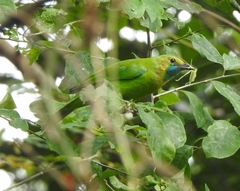
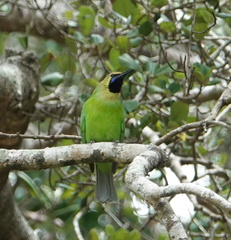
Jerdon's leafbird (Chloropsis jerdoni) is a species of leafbird found in forest and woodland in India and Sri Lanka. Its name honours Thomas C. Jerdon. It has traditionally been considered a subspecies of the blue-winged leafbird (C. cochinchinensis), but differ in measurements and morphology, it lacking the blue flight feathers for which the blue-winged leafbird was named.

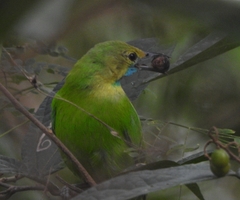
It builds its nest in a tree, and lays 2–3 eggs. This species eats insects, fruit and nectar. The male is green-bodied with a yellow-tinged head, black face and throat. It has a blue moustachial line. The female differs in that it has a greener head and blue throat, and young birds are like the female but without the blue throat patch.

Like other leafbirds, the call of Jerdon's leafbird consists of a rich mixture of imitations of the calls of various other species of birds. They are very shy of water, will only come down to drink for very short periods and are quick to flee.

BirdLife Species Factsheet. BirdLife International. Accessed 2008-06-25. Wells, D. R. (2005). Chloropsis jerdoni (Jerdon's Leafbird). P. 264 in: del Hoyo, J., A. Elliott, & D. A. Christie. eds. (2005). Handbook... Wikipedia →

Sounds

Duet0:27

India · 2022

© Kousheyo Bagchi · XC712208 · CC BY-NC-ND 4.0

Song0:22

India · 2019

© Ross Gallardy · XC454351 · CC BY-NC-SA 4.0

Call1:27

India · 2015

© Dilip KG · XC214153 · CC BY-NC-SA 4.0

Global Distribution

Parks Where Found

# Park Country Daily sighting probability
1 Minneriya National Park 🇱🇰 Sri Lanka
~30%
2 Udawalawe National Park 🇱🇰 Sri Lanka
~20%
3 Yala National Park 🇱🇰 Sri Lanka
~10%
4 Mudumalai National Park 🇮🇳 India
~10%
5 Nagarhole National Park 🇮🇳 India
~10%
6 Wilpattu National Park 🇱🇰 Sri Lanka
~10%
7 Kanha National Park 🇮🇳 India
~10%
8 Bandhavgarh National Park 🇮🇳 India
~10%
9 Bandipur National Park 🇮🇳 India
~10%
10 Satpura National Park 🇮🇳 India
~10%
11 Sinharaja Forest Reserve 🇱🇰 Sri Lanka
~10%
12 Periyar National Park 🇮🇳 India
<5%
13 Eravikulam National Park 🇮🇳 India
<5%

Cities Where Found

# City Country Daily sighting probability
1 Jamshedpur 🇮🇳 India
~10%
2 Thrissur 🇮🇳 India
~10%
3 Mysuru 🇮🇳 India
<5%
4 Kozhikode 🇮🇳 India
<5%
5 Nagpur 🇮🇳 India
<5%
6 Kochi 🇮🇳 India
<5%
7 Colombo [Sri Jayawardenepura Kotte] 🇱🇰 Sri Lanka
<5%
8 Bhopal 🇮🇳 India
<5%
9 Ponnani 🇮🇳 India
<5%
10 Bengaluru 🇮🇳 India
<5%

Before you go

What are the chances of seeing a Jerdon's Leafbird in Mumbai?

Rare

Under 5% of wildlife watchers report a Jerdon's Leafbird sighting in Mumbai on a given day, based on 18 verified sightings from GBIF citizen-science data. It is the 247th most-seen of the 283 birds we can rate there. Over three days the chance rises to under 5%, if each day is a fresh chance.

When is the best time to see a Jerdon's Leafbird in Mumbai?

Any time of year

In every month with enough records, under 5% of wildlife watchers report a Jerdon's Leafbird in Mumbai on a given day, so our monthly data shows no clear season.

What time of day is best to see a Jerdon's Leafbird?

Between 3 and 6 am

Across all the parks we cover, that three-hour window holds the most Jerdon's Leafbird sightings with a recorded time, and about half of them come between 6 am and 6 pm: it is most active around dawn and dusk.

Is Mumbai the best place to see a Jerdon's Leafbird?

12th of 12

Of the 12 cities where we can rate Jerdon's Leafbird sightings, Mumbai ranks 12th at under 5%. The best odds are in Jamshedpur (India, about 10%), Thrissur (India, about 10%) and Mysuru (India, under 5%).

Where does the Jerdon's Leafbird sighting chance come from?

GBIF citizen-science records

It is estimated from how often the Jerdon's Leafbird is recorded against all the birds logged in Mumbai (18 verified sightings), calibrated against known sighting rates. Figures are rounded to the nearest 10% because citizen-science data supports honest approximations, not decimals, and months with records from fewer than five people show "—". How it works.

← Back to Mumbai