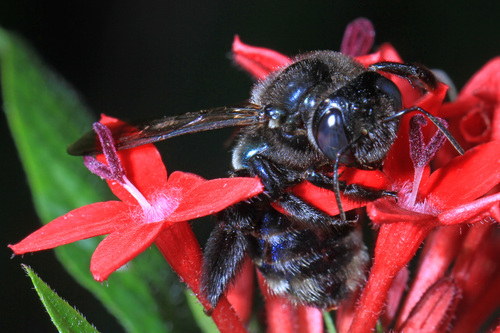
Eastern Cicada-Killer Wasp

Eastern Cicada-Killer Wasp

Sphecius speciosus

Daily sighting probability <5% · Rare
at Orlando

In 3 days ~10% in a week ~30%

11 Verified sightings at Orlando
75 In all 5 parks From 2019 to 2026
June Best month
☀️ Diurnal When it's spotted

About the Eastern Cicada-Killer Wasp

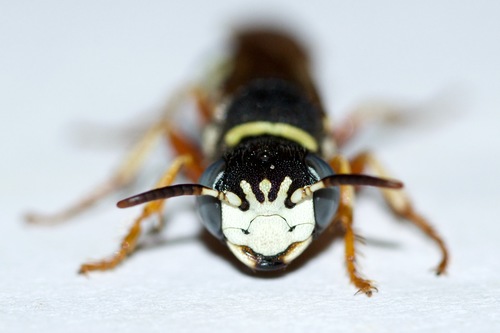
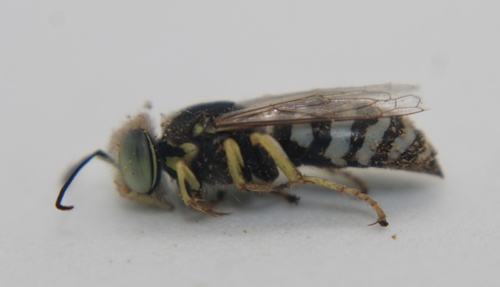
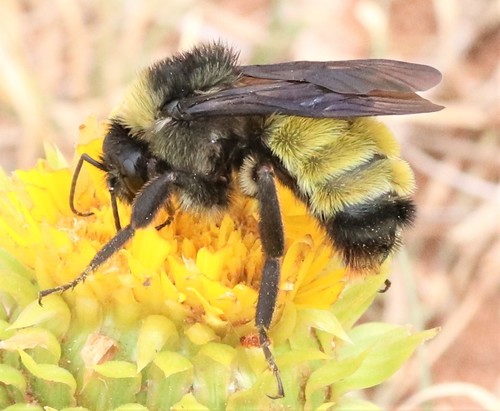
Sphecius speciosus, the eastern cicada-killer wasp, is a large, solitary digger wasp species in the family Bembicidae. They are so named because they hunt cicadas and provision their nests with them. Cicada killers exert a measure of natural control on cicada populations, and as such, they may directly benefit the deciduous trees upon which the cicadas feed. Sometimes, they are erroneously called sand hornets, despite not truly being hornets, which belong to the family Vespidae.

The most recent review of this species' biology is found in the posthumously published comprehensive study by noted entomologist Howard Ensign Evans. This species can be found in the Eastern and Midwest U.S. and southwards into Mexico and Central America.

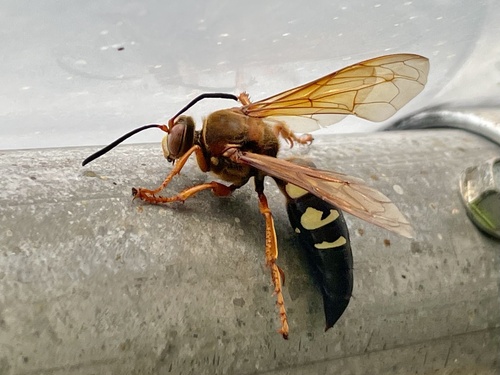
Adult eastern cicada wasps are large, 1.5 to 5.0 cm (0.6 to 2.0 in) long, robust wasps with hairy, reddish, and black areas on their thoraces (middle parts), and black to reddish brown abdominal (rear) segments that are marked with light yellow stripes. The wings are brownish. Coloration superficially resembles that of some yellowjacket and hornet species. The females are somewhat larger than the males, and both are among... Wikipedia →
Global Distribution

Parks Where Found

# Park Country Daily sighting probability
1 Point Pelee National Park 🇨🇦 Canada
~10%
2 Cumbres de Monterrey National Park 🇲🇽 Mexico
~10%
3 Shenandoah National Park 🇺🇸 United States
~10%
4 Great Smoky Mountains National Park 🇺🇸 United States
~10%
5 Big Bend National Park 🇺🇸 United States
<5%

Cities Where Found

# City Country Daily sighting probability
1 Philadelphia 🇺🇸 United States
~20%
2 Baltimore 🇺🇸 United States
~20%
3 New York City 🇺🇸 United States
~10%
4 Chicago 🇺🇸 United States
~10%
5 Austin 🇺🇸 United States
~10%
6 Dallas 🇺🇸 United States
~10%
7 Detroit 🇺🇸 United States
~10%
8 Washington 🇺🇸 United States
~10%
9 Boston 🇺🇸 United States
~10%
10 Minneapolis [Saint Paul] 🇺🇸 United States
~10%

Before you go

What are the chances of seeing an Eastern Cicada-Killer Wasp in Orlando?

Rare

Under 5% of wildlife watchers report an Eastern Cicada-Killer Wasp sighting in Orlando on a given day, based on 11 verified sightings from GBIF citizen-science data. It is the 148th most-seen of the 294 insects we can rate there. Over three days the chance rises to about 10%, and over a week to about 30%, if each day is a fresh chance.

When is the best time to see an Eastern Cicada-Killer Wasp in Orlando?

June to August

In those months about 10% of wildlife watchers report an Eastern Cicada-Killer Wasp in Orlando on a given day, against under 5% in September to May, the lowest months. Those are among Orlando's wettest months, with about 200 mm of rain a month against 50 mm in November.

What time of day is best to see an Eastern Cicada-Killer Wasp?

Between 8 and 11 am

Across all the parks we cover, that three-hour window holds the most Eastern Cicada-Killer Wasp sightings with a recorded time, and about 8 in 10 of them come between 6 am and 6 pm: it is a daytime animal.

Is Orlando the best place to see an Eastern Cicada-Killer Wasp?

16th of 16

Of the 16 cities where we can rate Eastern Cicada-Killer Wasp sightings, Orlando ranks 16th at under 5%. The best odds are in Philadelphia (United States, about 20%), Baltimore (United States, about 20%) and New York City (United States, about 10%).

Where does the Eastern Cicada-Killer Wasp sighting chance come from?

GBIF citizen-science records

It is estimated from how often the Eastern Cicada-Killer Wasp is recorded against all the insects logged in Orlando (11 verified sightings), calibrated against known sighting rates. Figures are rounded to the nearest 10% because citizen-science data supports honest approximations, not decimals, and months with records from fewer than five people show "—". How it works.

← Back to Orlando