About the Eastern Cicada-Killer Wasp
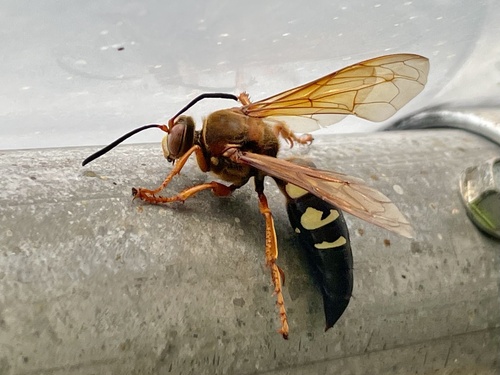
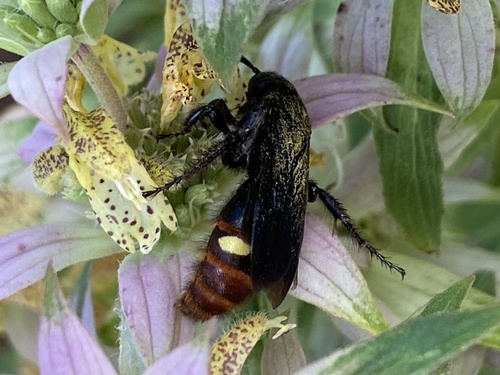
Sphecius speciosus, the eastern cicada-killer wasp, is a large, solitary digger wasp species in the family Bembicidae. They are so named because they hunt cicadas and provision their nests with them. Cicada killers exert a measure of natural control on cicada populations, and as such, they may directly benefit the deciduous trees upon which the cicadas feed. Sometimes, they are erroneously called sand hornets, despite not truly being hornets, which belong to the family Vespidae.
The most recent review of this species' biology is found in the posthumously published comprehensive study by noted entomologist Howard Ensign Evans. This species can be found in the Eastern and Midwest U.S. and southwards into Mexico and Central America.
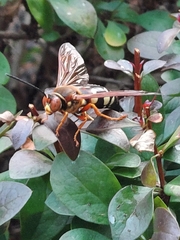
Adult eastern cicada wasps are large, 1.5 to 5.0 cm (0.6 to 2.0 in) long, robust wasps with hairy, reddish, and black areas on their thoraces (middle parts), and black to reddish brown abdominal (rear) segments that are marked with light yellow stripes. The wings are brownish. Coloration superficially resembles that of some yellowjacket and hornet species. The females are somewhat larger than the males, and both are among... Wikipedia →