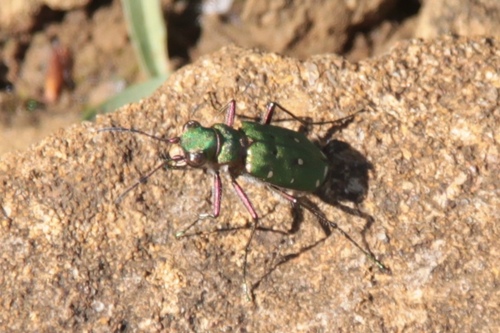
Green Tiger Beetle

Green Tiger Beetle

Cicindela campestris

Daily sighting probability <5% · Rare
at Porto

In 3 days ~10% in a week ~20%

5 Verified sightings at Porto
585 In all 16 parks From 2019 to 2026
March Best month
☀️ Diurnal When it's spotted

About the Green Tiger Beetle

Cicindela campestris, commonly called the green tiger beetle, is a widespread Eurasian species of tiger beetle. It is the type species of the large genus Cicindela. Adults are typically 12–15 millimetres (0.47–0.59 in) long. The elytra and thorax are green, varying in tone from light to dark, spotted with cream-coloured patches, and in bright sunlight are somewhat iridescent. The eyes are blackish; the legs are brown with whitish hairs. The antennae are long and straight, not clubbed.

The adults are sun-loving. They live in places with dry soils (sandy or chalky), mostly between May and October at the latitude of Britain. Like other tiger beetles, they run fast on their long legs and are most often seen on bare ground, in Britain typically on heather moorland. They can fly fast, making a loud buzzing noise. It can run at speeds of 60 cm per second.

Cicindela campestris is distributed across Europe from Spain in the southwest to Finland in the northeast. Most records are from the UK, Germany, Austria and the south of Sweden. In Britain, records are mainly from dry sandy or heathy areas such as the heathlands of Surrey, Hampshire and Dorset... Wikipedia →
Global Distribution

Parks Where Found

# Park Country Daily sighting probability
1 Aigüestortes National Park 🇪🇸 Spain
~30%
2 Cairngorms National Park 🇬🇧 United Kingdom
~30%
3 Hohe Tauern National Park 🇦🇹 Austria
~20%
4 Picos de Europa National Park 🇪🇸 Spain
~20%
5 Pyrénées National Park 🇫🇷 France
~20%
6 Vanoise National Park 🇫🇷 France
~20%
7 Bavarian Forest National Park 🇩🇪 Germany
~10%
8 Cévennes National Park 🇫🇷 France
~10%
9 Ecrins National Park 🇫🇷 France
~10%
10 Mercantour National Park 🇫🇷 France
~10%
11 Snowdonia National Park 🇬🇧 United Kingdom
~10%
12 Ordesa y Monte Perdido National Park 🇪🇸 Spain
~10%
13 Sierra Nevada National Park 🇪🇸 Spain
~10%
14 Triglav National Park 🇸🇮 Slovenia
~10%
15 Sierra de Guadarrama National Park 🇪🇸 Spain
~10%
16 Wadden Sea National Park 🇩🇪 Germany
~10%

Cities Where Found

# City Country Daily sighting probability
1 Algiers 🇩🇿 Algeria
~10%
2 Essen 🇩🇪 Germany
~10%
3 Budapest 🇭🇺 Hungary
~10%
4 Cologne 🇩🇪 Germany
~10%
5 Prague 🇨🇿 Czechia
<5%
6 Vienna 🇦🇹 Austria
<5%
7 Birmingham 🇬🇧 United Kingdom
<5%
8 Moscow 🇷🇺 Russia
<5%
9 Helsinki 🇫🇮 Finland
<5%
10 Porto 🇵🇹 Portugal
<5%

Before you go

What are the chances of seeing a Green Tiger Beetle in Porto?

Rare

Under 5% of wildlife watchers report a Green Tiger Beetle sighting in Porto on a given day, based on 5 verified sightings from GBIF citizen-science data. It is the 457th most-seen of the 498 insects we can rate there. Over three days the chance rises to about 10%, and over a week to about 20%, if each day is a fresh chance.

When is the best time to see a Green Tiger Beetle in Porto?

March and April

In those months about 10% of wildlife watchers report a Green Tiger Beetle in Porto on a given day, against under 5% in May to February, the lowest months.

What time of day is best to see a Green Tiger Beetle?

Between 1 and 4 pm

Across all the parks we cover, that three-hour window holds the most Green Tiger Beetle sightings with a recorded time, and about 9 in 10 of them come between 6 am and 6 pm: it is a daytime animal.

Is Porto the best place to see a Green Tiger Beetle?

10th of 11

Of the 11 cities where we can rate Green Tiger Beetle sightings, Porto ranks 10th at under 5%. The best odds are in Algiers (Algeria, about 10%), Essen (Germany, about 10%) and Budapest (Hungary, about 10%).

Where does the Green Tiger Beetle sighting chance come from?

GBIF citizen-science records

It is estimated from how often the Green Tiger Beetle is recorded against all the insects logged in Porto (5 verified sightings), calibrated against known sighting rates. Figures are rounded to the nearest 10% because citizen-science data supports honest approximations, not decimals, and months with records from fewer than five people show "—". How it works.

← Back to Porto