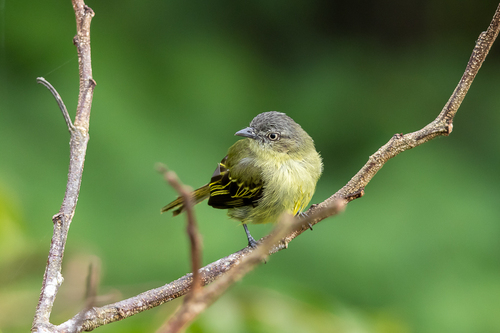
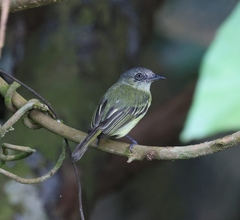

Slender-footed Tyrannulet

Slender-footed Tyrannulet

Zimmerius gracilipes

Silhouette: Emily Willoughby · PhyloPic

LCLeast ConcernNTVUENCR
Daily sighting probability ~10% · With luck
at Recife

In 3 days ~30% in a week ~60%

13 Verified sightings at Recife
508 In all 8 parks From 2019 to 2026
July Best month
☀️ Diurnal When it's spotted

About the Slender-footed Tyrannulet

The slender-footed tyrannulet (Zimmerius gracilipes) is a species of bird in the family Tyrannidae, the tyrant flycatchers. It is found in Bolivia, Brazil, Colombia, Ecuador, Peru, and Venezuela. The slender-footed tyrannulet was originally described as Tyranniscus gracilipes. Through much of the twentieth century it and several other tyrannulets were kept in genus Tyranniscus but a study published in 1977 erected the present genus Zimmerius for them.

What are now the red-billed tyrannulet (Z. cinereicapilla) and the Guianan tyrannulet (Z. acer) were previously treated as additional subspecies. The slender-footed tyrannulet is 9 to 12 cm (3.5 to 4.7 in) long and weighs 6.6 to 9.5 g (0.23 to 0.34 oz). The sexes have the same plumage. Adults of the nominate subspecies have a gray forehead and crown. They have a thin whitish supercilium that starts at their lores and a dark stripe through the eye on an otherwise yellowish white face. Their back and rump are dull olive. Their wings are dusky with... Wikipedia →

Sounds

Call0:24

Brazil · 2026

© JAYRSON ARAUJO DE OLIVEIRA · XC1186198 · CC BY-NC-SA 4.0

Dawn song0:12

Peru · 1997

© John V. Moore · XC258668 · CC BY-NC-SA 4.0

Call0:31

Ecuador · 2010

© Manuel Sánchez-Nivicela · XC1175810 · CC BY-NC-ND 4.0

Global Distribution

Parks Where Found

# Park Country Daily sighting probability
1 Brownsberg Nature Park 🇸🇷 Suriname
~40%
2 Amacayacu National Natural Park 🇨🇴 Colombia
~20%
3 Anavilhanas National Park 🇧🇷 Brazil
~10%
4 Sierra de la Macarena National Park 🇨🇴 Colombia
<5%
5 Yasuní National Park 🇪🇨 Ecuador
<5%
6 Cuyabeno Wildlife Reserve 🇪🇨 Ecuador
<5%
7 Manu National Park 🇵🇪 Peru
<5%
8 Tambopata National Reserve 🇵🇪 Peru
<5%

Cities Where Found

# City Country Daily sighting probability
1 Recife 🇧🇷 Brazil
~10%

Before you go

What are the chances of seeing a Slender-footed Tyrannulet in Recife?

With luck

About 10% of wildlife watchers report a Slender-footed Tyrannulet sighting in Recife on a given day, based on 13 verified sightings from GBIF citizen-science data. It is the 53rd most-seen of the 90 birds we can rate there. Over three days the chance rises to about 30%, and over a week to about 60%, if each day is a fresh chance.

When is the best time to see a Slender-footed Tyrannulet in Recife?

May and July

In those months about 20% of wildlife watchers report a Slender-footed Tyrannulet in Recife on a given day, against under 5% in January and November, the lowest months. Those are among Recife's wettest months, with about 200 mm of rain a month against 25 mm in November.

What time of day is best to see a Slender-footed Tyrannulet?

Between 7 and 10 am

Across all the parks we cover, that three-hour window holds the most Slender-footed Tyrannulet sightings with a recorded time, and about 8 in 10 of them come between 6 am and 6 pm: it is a daytime animal.

Where else can you see a Slender-footed Tyrannulet?

Only Recife, in our data

Recife is the only city on Wallace's Line with enough records to rate Slender-footed Tyrannulet sightings: about 10% of wildlife watchers there report one on a given day.

Which relatives of the Slender-footed Tyrannulet live in Recife?

Same family: Tyrannidae

The closest relatives of the Slender-footed Tyrannulet that you can see in Recife (family Tyrannidae, Tyrant Flycatchers) are Great Kiskadee (about 80%), Masked Water-Tyrant (about 70%) and Social Flycatcher (about 70%), with each one's daily chance of a sighting.

Where does the Slender-footed Tyrannulet sighting chance come from?

GBIF citizen-science records

It is estimated from how often the Slender-footed Tyrannulet is recorded against all the birds logged in Recife (13 verified sightings), calibrated against known sighting rates. Figures are rounded to the nearest 10% because citizen-science data supports honest approximations, not decimals, and months with records from fewer than five people show "—". How it works.

← Back to Recife