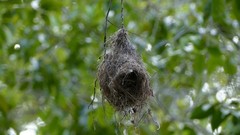
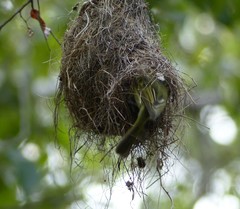

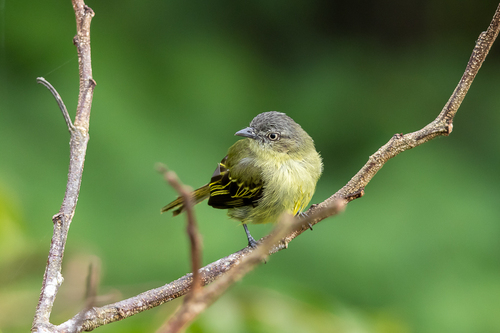
Yellow-breasted Flycatcher

Yellow-breasted Flycatcher

Tolmomyias flaviventris

Silhouette: Emily Willoughby · PhyloPic

LCLeast ConcernNTVUENCR
Daily sighting probability ~20% · Possible
at Recife

In 3 days ~50% in a week ~80%

21 Verified sightings at Recife
1,797 In all 15 parks From 2019 to 2026
October Best month
☀️ Diurnal When it's spotted

About the Yellow-breasted Flycatcher

The ochre-lored flatbill (Tolmomyias flaviventris) or yellow-breasted flycatcher, is a passerine bird in the family Tyrannidae, the tyrant flycatchers. It is found in Bolivia, Brazil, Colombia, French Guiana, Guyana, Panama, Suriname, Trinidad and Tobago, and Venezuela.

The ochre-lored flatbill was originally described as Muscipeta flaventris. The ochre-lored flatbill's taxonomy is complicated. The three subspecies of what is now the olive-faced flatbill (T. viridiceps) were previously included within the ochre-lored. Taxonomic systems began separating them in 2020 and the process continued into 2024. They might be valid, and some subspecies may warrant treatment as full species.

The ochre-lored flatbill is about 12 to 13 cm (4.7 to 5.1 in) long and weighs 9 to 17.5 g (0.32 to 0.62 oz). The sexes have the same plumage. Adults of the nominate subspecies... Wikipedia →

Sounds

Song0:25

Brazil · 2026

© JAYRSON ARAUJO DE OLIVEIRA · XC1162294 · CC BY-NC-SA 4.0

Call0:18

Guyana · 2025

© Richard E. Webster · XC1031499 · CC BY-NC-SA 4.0

Call0:08

Guyana · 2023

© Rolf A. de By · XC985059 · CC BY-NC-ND 4.0

Global Distribution

Parks Where Found

# Park Country Daily sighting probability
1 Main Ridge Forest Reserve 🇹🇹 Trinidad and Tobago
~40%
2 Chapada Diamantina National Park 🇧🇷 Brazil
~30%
3 Tayrona National Natural Park 🇨🇴 Colombia
~20%
4 Caroni Swamp 🇹🇹 Trinidad and Tobago
~20%
5 Sierra de la Macarena National Park 🇨🇴 Colombia
~10%
6 Henri Pittier National Park 🇻🇪 Venezuela
~10%
7 Amacayacu National Natural Park 🇨🇴 Colombia
~10%
8 Yasuní National Park 🇪🇨 Ecuador
~10%
9 Manu National Park 🇵🇪 Peru
<5%
10 Podocarpus National Park 🇪🇨 Ecuador
<5%
11 Tambopata National Reserve 🇵🇪 Peru
<5%
12 Cuyabeno Wildlife Reserve 🇪🇨 Ecuador
<5%
13 Darién National Park 🇵🇦 Panama
<5%
14 Serra dos Órgãos National Park 🇧🇷 Brazil
<5%
15 Tijuca National Park 🇧🇷 Brazil
<5%

Cities Where Found

# City Country Daily sighting probability
1 João Pessoa 🇧🇷 Brazil
~30%
2 São Luís 🇧🇷 Brazil
~30%
3 Valencia 🇻🇪 Venezuela
~30%
4 Recife 🇧🇷 Brazil
~20%
5 Salvador 🇧🇷 Brazil
~20%
6 Belém 🇧🇷 Brazil
~10%
7 Vitória 🇧🇷 Brazil
~10%
8 Maceió 🇧🇷 Brazil
~10%
9 Fortaleza 🇧🇷 Brazil
~10%
10 Niterói 🇧🇷 Brazil
<5%

Before you go

What are the chances of seeing a Yellow-breasted Flycatcher in Recife?

Possible

About 20% of wildlife watchers report a Yellow-breasted Flycatcher sighting in Recife on a given day, based on 21 verified sightings from GBIF citizen-science data. It is the 36th most-seen of the 90 birds we can rate there. Over three days the chance rises to about 50%, and over a week to about 80%, if each day is a fresh chance.

When is the best time to see a Yellow-breasted Flycatcher in Recife?

October

In that month about 40% of wildlife watchers report a Yellow-breasted Flycatcher in Recife on a given day, against about 10% in January–February, April and September, the lowest months. That is one of Recife's driest months, with about 35 mm of rain against 260 mm in June.

What time of day is best to see a Yellow-breasted Flycatcher?

Between 7 and 10 am

Across all the parks we cover, that three-hour window holds the most Yellow-breasted Flycatcher sightings with a recorded time, and about 9 in 10 of them come between 6 am and 6 pm: it is a daytime animal.

Is Recife the best place to see a Yellow-breasted Flycatcher?

4th of 11

Of the 11 cities where we can rate Yellow-breasted Flycatcher sightings, Recife ranks 4th at about 20%. The best odds are in João Pessoa (Brazil, about 30%), São Luís (Brazil, about 30%) and Valencia (Venezuela, about 30%).

Which relatives of the Yellow-breasted Flycatcher live in Recife?

Same family: Tyrannidae

The closest relatives of the Yellow-breasted Flycatcher that you can see in Recife (family Tyrannidae, Tyrant Flycatchers) are Great Kiskadee (about 80%), Masked Water-Tyrant (about 70%) and Social Flycatcher (about 70%), with each one's daily chance of a sighting.

Where does the Yellow-breasted Flycatcher sighting chance come from?

GBIF citizen-science records

It is estimated from how often the Yellow-breasted Flycatcher is recorded against all the birds logged in Recife (21 verified sightings), calibrated against known sighting rates. Figures are rounded to the nearest 10% because citizen-science data supports honest approximations, not decimals, and months with records from fewer than five people show "—". How it works.

← Back to Recife