Blue-winged Macaw

Blue-winged Macaw

Primolius maracana

Silhouette: Sheatherius · PhyloPic

LCLeast ConcernNTVUENCR
Daily sighting probability <5% · Rare
at Rio de Janeiro

In 3 days ~10% in a week ~20%

126 Verified sightings at Rio de Janeiro
1,189 In all 5 parks From 2019 to 2026
April Best month
☀️ Diurnal When it's spotted

About the Blue-winged Macaw

The blue-winged macaw (Primolius maracana), in aviculture more commonly known as Illiger's macaw, is a species of small macaw (sometimes called a mini-macaw) found in central and eastern South America. The second name is in honor of the German ornithologist Johann Karl Wilhelm Illiger. It was previously placed in the genera Ara or Propyrrhura. Blue-winged macaws have been known to reach an age of 50–60 years.

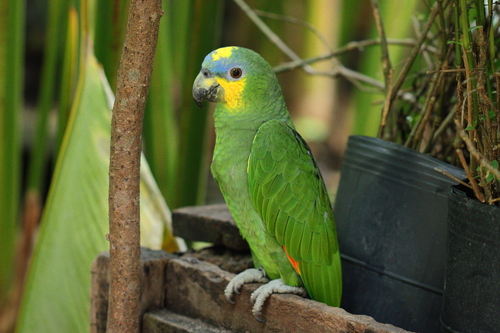
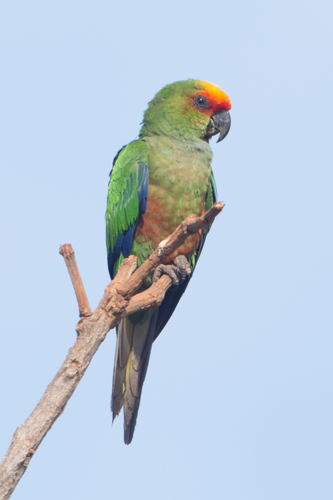
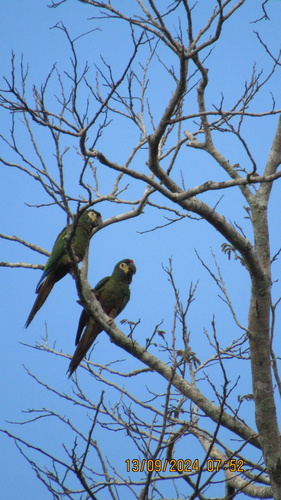
It has a total length of approximately 36–43 cm (14–17 in). It has a moderately sized black bill, a long tail and a mainly green plumage. The upperside of the remiges and primary coverts are blue, as indicated by its common name. The underside of the wings is yellowish, the tail-tip, crown and cheeks are bluish, and the tail-base and small belly-patch are red. The iris is amber. It and the red-bellied macaw are the only macaws where the bare facial-skin is yellowish, but this often fades to white in captivity. Unlike the red-bellied macaw, the blue-winged has a red lower abdomen and a red lower back. In the wild, its flight pattern is said to be a distinctive 'jerky, rearing motion.'

The blue-winged macaw occurs in eastern and southern... Wikipedia →
Sounds

Flight call0:36

Brazil · 2025

© Ricardo José Mitidieri · XC1009446 · CC BY-NC-SA 4.0

Call0:23

Brazil · 2022

© JAYRSON ARAUJO DE OLIVEIRA · XC754135 · CC BY-NC-SA 4.0

Uncertain0:14

Brazil · 2004

© Brian Cox · XC727673 · CC BY-NC-SA 4.0

Global Distribution

Parks Where Found

# Park Country Daily sighting probability
1 Serra dos Órgãos National Park 🇧🇷 Brazil
~40%
2 Itatiaia National Park 🇧🇷 Brazil
~30%
3 Chapada dos Guimarães National Park 🇧🇷 Brazil
~20%
4 Tijuca National Park 🇧🇷 Brazil
<5%
5 Chapada Diamantina National Park 🇧🇷 Brazil
<5%

Cities Where Found

# City Country Daily sighting probability
1 Niterói 🇧🇷 Brazil
~10%
2 Rio de Janeiro 🇧🇷 Brazil
<5%
3 Belém 🇧🇷 Brazil
<5%
4 Campo Grande 🇧🇷 Brazil
<5%
5 Vitória 🇧🇷 Brazil
<5%

Zoos & Centres Where Found

# Zoo / Centre Country
1 Parque das Aves 🇧🇷 Brazil In captivity
2 Safari Madrid 🇪🇸 Spain In captivity
3 Sanjay Gandhi Biological Park 🇮🇳 India In captivity
4 Berlin Zoological Garden 🇩🇪 Germany In captivity
5 Wrocław Zoological Garden 🇵🇱 Poland In captivity
6 Gramado Zoo 🇧🇷 Brazil In captivity
7 Lisbon Zoo 🇵🇹 Portugal In captivity
8 Parc de l'Auxois 🇫🇷 France In captivity
9 Bosque Rodrigues Alves 🇧🇷 Brazil In captivity
10 Zoo das Aves 🇧🇷 Brazil In captivity
11 Paphos Zoo 🇨🇾 Cyprus In captivity
12 Loro Parque 🇪🇸 Spain In captivity
13 Adelaide Zoo 🇦🇺 Australia In captivity
14 Mangal das Garças 🇧🇷 Brazil In captivity
15 Zoo Park da Montanha 🇧🇷 Brazil In captivity
16 Bird Park Steinen 🇩🇪 Germany In captivity
17 Africarium 🇵🇱 Poland In captivity
18 Parrot Zoo in Bošovice 🇨🇿 Czechia In captivity
19 Aquarium Berlin 🇩🇪 Germany In captivity
20 Stadtvolière Lindengut Winterthur 🇨🇭 Switzerland In captivity
21 terrarium ogrodu zoologicznego we Wrocławiu 🇵🇱 Poland In captivity

Before you go

What are the chances of seeing a Blue-winged Macaw in Rio de Janeiro?

Rare

Under 5% of wildlife watchers report a Blue-winged Macaw sighting in Rio de Janeiro on a given day, based on 126 verified sightings from GBIF citizen-science data. It is the 113th most-seen of the 278 birds we can rate there. Over three days the chance rises to about 10%, and over a week to about 20%, if each day is a fresh chance.

When is the best time to see a Blue-winged Macaw in Rio de Janeiro?

April–May and July

In those months about 10% of wildlife watchers report a Blue-winged Macaw in Rio de Janeiro on a given day, against under 5% in June and August–March, the lowest months. Those are among Rio de Janeiro's driest months, with about 70 mm of rain a month against 230 mm in December.

What time of day is best to see a Blue-winged Macaw?

Between 6 and 9 am

Across all the parks we cover, that three-hour window holds the most Blue-winged Macaw sightings with a recorded time, and about 9 in 10 of them come between 6 am and 6 pm: it is a daytime animal.

Is Rio de Janeiro the best place to see a Blue-winged Macaw?

2nd of 5

Of the 5 cities where we can rate Blue-winged Macaw sightings, Rio de Janeiro ranks 2nd at under 5%. The best odds are in Niterói (Brazil, about 10%).

Which relatives of the Blue-winged Macaw live in Rio de Janeiro?

Same family: Psittacidae

The closest relatives of the Blue-winged Macaw that you can see in Rio de Janeiro (family Psittacidae, New World and African Parrots) are Plain Parakeet (about 50%), Monk Parakeet (about 20%) and Maroon-bellied Parakeet (about 20%), with each one's daily chance of a sighting.

Where does the Blue-winged Macaw sighting chance come from?

GBIF citizen-science records

It is estimated from how often the Blue-winged Macaw is recorded against all the birds logged in Rio de Janeiro (126 verified sightings), calibrated against known sighting rates. Figures are rounded to the nearest 10% because citizen-science data supports honest approximations, not decimals, and months with records from fewer than five people show "—". How it works.

← Back to Rio de Janeiro